Cell Biology · Skim version
The Nuclear Envelope and Nuclear Transport
Read the full lesson → Skim the whole course →
The guiding idea
If one pore carries traffic both ways, what decides which way each protein goes?
The nuclear pore is a selective passage with no direction of its own; in Ran-dependent transport, short signals, their receptors and a gradient of the small GTPase Ran decide which way each protein goes.
From the film: One Pore, Two Directions
- For soluble protein cargo, the nuclear pore is a selective passage, not a one-way motor.
- In Ran-dependent protein transport, nuclear RanGTP tells importins to unload and exportins to load.
- Importins carry NLS cargo inward, while CRM1 carries many NES cargoes outward.
- In Ran-dependent transport, GTP hydrolysis maintains the gradient; it does not push cargo through the pore.
From the film: Move It, Mutate It, Block It
- In frog oocytes, bare nucleoplasmin cores injected into the cytoplasm stayed out, while a larger pentamer with one tail went in.
- Nucleoplasmin-coated gold entered through pores; inert-coated gold was largely kept out, so the coat decided entry.
- The SV40 large-T signal made two cytoplasmic proteins nuclear, and one lysine change abolished that accumulation.
- Extra CRM1, leptomycin B and an NES–RanGTP binding test converged on CRM1 as an export receptor.
- Moving, mutating and blocking are complementary tests; each result supports only a limited claim.
-
The envelope, lamina and pore
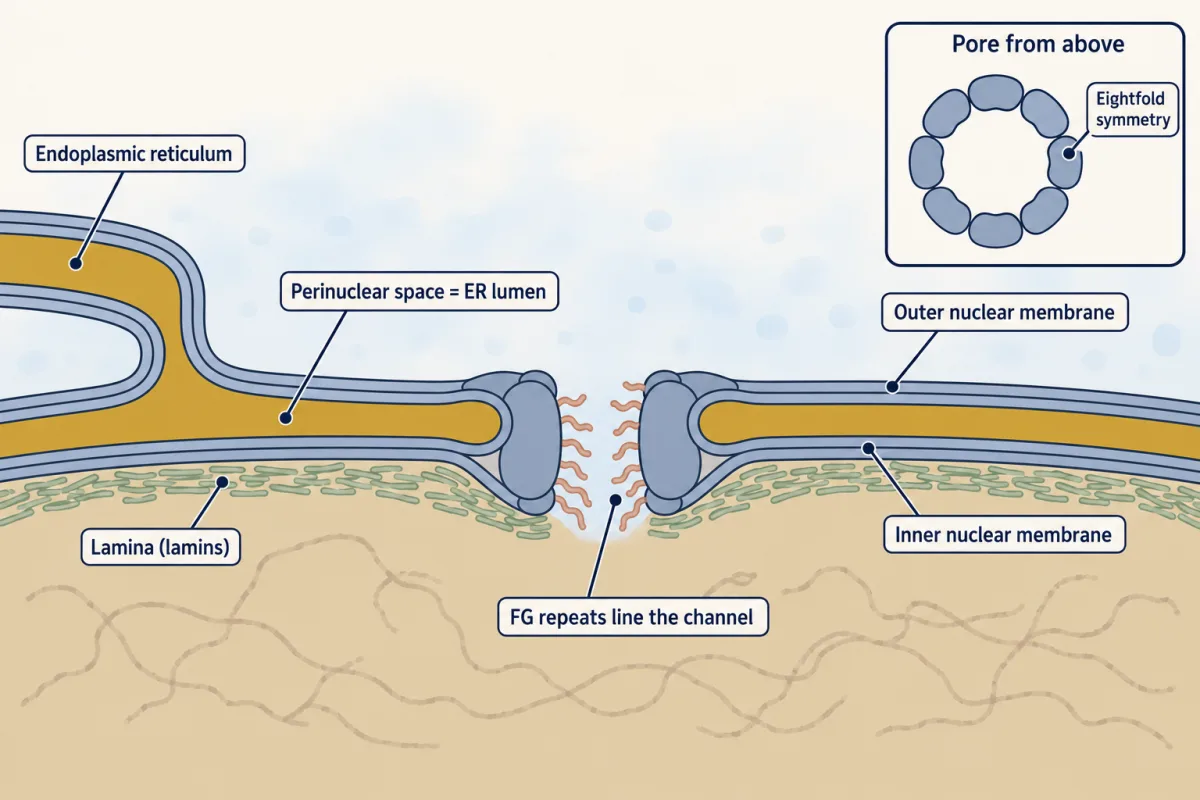
The outer nuclear membrane is continuous with the ER, so the space between the two membranes is ER lumen. The membranes meet at the pore, whose scaffold has eightfold symmetry and whose channel is lined with FG repeats; the lamina lies under the inner membrane. AI-generated illustration -
A soft barrier, measured
-
Signals: what an experiment can prove
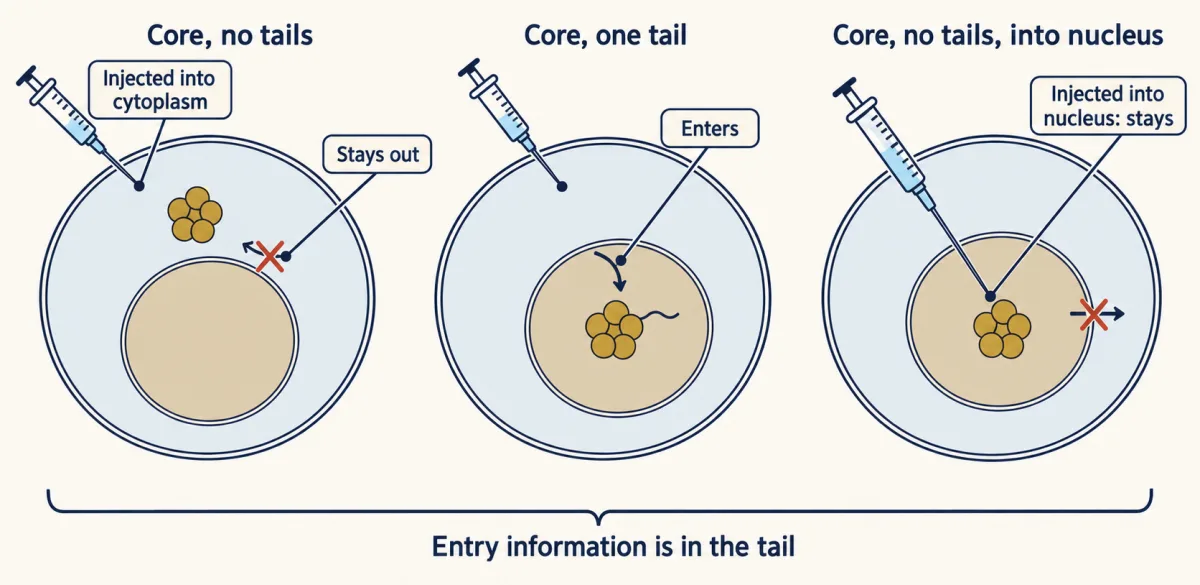
The tail carries the information for entry, and the core is enough for staying: cores without tails stay in the cytoplasm when injected there, a pentamer with one tail enters, and cores injected into the nucleus stay there. AI-generated illustration -
Crossing is not direction
-
Predict and design: the drug puzzle
-
Going deeper
Where this lesson fits
Before thisReview first
- Protein Sorting into CompartmentsThis course · Lesson 7
Signal sequences and receptors that send proteins to compartments are the idea the nuclear signals here build on.
- Membrane Organization and TopologyThis course · Lesson 4
The envelope's two bilayers and the outer membrane's continuity with the ER rest on how membranes and their faces are organized.
- Organelles as Distinct EnvironmentsThis course · Lesson 6
You need to know how compartments keep different contents separate to see why a nucleus needs selective transport.
After thisStudy next
- Nuclear Architecture and Membraneless CompartmentsThis course · Lesson 10
It takes the nucleus further, asking how it organizes compartments inside without membranes after this lesson's border.
- Protein Quality Control and Organelle TurnoverThis course · Lesson 9
Shuttling and turnover of proteins by receptors and tags extends this lesson's idea that traffic is read from signals.
- Cytoskeletal Polymers and DynamicsThis course · Lesson 14
Another GTPase-driven polymer system whose GTP cycle sets direction, reusing this lesson's switch logic.
Suggested by an AI model from the lessons themselves, then checked. How we use AI