Developmental Neuroscience · Skim version
One Axon, Many Dendrites: Neuronal Polarity
Read the full lesson → Skim the whole course →
The guiding idea
A neuron takes in signals on dendrites and sends them out along one axon. Cut that axon close to the cell body in a dish and one of its dendrites can become a new axon. How does a neuron choose its axon, and keep it?
In cultured neurons, an axon is won in a race among young neurites and then held by the axon's microtubule tracks and its initial segment.
From the film: Cut the Axon
- An axon is not a permanent label: in a dish, cutting it close to the cell body can let a dendrite grow out as a new axon.
- An axon is won in a race among young neurites, and then held.
- Cut almost all of the axon away and the race can reopen.
From the film: Five Stages and a Race
- Cultured rat hippocampal neurons polarize in five stages, and the axon appears at stage three when one neurite grows much faster than the rest.
- Cutting the leader can hand the axon to another neurite, so the choice can be undone and behaves like a race in which length is part of the score.
- The 10 micrometre lead belongs to these cultured-neuron experiments and is not a rule for every neuron.
From the film: What Makes a Winner
- Growth in simple proportion to length picks no winner, because the leader stays the same fraction ahead.
- One winner needs positive feedback within each neurite plus competition between neurites.
- In the proposed loop, PIP3 builds up at the tip of the future axon, and the race model is a thought experiment, not a measurement.
From the film: Rig the Race
- The growth cone of the future axon has a looser, more dynamic actin network than its siblings.
- Boosting loose actin or stable microtubules in one neurite made it more likely to become the axon, and blocking PI3-kinase throughout is reported to leave no axon.
- Whole-cell drug doses led several neurites to grow as axons, which a plain speed-up of the race model does not predict.
From the film: Tracks That Point Two Ways
- In cultured rat hippocampal neurons, axon microtubules nearly all point plus end out, while dendrite microtubules point both ways.
- The way the tracks point limits which motors can carry cargo outward: dynein can do so into dendrites far more readily than into the axon.
- In fly neurons the dendrites are mostly minus end out, so the details depend on the animal.
From the film: The Gate, and the Race Reopened
- The axon initial segment is a coat built on ankyrin G, and in many neurons it is where the action potential starts.
- Lowering ankyrin G in cultured neurons after the axon was chosen broke up the initial segment and let MAP2 spread into the axon, so identity has to be actively held.
- A mature neuron's cut reopens the race only when almost the whole axon is removed, in the cultures studied.
- In the developing cortex, neurons lacking LKB1 or both SAD kinases fail to form axons.
-
One cell, two kinds of process
-
Five stages and a race
-
What a race with one winner needs
-
Rig the race
-
Tracks that point two ways
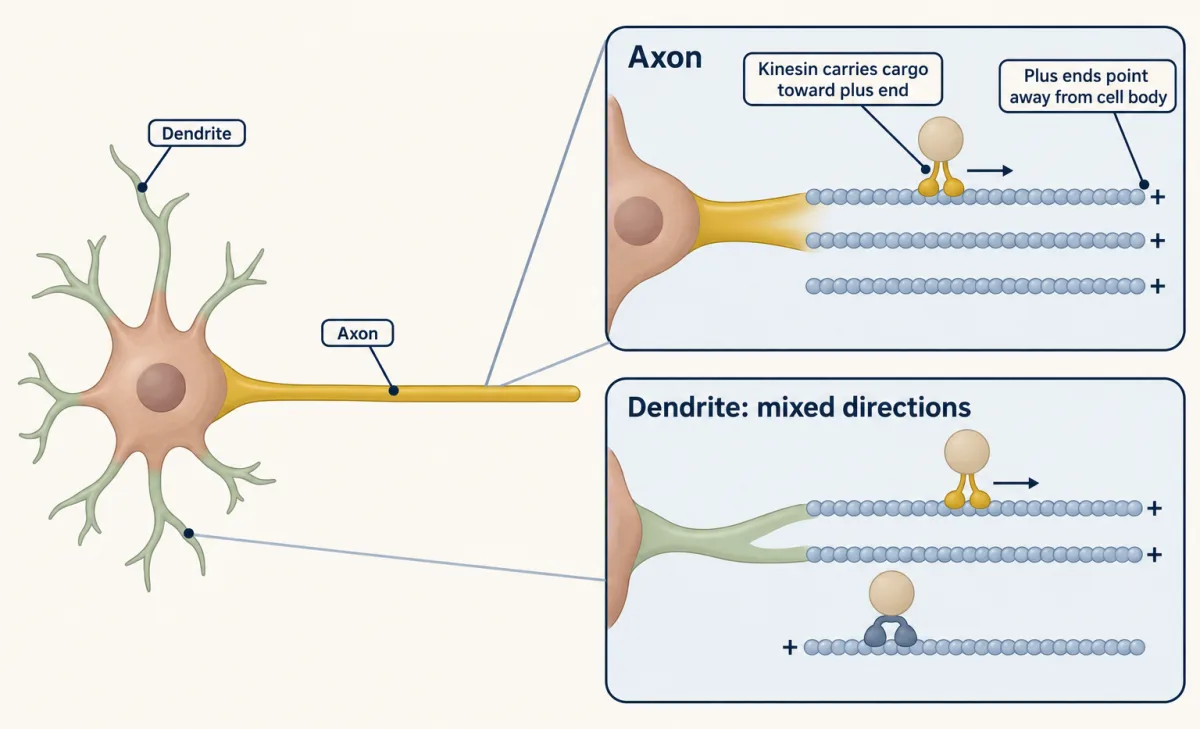
In vertebrate neurons, axon microtubules nearly all point plus end out, while dendrites mix both directions, so a kinesin that prefers the axon's stable plus-end-out tracks can steer cargo into it. In fly neurons the dendrites are instead mostly minus-end-out. AI-generated illustration -
The initial segment: a gate that holds the win
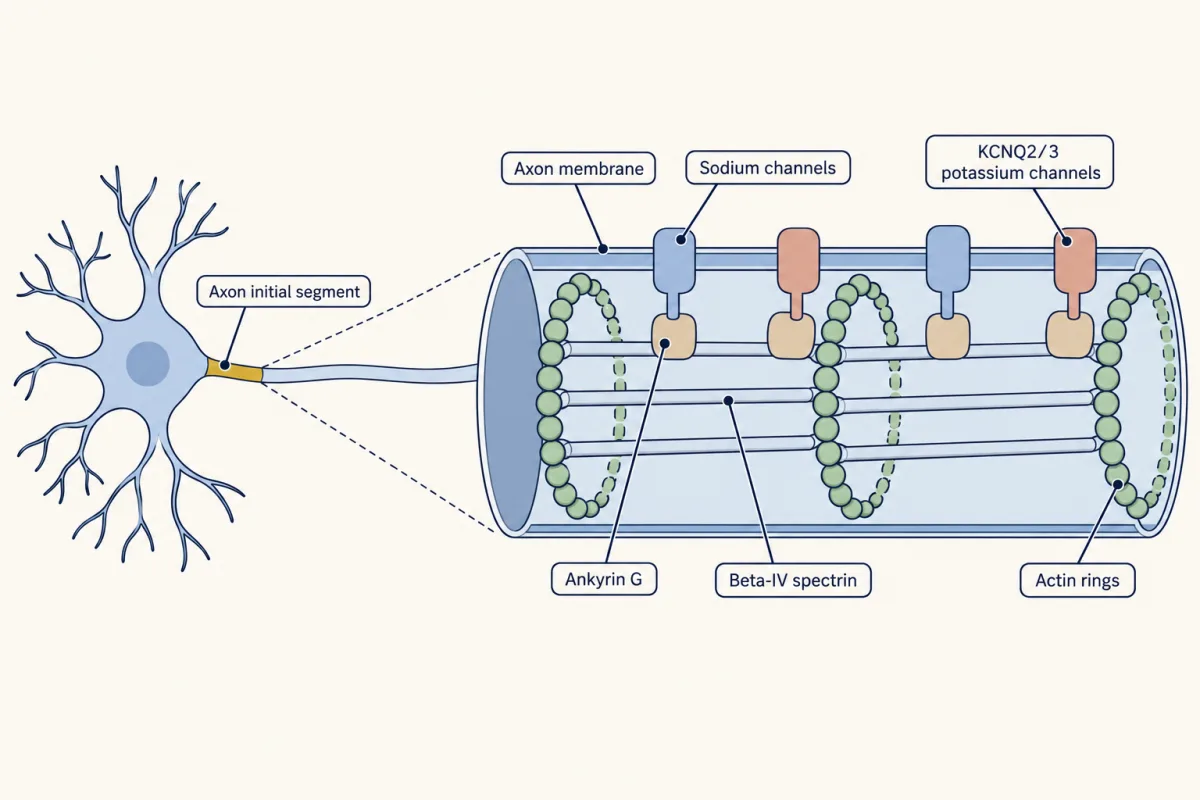
The axon initial segment, the first few tens of micrometres of the axon, carries a dense coat built on ankyrin G, which binds channels in the membrane and, through beta-IV spectrin, rings of actin underneath. Neurofascin-186, NrCAM and, in many neurons, Kv1 channels gather there too. AI-generated illustration -
Does the brain run the same race?
-
Putting it together
-
Going deeper
Where this lesson fits
Before thisReview first
- The Growth Cone: The Tip That Steers the AxonThis course · Lesson 3
The competing neurites each end in a growth cone, and its actin and microtubule dynamics are what the race reads.
- Seeing Neurons: Golgi, Cajal and the Neuron DoctrineThis course · Lesson 2
You need the picture of the neuron as one cell with dendrites and a single axon from there.
After thisStudy next
- Pioneers, Guideposts and the Logic of Guidance CuesThis course · Lesson 22
Once one axon is chosen and held, this lesson asks how its growth cone is steered to a target.
- Myelination: Wrapping the Axon So the Signal JumpsThis course · Lesson 44
Myelin and nodes of Ranvier repeat the initial segment's ankyrin G machinery along the axon.
Elsewhere on the siteFilms, simulations and method films in other courses
- Grip, Swing, Let GoFilm · Cell Biology
It shows how kinesin and dynein walk microtubule tracks of fixed direction, which limits cargo entry into axon versus dendrite.
- Tight Ends, Loose EndsFilm · Cell Biology
It shows how microtubule ends grow and shrink, the stabilization difference that favours one neurite.
Suggested by an AI model from the lessons themselves, then checked. How we use AI