Developmental Neuroscience · Skim version
Netrin and DCC: One Cue, Two Answers
Read the full lesson → Skim the whole course →
The guiding idea
The same protein pulls one axon toward the midline of the embryonic spinal cord and pushes another away. What decides?
Netrin marks a place; the growth cone decides what to do there, through its receptors (DCC and UNC5) and, in some cells, its internal state.
From the film: The Map and the Puzzle
- Netrin marks a place, and the growth cone decides what to do there.
- Where netrin is supplies the where, and the growth cone's receptors and, in some cells, its internal state supply the sign.
- Netrin is not always a long-range gradient, and it does more than steer.
From the film: Something Crosses the Gel
- In a gel, a floor plate explant drew commissural axons from dorsal spinal cord at a distance without touching it.
- Netrin is what crosses the gel, and it can attract at a distance.
- Promoting outgrowth is not the same as setting direction, so direction needed its own test.
From the film: The Worm Already Knew
- In the worm, one cue, UNC-6, sends cells and axons in two directions, depending on the reader.
- UNC-40 mainly reads toward and UNC-5 mainly reads away.
- Making worm touch neurons express UNC-5 turned their axons away from the unchanged cue, so the receptor set the direction.
From the film: The Vertebrate Readers: DCC and UNC5
- DCC, the vertebrate relative of UNC-40, is on commissural axons, and blocking it blocked netrin-evoked outgrowth.
- In mice, removing netrin or removing DCC left commissural axons misrouted in much the same way.
- DCC usually draws a growth cone in and UNC5 receptors add repulsion, but that is a starting point, since other receptors and partners take part.
From the film: Same Receptor, Opposite Turn
- A growth cone with the same receptor can turn toward netrin under one condition and away under another.
- In frog spinal growth cones, blocking cAMP signaling turned DCC-dependent attraction into repulsion.
- This is one worked example in one system, not a rule for every netrin-responsive axon.
From the film: Where Is the Netrin?
- A growth cone measures bound receptors, so a small difference across it is easiest to detect near the receptor's KD.
- In mice, removing progenitor netrin sent many commissural axons off course, while most stayed on course without floor plate netrin.
- Much of the netrin that matters seems to act near where progenitors lay it down, though the floor plate keeps a part.
-
The layout
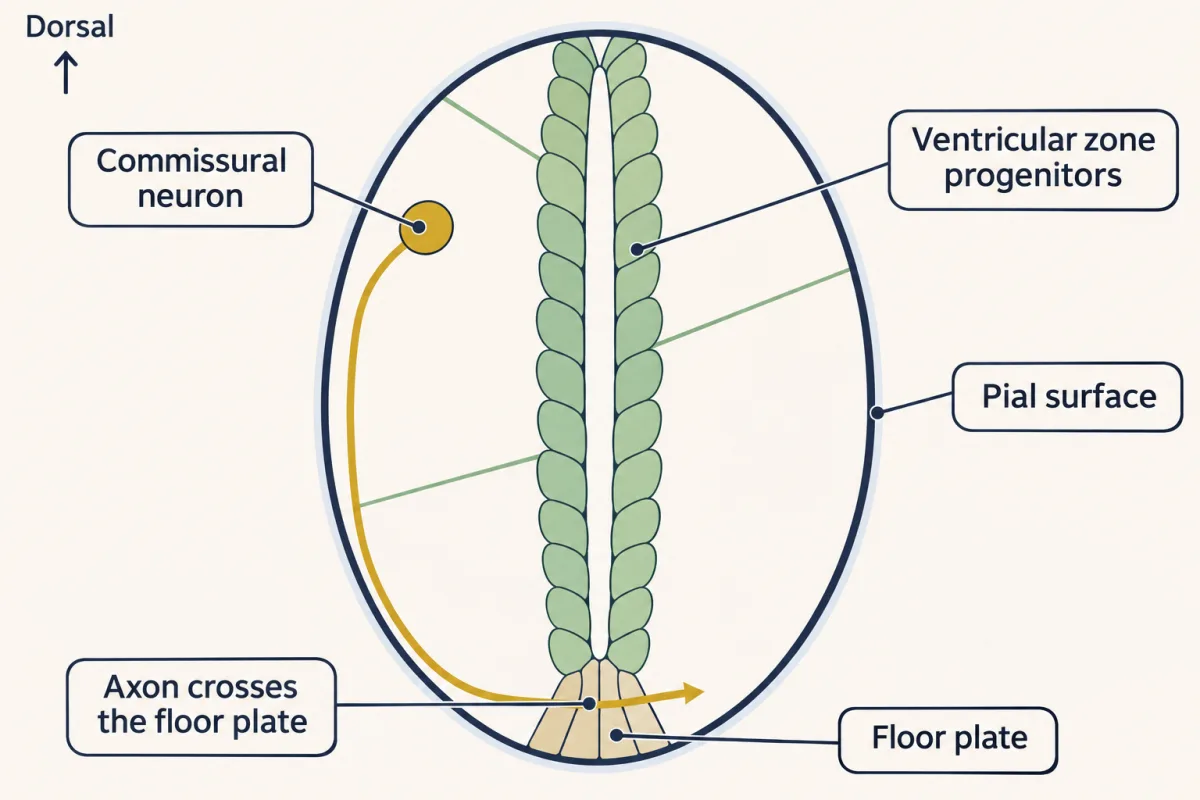
The map for this lesson: in the embryonic spinal cord, commissural axons grow ventrally close to the pial surface, then turn inward and cross the floor plate at the ventral midline. Ventricular-zone progenitors line the canal and reach the pial surface with long fibres. AI-generated illustration -
Something crosses the gel
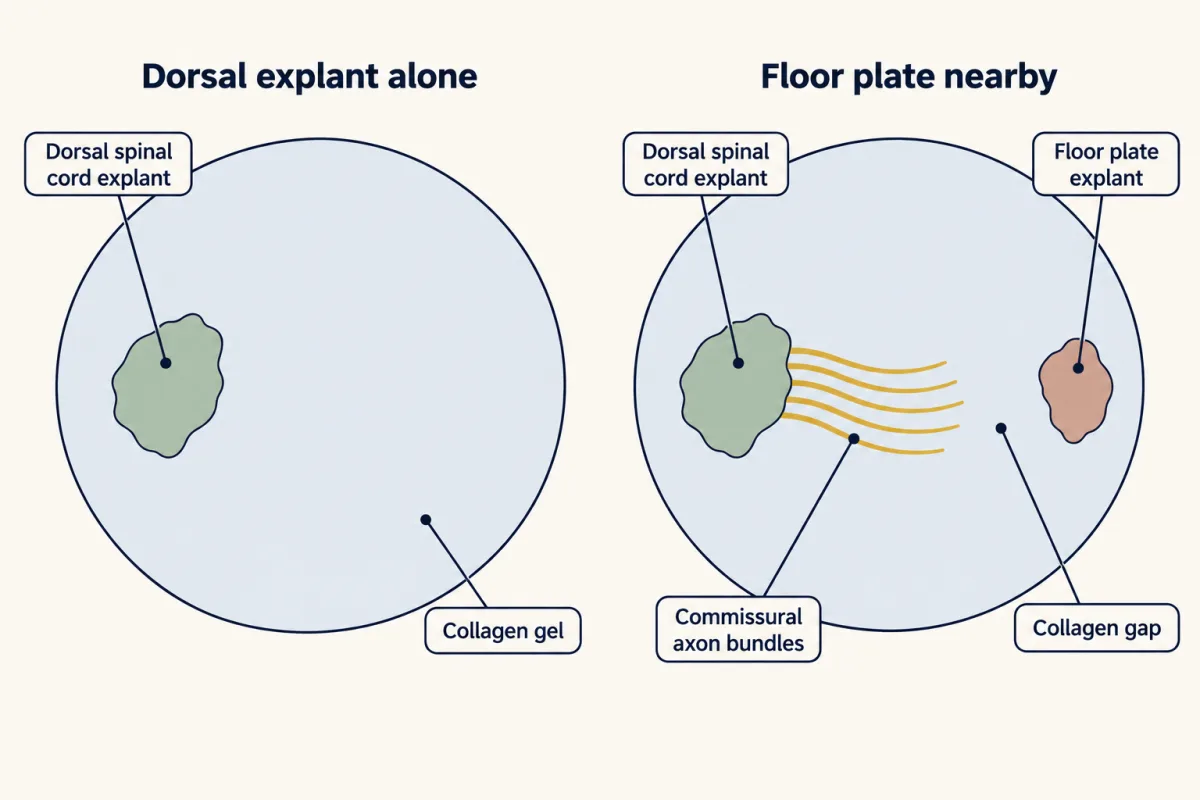
Dorsal spinal cord explants in collagen gel send out few or no commissural axons on their own, but with a floor plate explant nearby, commissural axon bundles grow toward it though the two never touch. AI-generated illustration -
From an activity to a molecule
-
The worm already knew: one cue, two readers
-
The vertebrate readers: DCC and UNC5
-
Same receptor, opposite turn
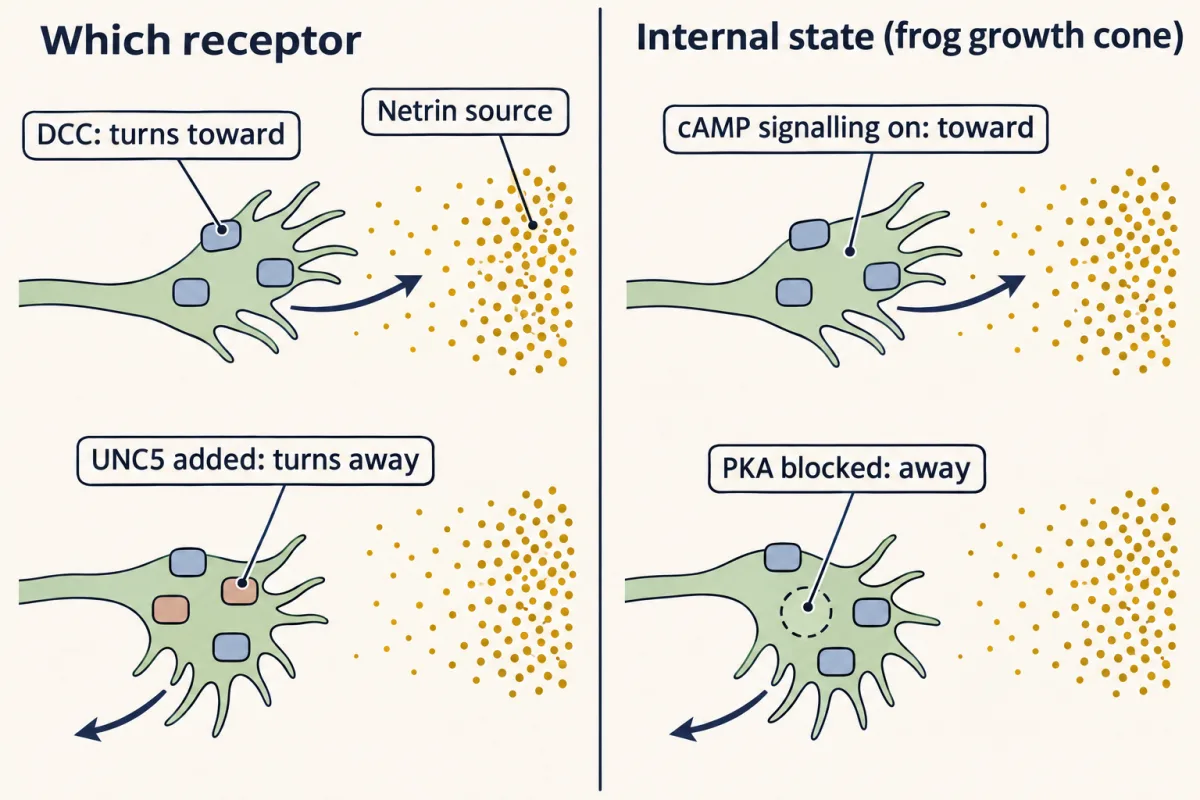
Netrin marks the place; the growth cone sets the sign. DCC usually draws a growth cone toward netrin and UNC5 receptors add repulsion, and in frog spinal growth cones, blocking cAMP signalling turned the same DCC-dependent attraction into repulsion. AI-generated illustration -
Where is the netrin?
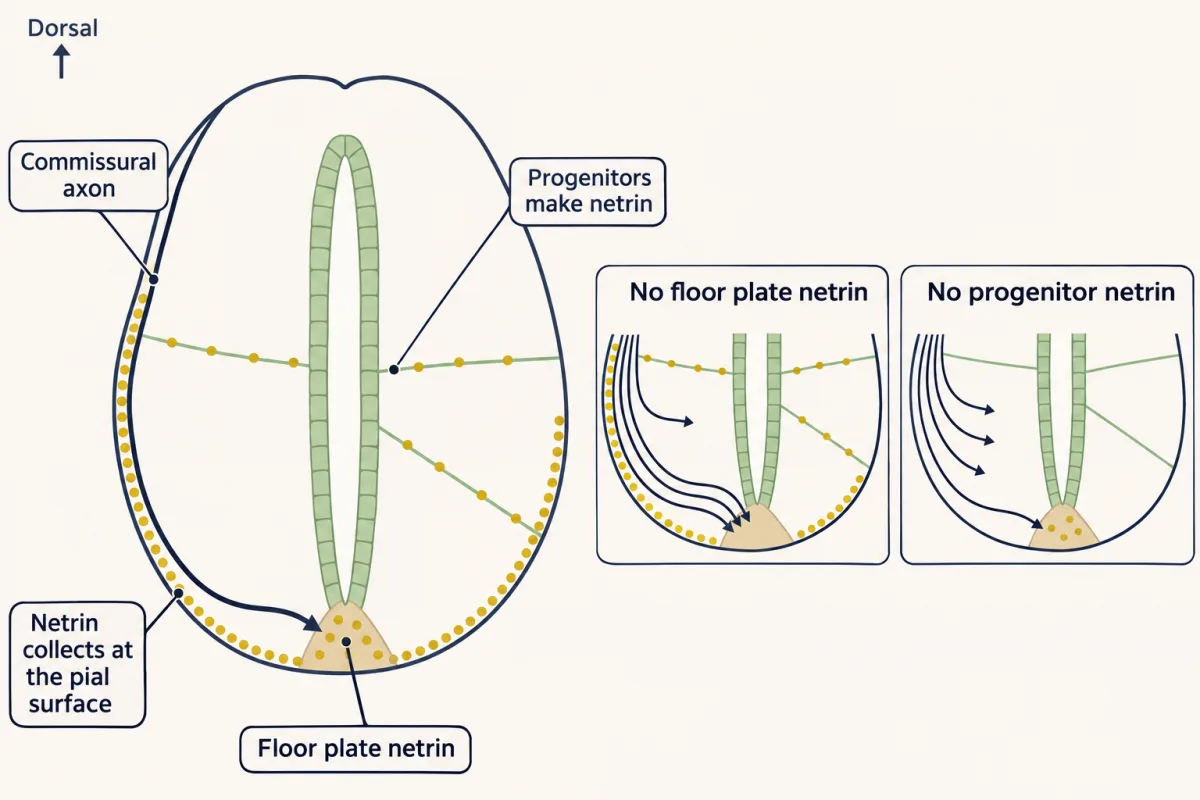
Netrin-1 comes from two sources: the floor plate, and ventricular-zone progenitors whose netrin collects at the pial surface along the commissural axons' path. In mice, removing progenitor netrin sent many commissural axons off course, while most stayed on course without floor plate netrin; which source matters does not by itself say how axons read it. AI-generated illustration -
Putting it together
-
Going deeper
Where this lesson fits
Before thisReview first
- The Growth Cone: The Tip That Steers the AxonThis course · Lesson 3
You need how the growth cone senses and steers from there to follow how it reads netrin.
- Pioneers, Guideposts and the Logic of Guidance CuesThis course · Lesson 22
This lesson builds on the four classes of guidance cue, including long-range attraction, introduced there.
- Ventral to Dorsal: Sonic Hedgehog and BMP in the Neural TubeThis course · Lesson 10
It sets out the floor plate as a midline signalling centre of the neural tube, which netrin comes from here.
After thisStudy next
- Crossing the Midline Once: Slit, Robo and CommThis course · Lesson 24
It explains what changes in the reader after commissural axons cross the floor plate, using Slit and Robo.
- Semaphorins and RepulsionThis course · Lesson 25
It gives a second repulsive cue and shows how receptors on the growth cone set which way it turns.
- Topographic Maps: Sperry's Eye and Eph GradientsThis course · Lesson 26
It uses gradients of guidance cues read by growth cones, taking the idea of reading shallow gradients further.
Elsewhere on the siteFilms, simulations and method films in other courses
- GTPase timerSimulation · Cell Signaling
Rho-family GTPase switches sit downstream of DCC and UNC5 and set the turn of the growth cone.
Suggested by an AI model from the lessons themselves, then checked. How we use AI