Developmental Neuroscience · Skim version
Transcription Factor Codes: Building a Motor Neuron
Read the full lesson → Skim the whole course →
The guiding idea
Put Lhx3 into chick spinal cord cells that make no Isl1 and they turn on interneuron genes. Add Isl1 and the same protein turns on motor-neuron genes. If no single gene says motor neuron, how does a set of transcription factors make one, and choose the muscle its axon will reach?
In the developing spinal cord, no single factor says motor neuron: what a cell becomes depends on which complexes the transcription factors form, and in what ratio.
From the film: One Protein, Two Cell Types
- No single factor says motor neuron: here, identity depends on which complexes form, and that depends on which partners are present and in what ratio.
- In chick cells, Lhx3 without Isl1 turns on V2 interneuron genes such as Chx10, and Lhx3 with Isl1 turns on motor neuron genes such as Mnx1.
- The cofactor NLI is in both complexes, and what differs is whether Isl1 bridges NLI to Lhx3.
- In a simple binding model, binding alone gives a mixture rather than a clean switch, so real cells need more to lock the choice in.
From the film: Enough, Needed, and Kept
- A factor is sufficient if adding it produces the effect in the cells tested, and necessary if the effect does not happen without it.
- In mouse, deleting Mnx1 still allows motor neurons to form, but they transiently show V2 interneuron features, so Mnx1 is needed to keep a motor neuron rather than to make one.
- Motor neurons still form without Lhx3 and Lhx4, but their subclass and axon exit change, so enough is not the same as needed.
From the film: Which Motor Neuron, and a Recipe
- Position along the cord is written in Hox proteins, and in chick, Hoxc9 given early in the brachial cord suppresses limb column identity and gives a preganglionic identity.
- In mouse, motor neurons still form without Foxp1, but the limb and autonomic columns are not assigned correctly and axons appear to choose paths at random.
- Within the limb column, lateral cells make Lim1 and their axons take a dorsal path, while medial cells keep Isl1 and their axons go ventral.
- Retinoic acid and a Hedgehog agonist can turn mouse stem cells into motor neurons, but the basic protocol gives mostly medial column cells.
-
One protein, two cell types
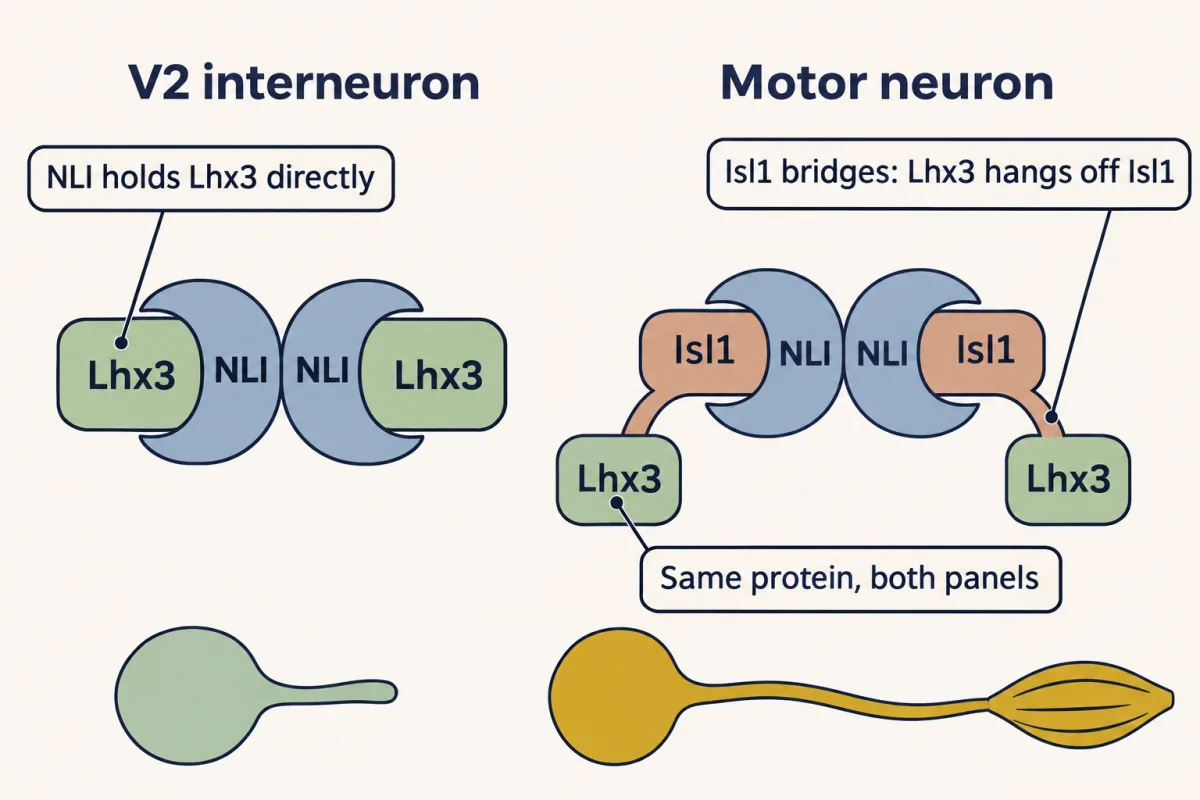
NLI is in both complexes. What differs is whether Isl1 bridges NLI to Lhx3, and the same protein, Lhx3, sits in each. AI-generated illustration -
Before the code: a stripe of progenitors
-
Enough, needed, and kept
-
Which motor neuron: Hox proteins and FoxP1 along the cord
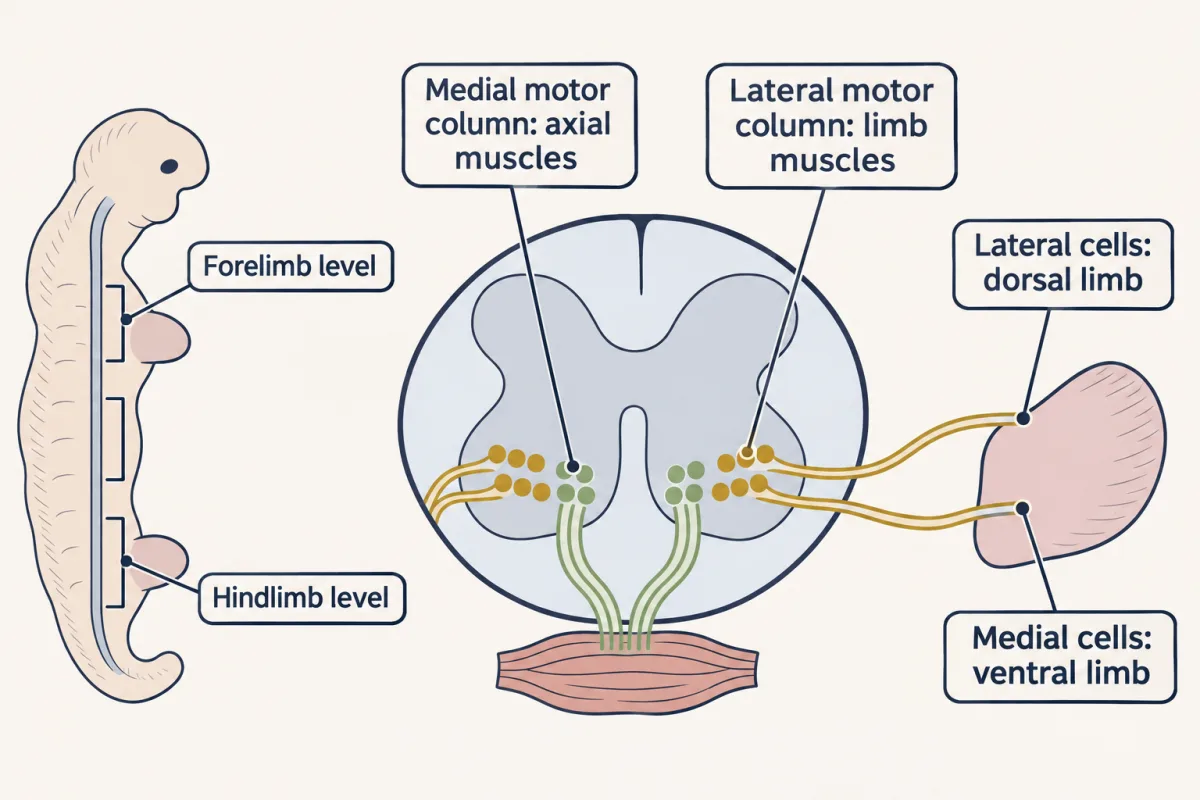
A motor column is defined by where the cell bodies sit and where the axons go. The medial motor column innervates axial muscles at every level; the lateral motor column appears at limb levels, and within it the lateral cells take a dorsal path in the limb and the medial cells a ventral one. AI-generated illustration -
Which half of the limb: the LIM code sets the first axon choice
-
Making motor neurons in a dish
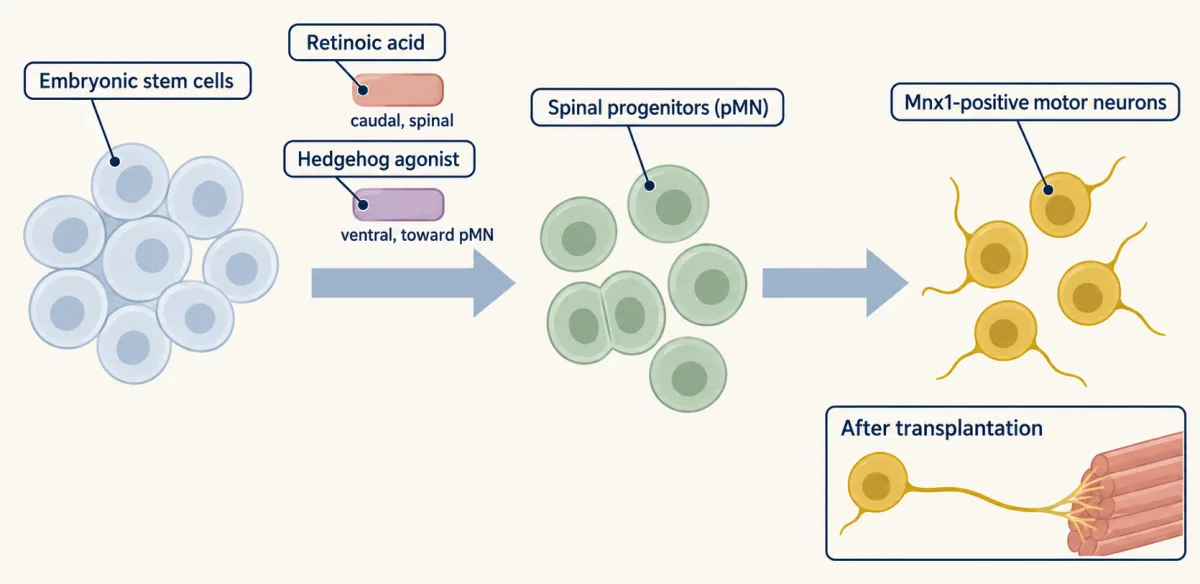
Mouse embryonic stem cells can be patterned toward spinal pMN progenitors with retinoic acid and Hedgehog signalling, then differentiate into Mnx1-positive motor neurons. Retinoic acid alone gives relatively rostral hindbrain and cervical Hox profiles; more caudal identities need earlier signals. The basic protocol yields mostly medial motor column neurons. The inset summarises a separate transplantation test: the neurons populated an embryonic spinal cord and formed synapses with muscle. AI-generated illustration -
Putting it together
-
Going deeper
Where this lesson fits
Before thisReview first
- Ventral to Dorsal: Sonic Hedgehog and BMP in the Neural TubeThis course · Lesson 10
The Hedgehog and BMP gradient that sets the pMN and p2 progenitor domains is used here without being re-taught.
- Head to Tail: Hox Genes, Retinoic Acid and RhombomeresThis course · Lesson 8
You need Hox genes writing position along the axis from there to read the column code along the cord.
- Tools for Following Cells and GenesThis course · Lesson 4
The lesson reads chick electroporation and mouse knockout results as sufficiency and necessity tests, which depend on these tools.
After thisStudy next
- Pioneers, Guideposts and the Logic of Guidance CuesThis course · Lesson 22
Axon guidance cues act on the Lim1 and Isl1 limb code, steering lateral and medial axons.
- Too Many Neurons: Naturally Occurring Cell DeathThis course · Lesson 28
Motor neurons made by this code are overproduced, and about half die while competing for muscle.
- Where Glia Come FromThis course · Lesson 43
The same Olig2 pMN domain that makes motor neurons later switches to making oligodendrocytes.
Elsewhere on the siteFilms, simulations and method films in other courses
- Engineered mutants: site-directed, dominant-negative and constitutively activeMethod film
The fused Isl1-Lhx3 protein shows how engineered protein changes test which complex a cell needs.
Suggested by an AI model from the lessons themselves, then checked. How we use AI