Developmental Neuroscience · Skim version
When Building Goes Wrong: Microcephaly, Zika and Lissencephaly
Read the full lesson → Skim the whole course →
The guiding idea
Why does the same doublecortin mutation give a boy a smooth brain and his mother a second band of cortex?
A cerebral cortex can be malformed because too few neurons were made or because the neurons that were made never reached their layer.
From the film: Size Counts the Doublings
- Size counts the doublings, and layering records the journey.
- A small cortex with orderly layers points first to a problem in making neurons, and near-normal size with disordered layers points to migration.
- Because the progenitor pool doubles, a small fault that recurs in each round can compound into a large loss.
- This size-and-layering split is a first question, not a diagnosis.
From the film: Too Few: the Spindle and a Virus
- Primary microcephaly genes such as ASPM mostly act at the spindle pole of dividing progenitors, leaving a small cortex with layers broadly in order.
- In mouse embryos, knocking down Aspm tilted the division plane and shifted divisions away from making progenitors.
- Evidence that Zika virus causes microcephaly came from epidemiology, pathology and laboratory models, and each kind of evidence has limits.
- Most Zika infections in pregnancy do not produce microcephaly, and the virus can also damage tissue already built.
From the film: The Nucleus Left Behind
- In classic lissencephaly the neurons are made but fail to travel, and the head is usually near normal in size at birth.
- Losing one copy of LIS1 is enough to cause lissencephaly, and LIS1 binds the dynein motor that helps pull the nucleus forward.
- Doublecortin is not a motor but binds and steadies microtubules, the tracks the nucleus travels on.
- Because of X inactivation, the same DCX mutation can give a boy lissencephaly and his mother a band of misplaced neurons.
-
Number or place
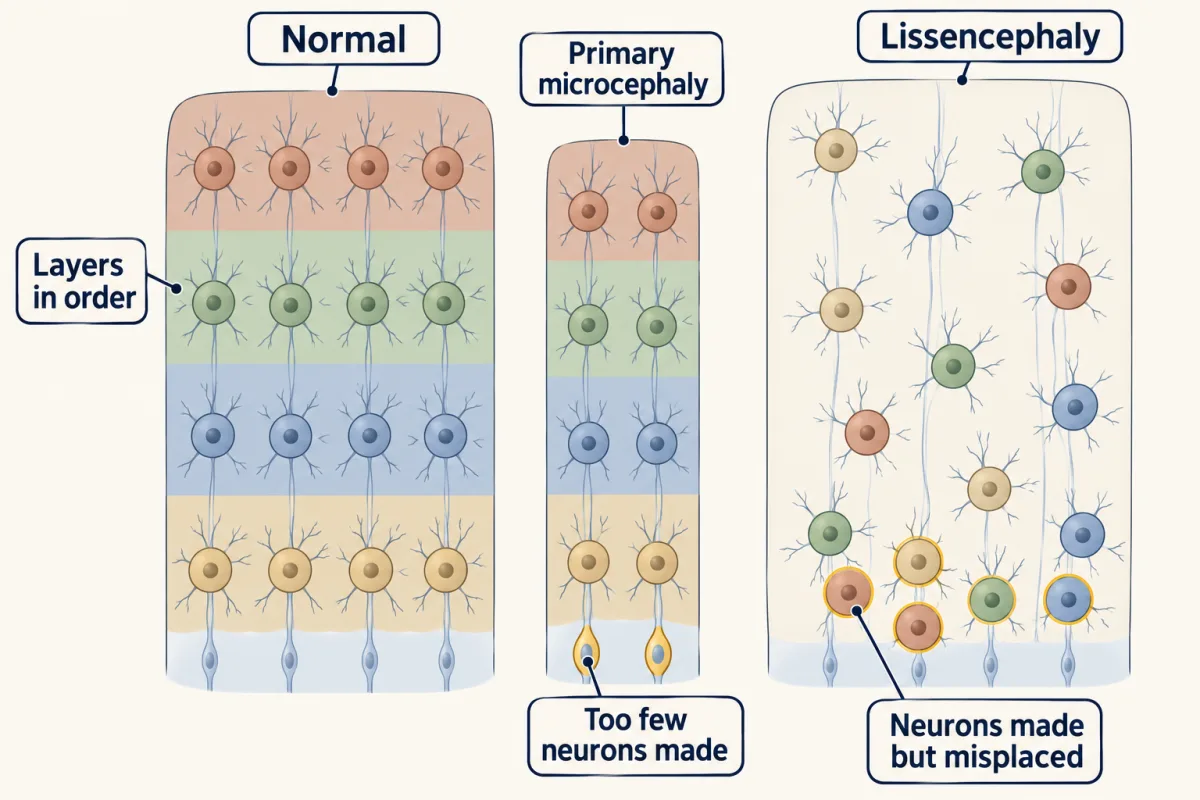
Too few neurons made gives a small cortex with its layers broadly in order, as in most forms of primary microcephaly. Neurons made but not moved gives a thick, disordered cortex, as in classic lissencephaly. The real cortex has six layers and classic lissencephaly about four crude ones; the schematic draws four bands, and its symbols and widths are not cell counts. AI-generated illustration -
Too few: a tape measure and a spindle
-
Zika: how do you show that a virus causes a birth defect?
-
In the wrong place: lissencephaly and the double cortex
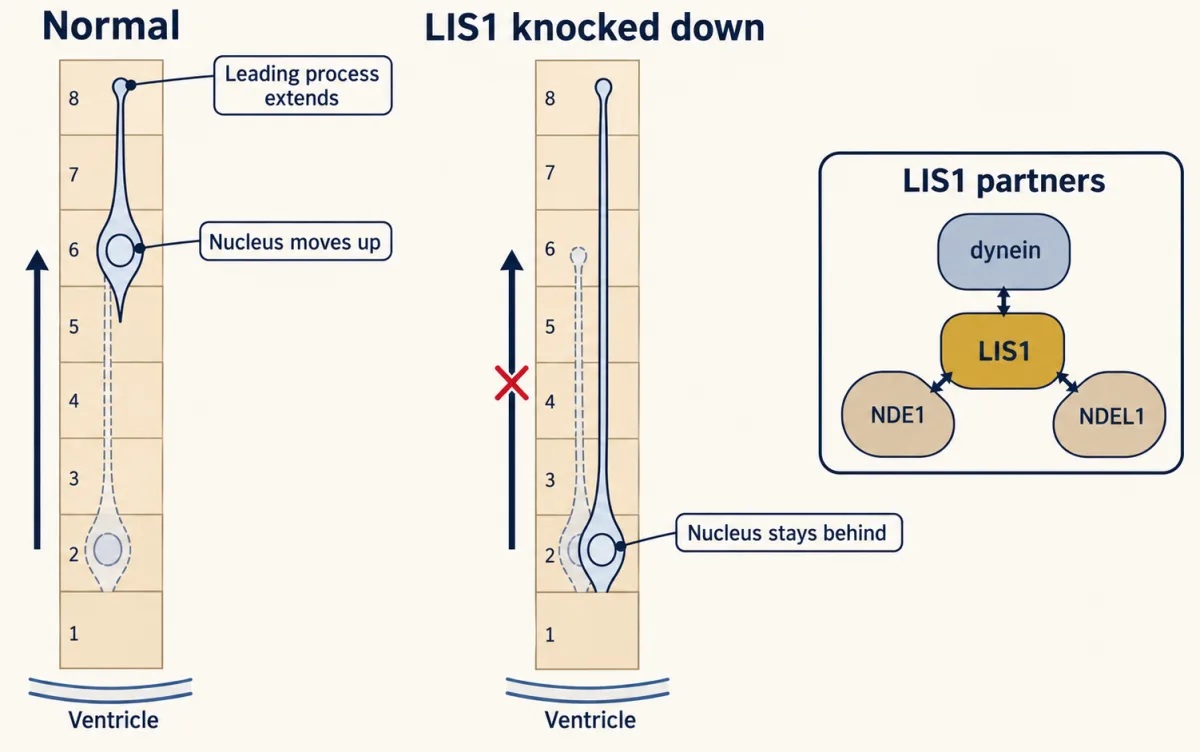
In the rare LIS1-knockdown cells that became bipolar, the leading process kept extending while the nucleus stayed behind. Most knockdown cells (not drawn) stalled as multipolar cells near the ventricle. The inset shows LIS1 binding dynein and the NudE-family proteins NDE1 and NDEL1. AI-generated illustration -
Where the sort breaks
-
Putting it together
-
Going deeper
Where this lesson fits
Before thisReview first
- The Ventricular Zone: Radial Glia as Stem CellsThis course · Lesson 13
Radial glia divide to make more progenitors and then neurons, and this lesson asks which of those divisions fails.
- Asymmetric Division: Numb and the NeuroblastThis course · Lesson 15
You need how spindle orientation sets symmetric versus neuron-making divisions to see how ASPM loss shrinks the progenitor pool.
- Radial Migration: Climbing the Glial LadderThis course · Lesson 17
You need the two-step nuclear movement along the glial fiber to see why LIS1 and doublecortin loss stall neurons.
After thisStudy next
- What Makes the Human Brain BigThis course · Lesson 50
It takes progenitor number and outer radial glia further to explain why the human cortex is so large.
- Brains in a Dish: Stem Cells and OrganoidsThis course · Lesson 51
It extends the organoid models used in the Zika work into a tool for studying human brain disease.
Elsewhere on the siteFilms, simulations and method films in other courses
- How One Set Becomes TwoFilm · Biology
Spindle poles and chromosome separation in dividing cells are the machinery that microcephaly genes disturb.
- Grip, Swing, Let GoFilm · Cell Biology
It shows how dynein walks toward the microtubule minus end, the motor LIS1 regulates.
- Tight Ends, Loose EndsFilm · Cell Biology
It explains how microtubules grow and are stabilized, the track that doublecortin steadies.
Suggested by an AI model from the lessons themselves, then checked. How we use AI