Genetics and Molecular Biology · Skim version
Mendel's Peas: Segregation and Independent Assortment
Read the full lesson → Skim the whole course →
The guiding idea
Mendel crossed round peas with wrinkled ones and every hybrid seed came out round. A generation later he counted 5,474 round seeds and 1,850 wrinkled. Where had wrinkled been hiding, and why one in four?
In modern terms, a pea plant carries two copies of each gene and passes one, chosen as if by a coin toss, into each gamete (segregation), and in Mendel's crosses the genes for different characters were passed on independently, like separate coins (independent assortment).
From the film: Two Copies, One Coin Toss
- Crossing true-breeding round and wrinkled peas gives only round hybrid seeds, yet wrinkled seeds return in the next generation.
- In modern terms, each pea plant carries two copies of the seed-shape gene, one from each parent.
- Each egg or pollen grain gets one of the two copies, chosen as if by a fair coin toss.
- One round copy is enough for a round seed, so a 1:2:1 mix of genotypes looks like about 3 round to 1 wrinkled.
- Mendel's 7,324 seeds came out 2.96 to 1: near 3 to 1, with the scatter of real counts.
From the film: Two Genes, Two Coins
- Mendel asked whether the genes for seed shape and seed colour go into gametes together or separately.
- Crossing the double hybrid to wrinkled green lets each seed show one gamete of the hybrid.
- Eggs and pollen alike carried all four combinations in about equal numbers, so the two genes were sorted separately.
- Separate tosses multiply, so the selfed double hybrid gives four classes near 9:3:3:1.
- This held for seed shape and colour; it does not hold for every pair of genes.
-
The setup
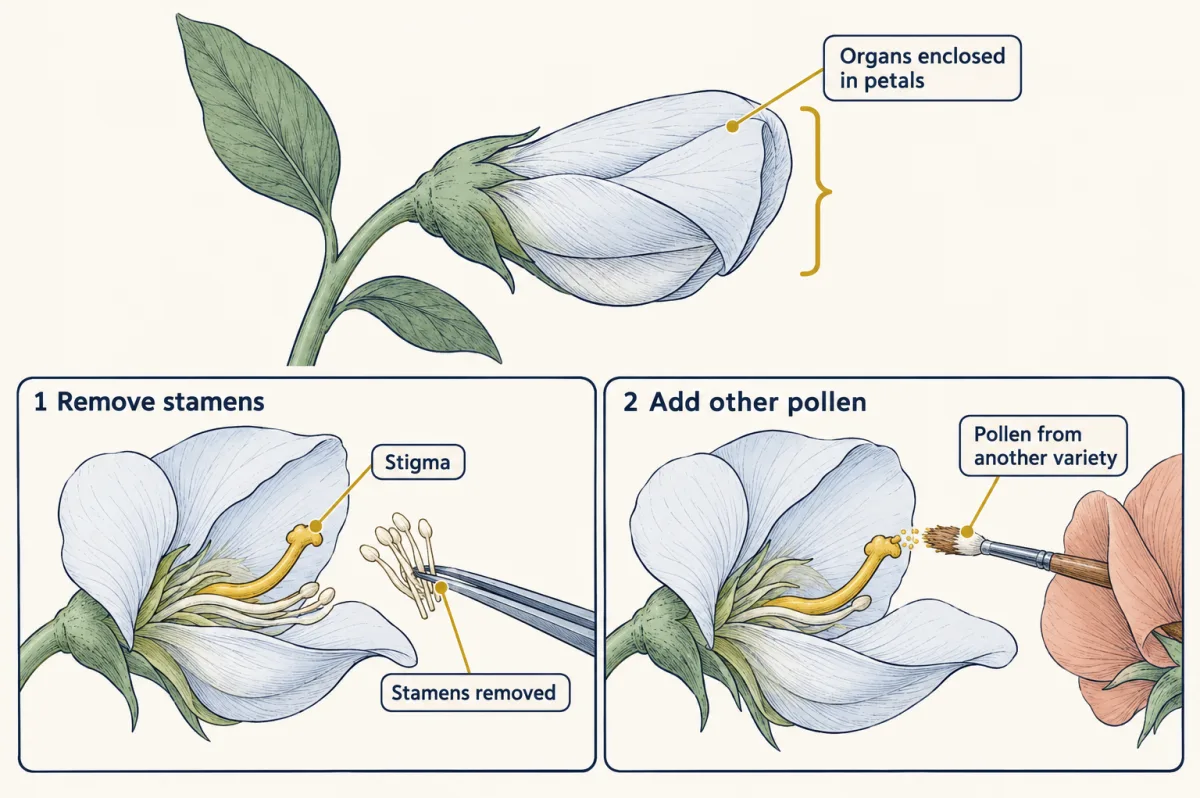
A pea flower normally pollinates itself inside its petals. To cross two lines, Mendel removed the stamens from an immature flower and placed pollen from another variety on its stigma, so he chose the father of each seed. AI-generated illustration -
Two kinds of round
-
What “dominant” means
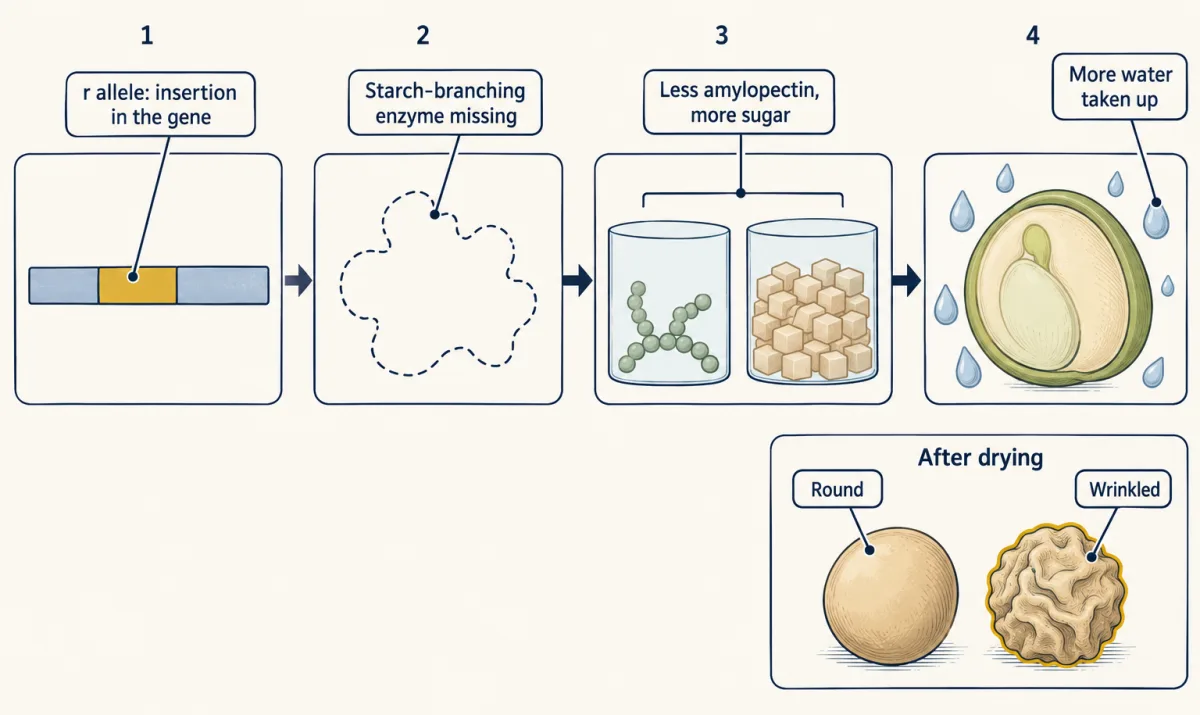
The wrinkled allele r carries an insertion resembling a transposable element in a gene for a starch-branching enzyme. Without the enzyme, rr embryos make less amylopectin and hold more sugar, take up more water as they develop, and wrinkle as they dry. AI-generated illustration -
Counts scatter
-
The test cross: reading a genotype you cannot see
-
Two characters: what the film left out
-
What Mendel knew
-
Going deeper
Where this lesson fits
Before thisReview first
- Mendel and Punnett SquaresBiology · High school
It teaches the 3:1 cross, genotype versus phenotype and Punnett squares, which this lesson uses at full depth.
After thisStudy next
- Chromosomes and Meiosis: The Physical Basis of Mendel's LawsThis course · Lesson 2
It shows the chromosome behaviour in meiosis that physically explains segregation and independent assortment.
- Probability, Crosses and the Chi-Square TestThis course · Lesson 3
It tests whether counts like 315:108:101:32 fit 9:3:3:1 using the chi-square test.
- Extending Mendel: Dominance, Multiple Alleles and Gene InteractionThis course · Lesson 4
It takes the idea further when dominance is incomplete or genes interact, so ratios differ from 3:1 and 9:3:3:1.
Elsewhere on the siteFilms, simulations and method films in other courses
- Chi-square testMethod film
It decides whether counts such as 5,474 round to 1,850 wrinkled fit a 3:1 expectation.
- Breed pea plantsSimulation · Life Science
Breeding pea plants one-gene crosses shows how hidden recessive alleles return as a 3:1 ratio.
Suggested by an AI model from the lessons themselves, then checked. How we use AI