Cell Biology · Skim version
Transport Across Membranes
Read the full lesson → Skim the whole course →
The guiding idea
Which way will potassium flow if you hold a cell at −70 millivolts? Its concentrations alone will not tell you.
A lipid bilayer stops ions and most polar molecules, so every cell relies on proteins to move them: channels, carriers and pumps.
From the film: Two Pushes, One Hill
- An ion feels two pushes: its concentration difference and the membrane voltage.
- Net flow goes whichever way the two pushes together run downhill.
- At its equilibrium potential the pushes cancel, and ions cross equally both ways.
- For a positive ion, a voltage above that potential sends net flow out; below it, in.
- Channels and passive carriers choose which solute and how fast, never which way; climbing needs a steeper downhill partner.
From the film: Read the Traffic
- An open channel forms a continuous pore, while a carrier completes an alternating-access cycle.
- A single-channel trace separates unitary current from open probability.
- A rate that saturates at low substrate concentrations points toward a carrier.
- Tracer entry can be exchange rather than net uptake.
- Mechanism comes from combined functional evidence, not a protein family name.
-
The wall and the one rule
-
Two pushes, one number
-
The machinery, sorted by the rule
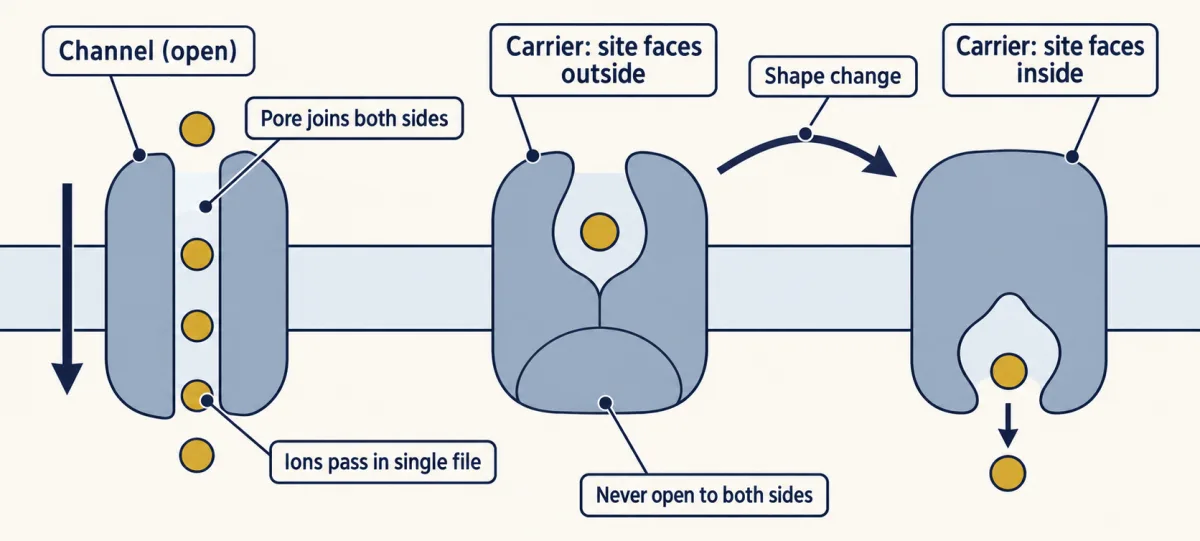
An open channel is one pathway joining both sides at once, so ions stream through. A carrier's binding site is open to one side at a time: it binds its solute on one side, changes shape and releases it on the other, which is why it is slower and can saturate. AI-generated illustration 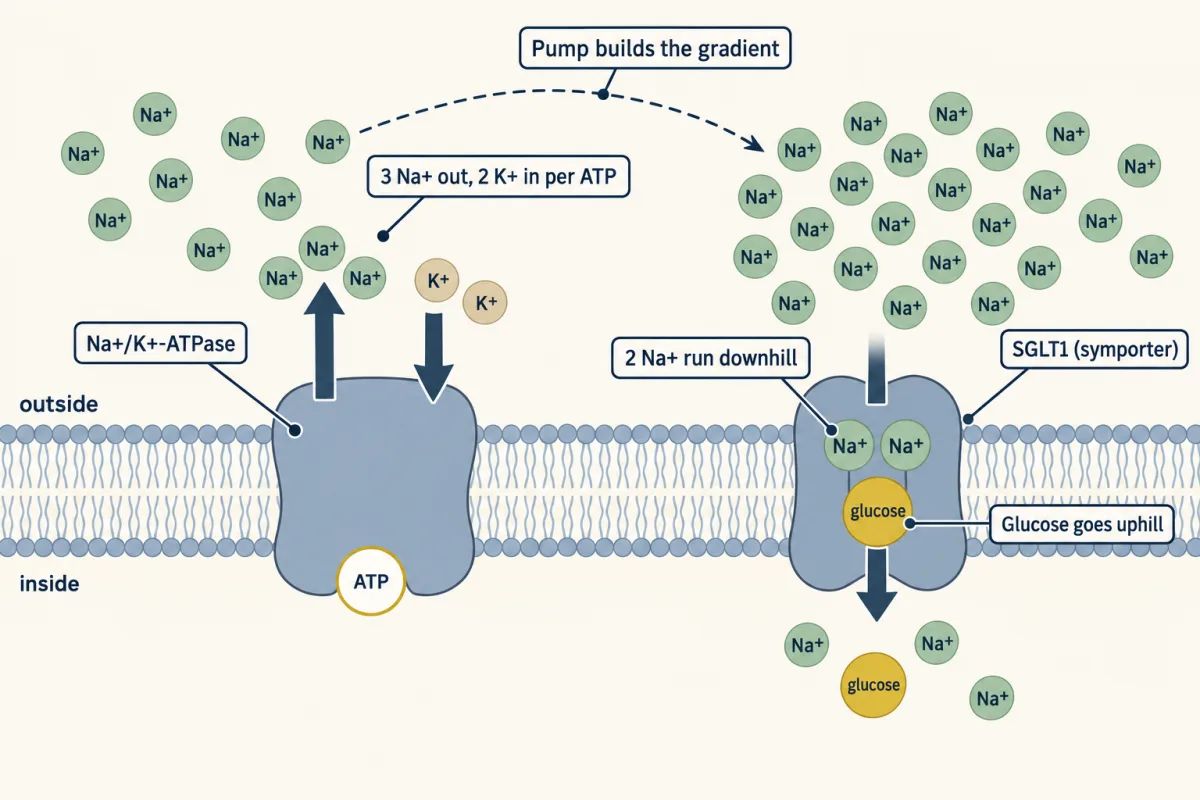
The Na+/K+-ATPase spends ATP to keep sodium high outside. SGLT1 then lets sodium run downhill into the cell, and that downhill run pays for glucose to go uphill; the pump never touches the glucose. AI-generated illustration -
Telling a channel from a carrier from the data
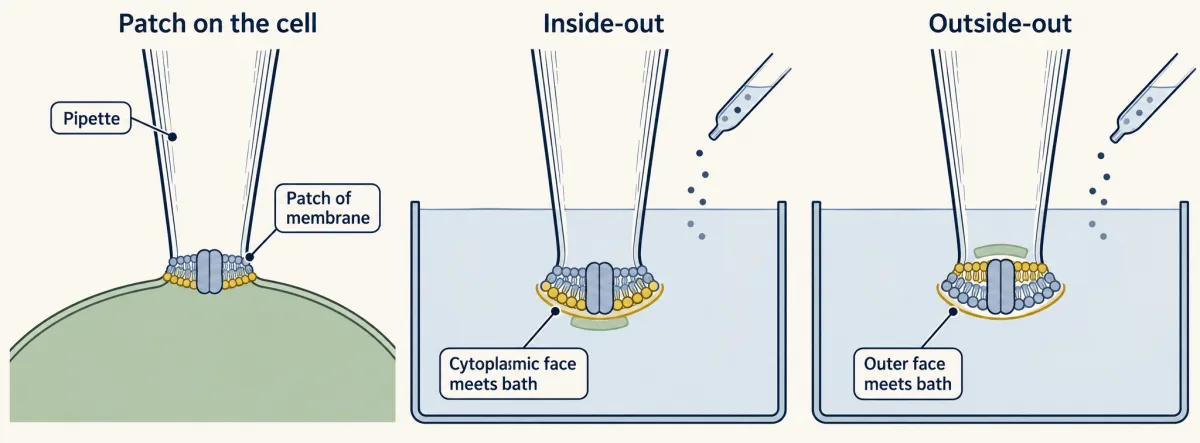
In an inside-out patch the cytoplasmic face meets the bath; in an outside-out patch the outer face does. Applying a substance that cannot cross the membrane to the bath of each shows which side it acts from. AI-generated illustration -
Going deeper
Where this lesson fits
Before thisReview first
- Membrane Organization and TopologyThis course · Lesson 4
It explains which face of each membrane protein looks into the cell, which sets the direction a pump pushes.
- Crossing the MembraneBiology · High school
It introduces diffusion, channels and carriers across the bilayer, which this lesson makes quantitative with the Nernst equation.
After thisStudy next
- Organelles as Distinct EnvironmentsThis course · Lesson 6
It uses pumps and the downhill rule to explain how each compartment holds its own ion and proton levels.
- Epithelia and Tissue OrganizationThis course · Lesson 23
It uses coupled carriers like SGLT1 and the sodium pump to explain how a cell sheet moves glucose in one direction.
- Endocytosis, Recycling and DegradationThis course · Lesson 13
Its tracer uptake and binding-versus-entry experiments reuse the flux reasoning you practiced here.
Elsewhere on the siteFilms, simulations and method films in other courses
- The length constantSimulation · Neuroscience
It shows how potassium and sodium leaks set the resting voltage from the same two pushes.
- Run the 1952 equationsSimulation · Neuroscience
It uses Nernst potentials and voltage-driven flow to explain how sodium channels carry the spike.
- A Path Is Not a PumpFilm · Biochemistry
It shows how an electrochemical gradient sets an ion's direction of flow, and why a path is not a pump.
Suggested by an AI model from the lessons themselves, then checked. How we use AI