Biochemistry · Skim version
Membranes: The Impermeable Sheet That Builds Itself
Read the full lesson → Skim the whole course →
The guiding idea
Lipids assemble on their own into a sealed, nearly impermeable sheet, and proteins in that sheet decide what crosses.
A cell membrane is a lipid bilayer that assembles itself in water and blocks almost everything charged.
From the film
- Charged solutes pay an energy toll to leave water for a bare bilayer.
- An electrochemical gradient combines concentration and voltage to set a solute's downhill direction.
- Channels and passive carriers speed downhill transport but cannot drive it uphill.
- In this lesson, uphill transport couples to ATP or another solute moving downhill.
-
The membrane and its puzzles
-
A sheet that builds itself
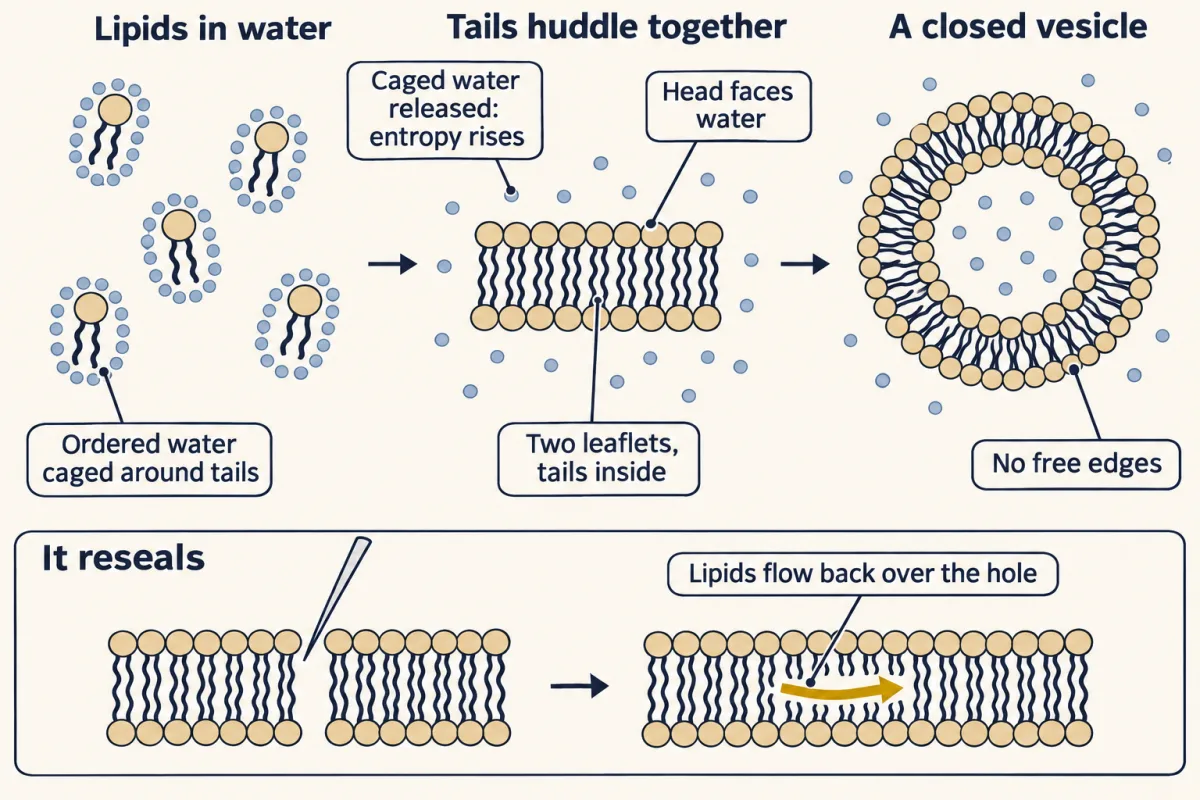
The bilayer builds itself. Water caged around lipid tails is released when the tails huddle together, so entropy rises and no ATP is needed. The sheet closes into compartments with no free edges, and because no covalent bonds hold it, a hole reseals as the lipids flow back. AI-generated illustration -
The toll for leaving water
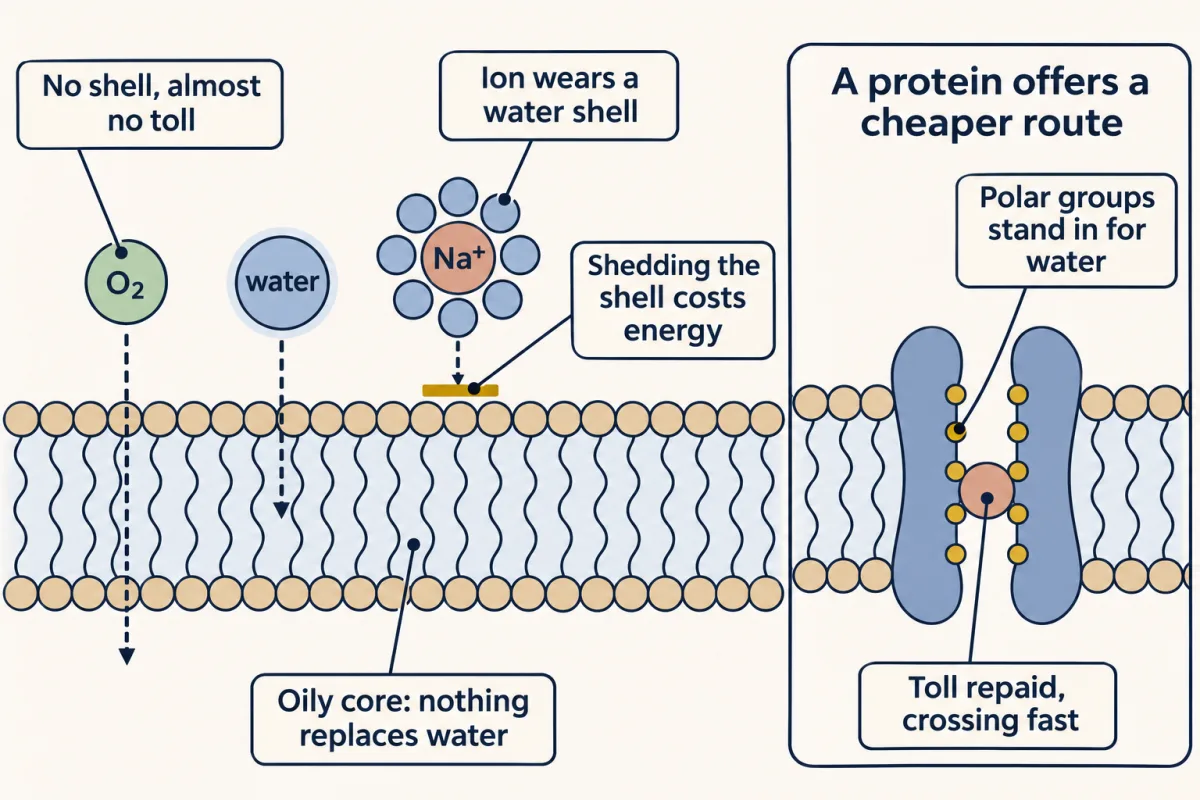
The toll for leaving water. A charged ion carries a tight shell of water, and the oily core of the bilayer offers nothing in its place, so the ion almost never crosses. Small nonpolar molecules pay almost no toll. A protein speeds the crossing by offering a path lined with polar groups that stand in for the lost water; a path alone changes how fast, not which way. AI-generated illustration -
A separate question: keeping the sheet fluid
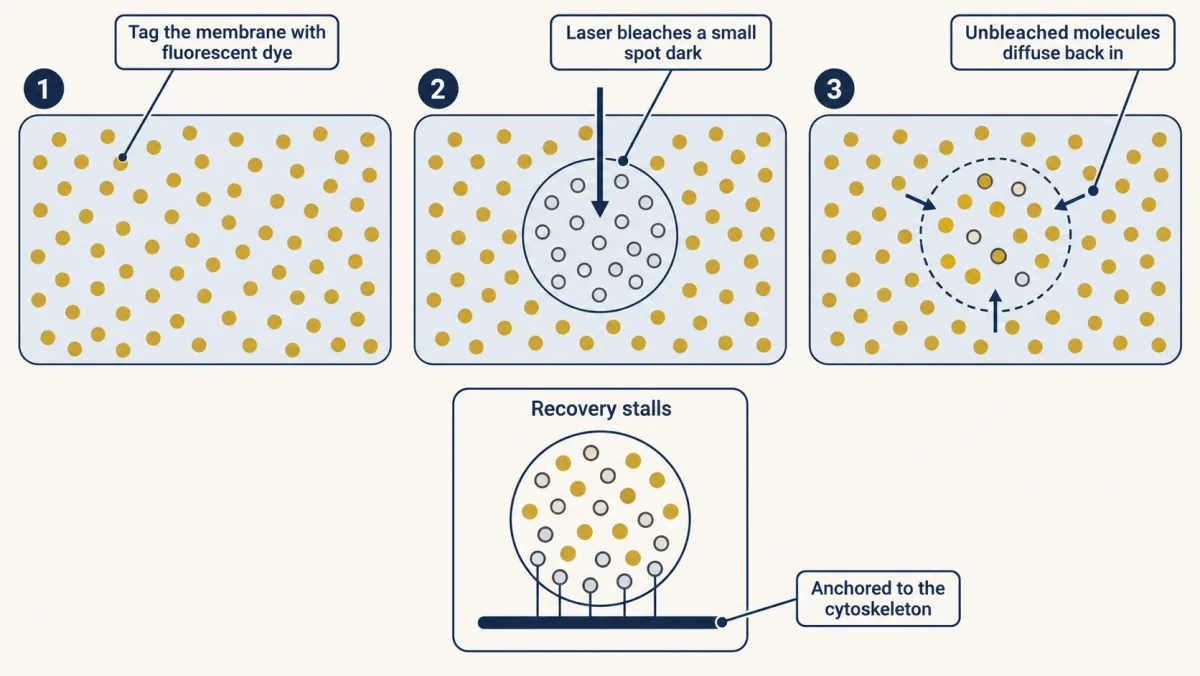
In FRAP, a laser bleaches a small spot of fluorescently labeled membrane. Unbleached mobile molecules diffuse into the spot as bleached mobile molecules diffuse out. Incomplete fluorescence recovery indicates a fraction that does not exchange during the observation period; attachment to the cytoskeleton is one possible explanation. AI-generated illustration -
Proteins in the sheet
-
Which way: the electrochemical gradient
-
Moving things across: channels, carriers and paying for uphill
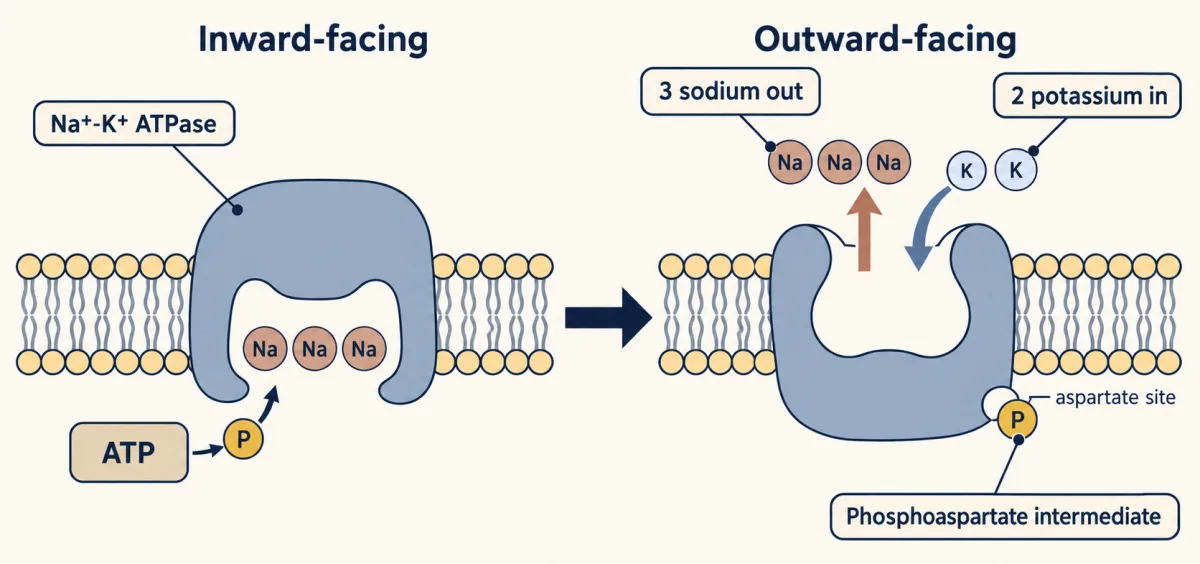
The Na⁺-K⁺ ATPase phosphorylates one of its own aspartates, and that phosphoaspartate intermediate drives the flip from inward-facing to outward-facing, ejecting 3 sodium ions and importing 2 potassium ions per ATP. AI-generated illustration 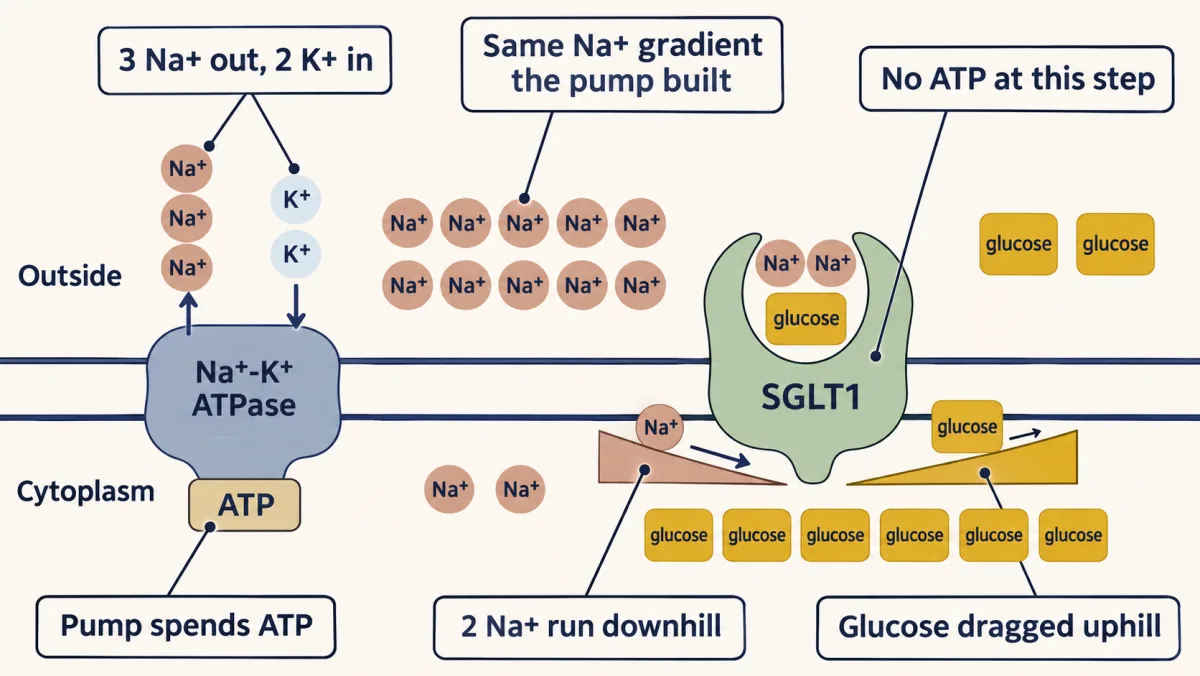
Charging and spending the sodium battery. The Na⁺-K⁺ ATPase spends ATP to keep sodium high outside. SGLT1 couples two sodium ions running downhill into the cell to one glucose moving uphill, so no ATP is spent at that step. Kill the pump and the coupled transporter stalls too. AI-generated illustration -
Lowering the toll exactly: the potassium channel filter
-
CFTR: a channel built from a pump family
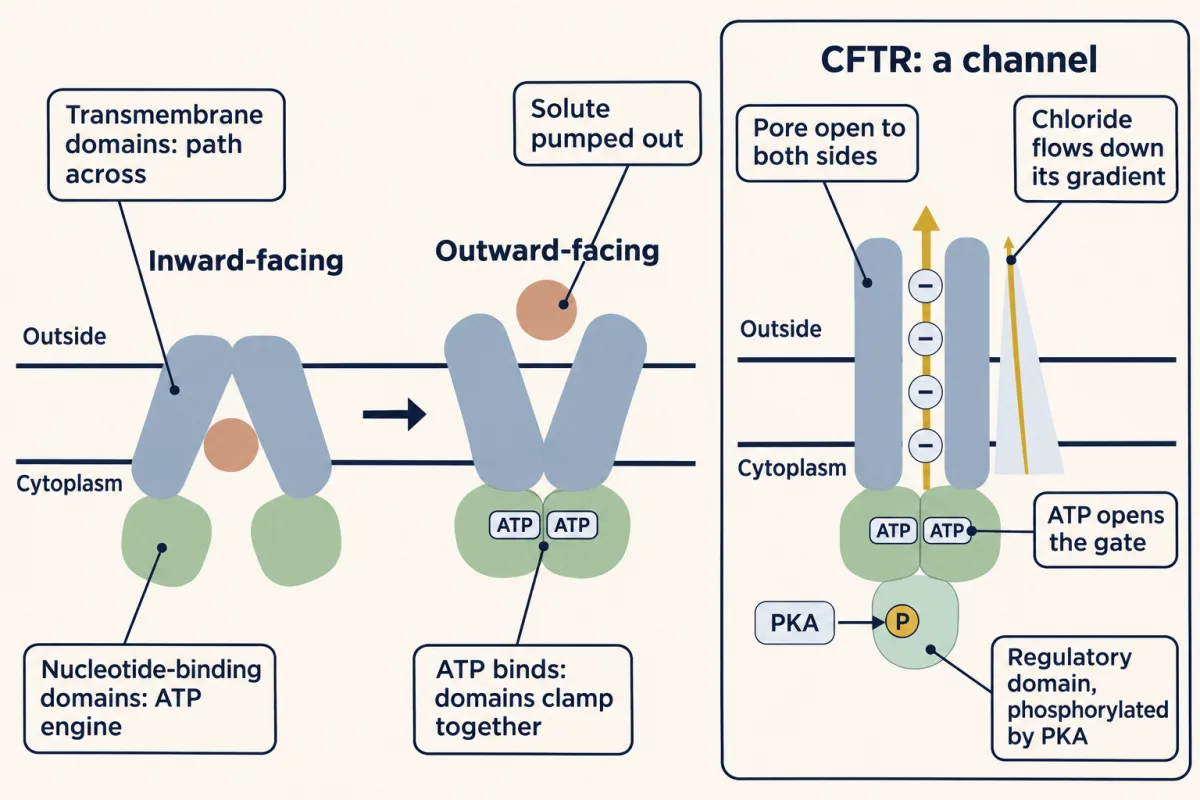
An ABC exporter has two transmembrane domains and two nucleotide-binding domains. ATP binding clamps the nucleotide-binding domains together and flips the transporter outward, pumping the solute out. CFTR shares these core domains but adds a regulatory domain: once protein kinase A phosphorylates it, ATP binding opens the gate, and chloride then flows down its own electrochemical gradient. ATP opens the gate; it does not pay for the move. AI-generated illustration -
Putting the two questions together
-
Going deeper
Where this lesson fits
Before thisReview first
- Water, Weak Bonds, and the Generation of OrderThis course · Lesson 3
The hydrophobic effect and hydrogen bonding with water explain why bilayers self-assemble and why ions pay a toll to leave water.
- Lipids: The Building Blocks That Refuse to PolymerizeThis course · Lesson 11
You need the lipid structures and the packing of saturated and unsaturated chains from there to follow bilayer assembly and fluidity.
- Protein Three-Dimensional Structure: The Sequence Sets the ShapeThis course · Lesson 5
Alpha-helices and beta-barrels as ways to bury backbone polar groups in oil are used here without being re-taught.
After thisStudy next
- Signal-Transduction Pathways: How Cells Compute With Molecular SwitchesThis course · Lesson 13
Receptors and channels in the membrane pass signals inward, using the gradients and gating set up here.
- Digestion and Absorption: Turning a Meal into Molecules Your Cells Can UseThis course · Lesson 14
Sodium-coupled glucose uptake by SGLT1 in gut cells is the secondary active transport built here.
- The Proton-Motive Force and ATP SynthaseThis course · Lesson 21
It takes the electrochemical gradient across a membrane and uses it to drive ATP synthase.
Elsewhere on the siteFilms, simulations and method films in other courses
- One channel, two numbersSimulation · Cell Biology
Its one-channel, two-numbers simulation lets you work with concentration and voltage terms that set an ion's flow direction.
- Two Pushes, One HillFilm · Cell Biology
It shows how concentration difference and membrane voltage together decide which way an ion flows.
- Downhill for FreeFilm · Biology
It shows downhill movement across a membrane without energy, which this lesson builds on for channels and carriers.
- The length constantSimulation · Neuroscience
Potassium and sodium leak currents through channels set a resting voltage, which applies the equilibrium potential idea.
Suggested by an AI model from the lessons themselves, then checked. How we use AI