Cell Biology · Skim version
Cells Control Their Size: A Measured Eukaryotic Cell
Read the full lesson → Skim the whole course →
The guiding idea
A cell has no ruler, so how does it know its size, and what does being big cost it?
Many of a cell's processes depend on concentrations, amount divided by volume, so growth dilutes anything whose amount does not keep pace.
From the film: Amount over Volume
- In a leading but debated model, budding-yeast daughters get about the same dose of the brake Whi5, so a small one must grow more to dilute it before Start, closing only part of the size gap.
- Most growing cells make RNA and protein roughly in step with their volume, so their concentrations stay about steady, and a steady concentration cannot tell a cell its size.
- Yeast held so they grow without dividing fell behind in synthesis and their cytoplasm was diluted; at such sizes one genome copy appears to become a limit.
- For a sphere, doubling the radius halves the membrane available to each unit of volume.
From the film: Where the Volume Goes
- A membrane-bound compartment's share is its volume divided by the cell's, and it belongs to one cell type: the nucleus is about 27% of a cultured hamster V79 cell but about 8% of a fission-yeast cell.
- There is no universal nuclear fraction, so every measured share should carry its cell type.
- In fission yeast the nucleus grows with the cell, so its share holds as the cell gets bigger.
- As Arabidopsis root cells lengthen, vacuolar occupancy rises from about 30 to 40% of the cell to 80 to 90%, so most added cell volume is vacuolar, with comparatively little added cytosol.
- For the core parts compared here, animal, plant and fungal cells differ in walls, plastids and vacuoles; a root cell deep in soil usually has other plastids but no chloroplasts.
-
Reading size: the brake that growth dilutes
-
Keeping pace: RNA and protein
-
What can fall behind: the genome
-
What falls behind: the surface
-
Where the volume goes: compartments and their shares
-
Plants add volume mostly as vacuole, not cytoplasm
-
Same parts, different shares
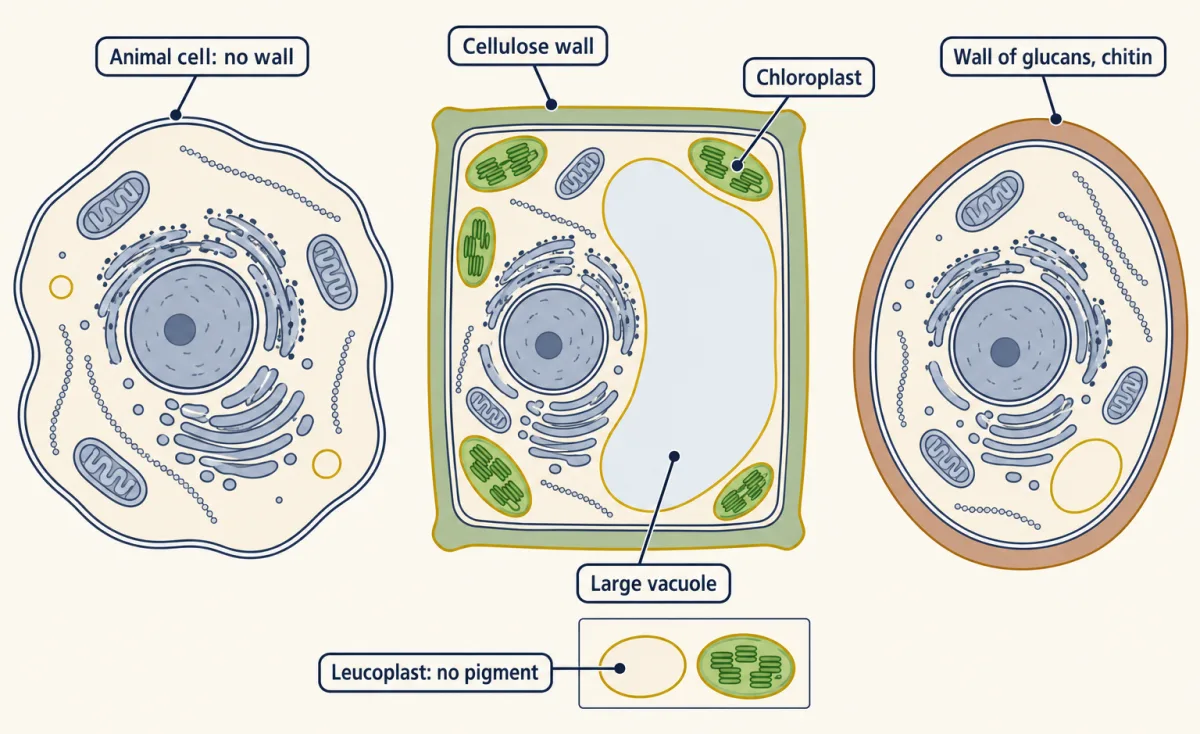
Animal, plant and fungal cells share a plasma membrane, nucleus, ER, Golgi, mitochondria and cytoskeleton. The slips are in the wall, the plastids and the vacuole, and a root cell is usually a plant cell with no chloroplasts. AI-generated illustration -
Going deeper
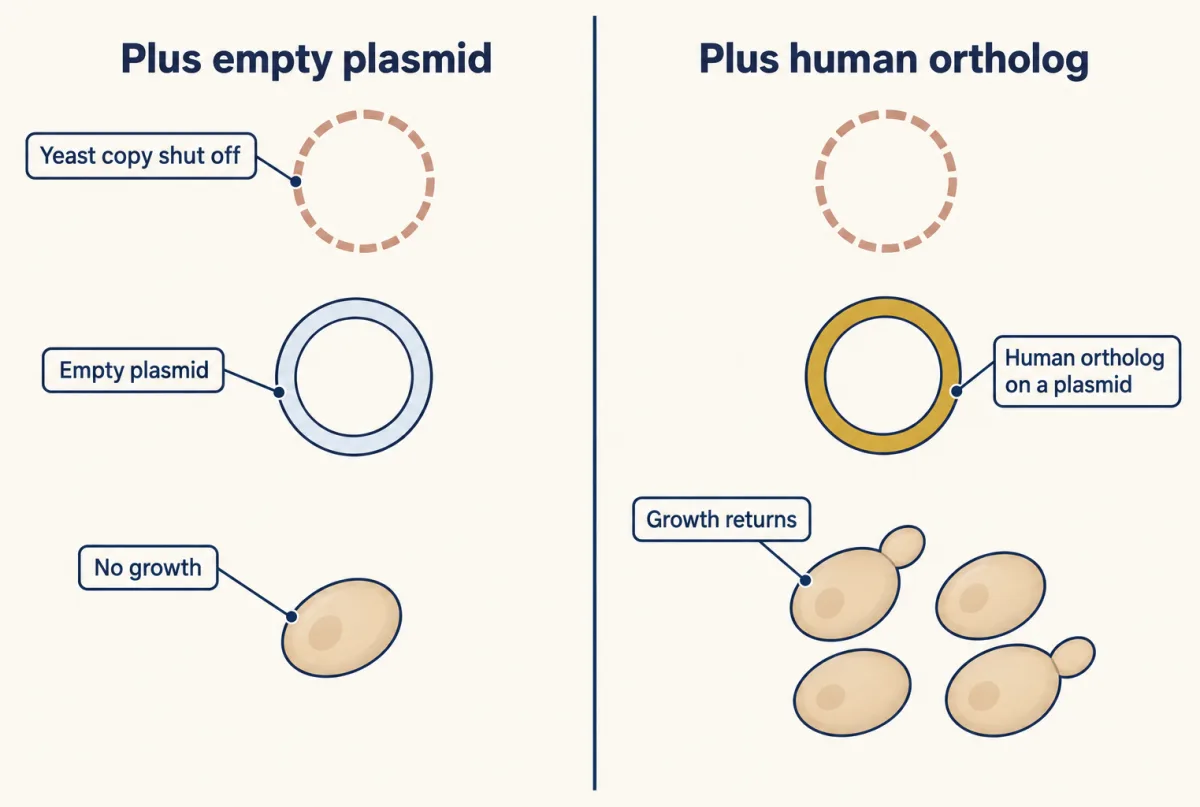
With the yeast copy of an essential gene shut off, cells with an empty plasmid cannot grow, while cells given the human ortholog can. Growth rescue shows a conserved function; failure alone does not say why. AI-generated illustration
Where this lesson fits
Before thisReview first
- Size, Scale and SurfaceOrganismal Biology · Starting college
You need surface-to-volume reasoning for whole organisms from there before applying it to a single cell here.
- The Cell Cycle and MitosisBiology · High school
This lesson assumes you know G1, S, G2 and M, which are set out there.
- Organelles as a SystemBiology · High school
You need the main organelles and what each does there before comparing their volume shares here.
After thisStudy next
- Microscopy and Quantitative ImagesThis course · Lesson 2
It shows how cell and organelle volumes like the V79 numbers here are actually measured from images.
- Cyclin-CDK Control of the Cell CycleThis course · Lesson 17
It takes the Start and restriction-point decision further, with cyclin-CDK and Rb as the mammalian counterpart of Whi5.
- Experiments That Distinguish MechanismsThis course · Lesson 3
Its logic of separating mechanisms applies to the DNA-versus-cell-size nucleus experiment designed here.
Elsewhere on the siteFilms, simulations and method films in other courses
- A Water Balloon in a BoxFilm · Life Science
It compares plant and animal cell parts, including the big vacuole and wall that this lesson's share comparison uses.
Suggested by an AI model from the lessons themselves, then checked. How we use AI