Genetics and Molecular Biology · Skim version
Linkage and Recombination Mapping
Read the full lesson → Skim the whole course →
The guiding idea
Independent assortment predicts four equal test-cross classes. Why do two classes dominate?
For short intervals, recombination frequency estimates map distance; over long intervals, hidden crossovers make it underestimate distance.
From the film: When Four Classes Refuse to Be Equal
- For short intervals, recombination frequency estimates map distance.
- A test cross makes the double heterozygote's four gamete classes visible in its offspring.
- Phase, not class size, defines which combinations are parental and recombinant.
- A crossover between two loci can separate their alleles into new combinations.
From the film: Why the Map Outgrows the Count
- Over long intervals, hidden crossovers make recombination frequency underestimate distance.
- A two-point count records the final allele combination, not the number of crossovers.
- Recombination frequency approaches 50%, so distant linked loci can look unlinked.
- Map distances add across short intervals; raw recombination frequencies do not.
-
Read the four classes before counting them
-
Crossing over makes recombinants
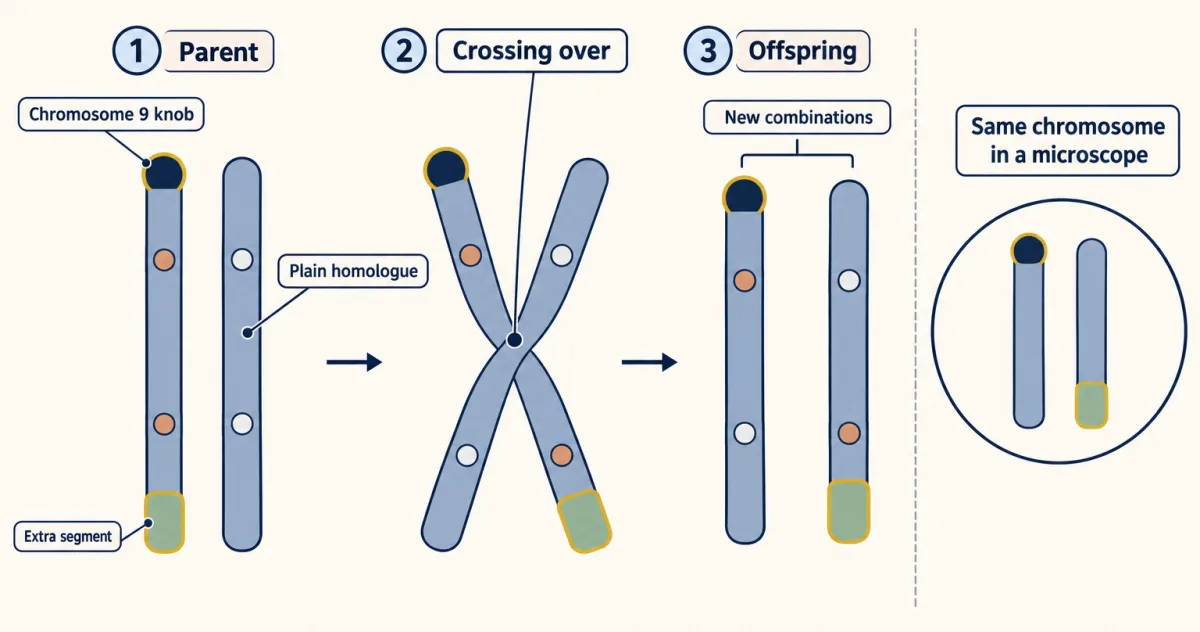
Recombinant genes travelled with recombinant chromosome landmarks, showing that crossing over physically exchanges chromosome parts. AI-generated illustration -
Sturtevant’s map: frequency as distance
-
The 50% ceiling, and what a mapping function corrects
-
Going deeper
Where this lesson fits
Before thisReview first
- Mendel's Peas: Segregation and Independent AssortmentThis course · Lesson 1
You need independent assortment and the 1:1:1:1 test-cross ratio from there, since linkage is a failure of that rule.
- Chromosomes and Meiosis: The Physical Basis of Mendel's LawsThis course · Lesson 2
You need homologue pairing, chromatids and chiasmata from there to see how crossing over makes recombinant gametes.
- Probability, Crosses and the Chi-Square TestThis course · Lesson 3
The chi-square test from there is used here to show the excess of parental classes is not chance.
After thisStudy next
- Three-Point Crosses: Gene Order and Double CrossoversThis course · Lesson 9
A third marker catches the double crossovers that a two-point count hides, putting genes in order.
- Bacterial and Phage Genetics: Conjugation, Transduction and TransformationThis course · Lesson 11
Mapping by timing or co-transfer extends the idea of distance from recombination to organisms without meiosis.
- Complementation and Gene Function: From Beadle and Tatum to BenzerThis course · Lesson 10
Once mutations are placed on the map, complementation tests whether they hit the same gene.
Elsewhere on the siteFilms, simulations and method films in other courses
- Homologs First, Sister Chromatids SecondFilm · Biology
It shows how meiosis shuffles chromosomes, including crossing over that makes recombinant gametes.
Suggested by an AI model from the lessons themselves, then checked. How we use AI