Biochemistry · Skim version
Photosynthesis: The Light Reactions
Read the full lesson → Skim the whole course →
The guiding idea
Two photon-driven uphill boosts, wired so water splits, oxygen leaves, and NADPH and ATP get made.
The light reactions use two photosystems in series to move electrons from water to NADP+, releasing oxygen, building a proton gradient that makes ATP, and making NADPH.
From the film
- In linear flow, each electron needs two light-driven lifts from water to NADP+.
- Fast downhill steps stabilize charge separation but spend much of each photon's energy.
- Water splitting and cytochrome b6f load protons into the lumen.
- The lumen proton gradient powers ATP synthase.
-
Where it happens: a captured bacterium
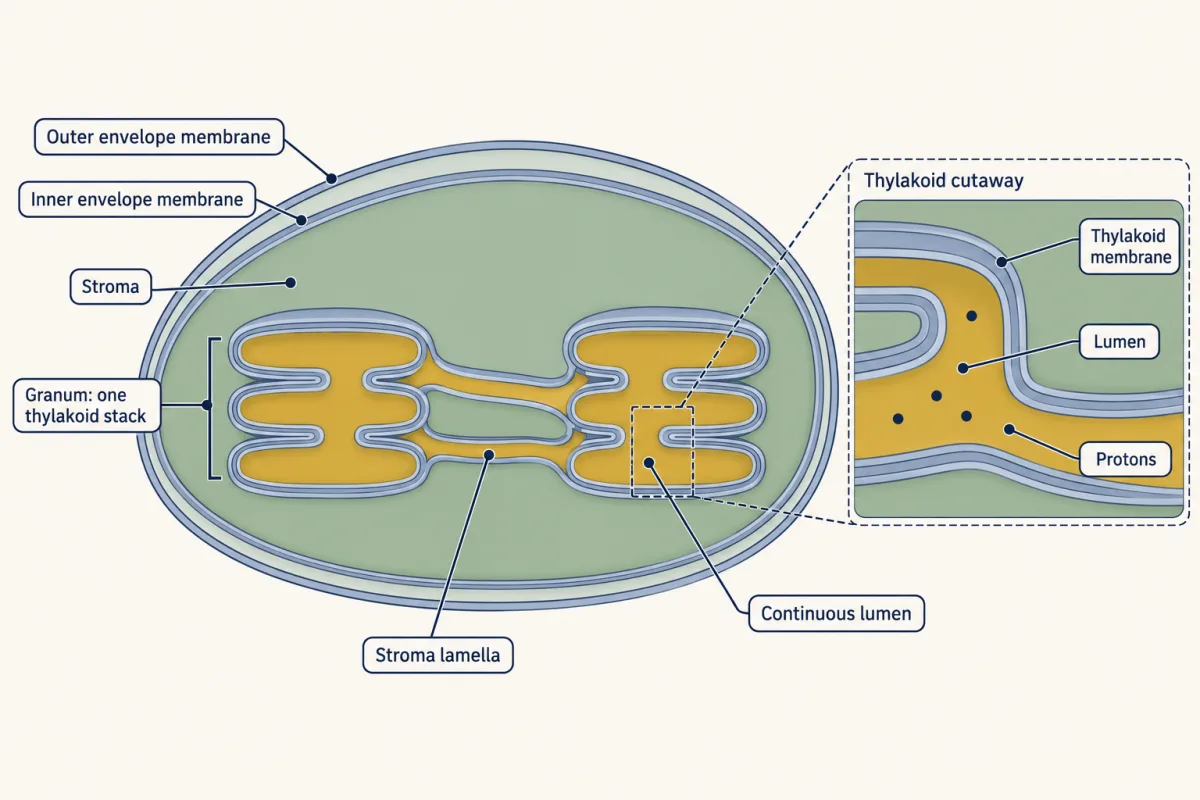
Inside the chloroplast, the stroma surrounds stacks of thylakoid sacs called grana; the protons from the light reactions end up in the lumen, inside the sacs. AI-generated illustration -
What a photon can do
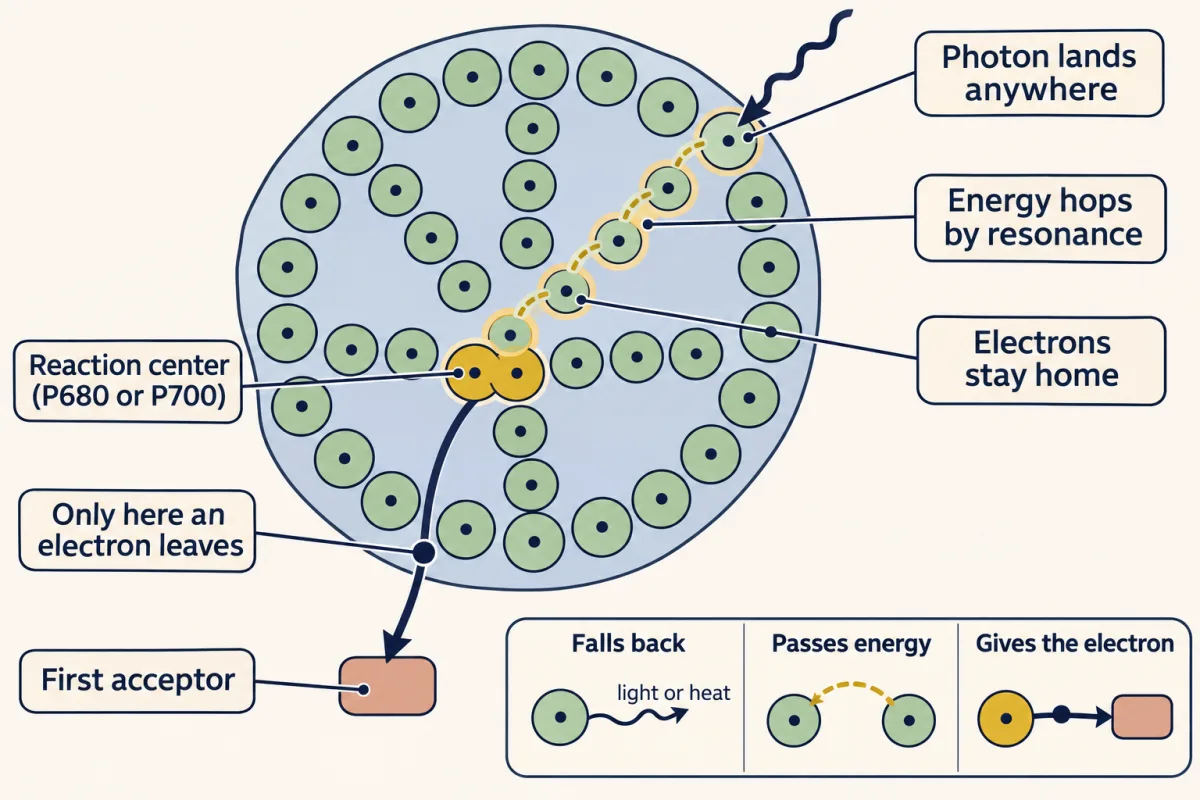
In the antenna, energy hops pigment to pigment by resonance and no electron moves. Only at the reaction center does the photon's energy lift an electron out to an acceptor: one photon, one electron, the step the whole lesson counts. AI-generated illustration -
Why two lifts
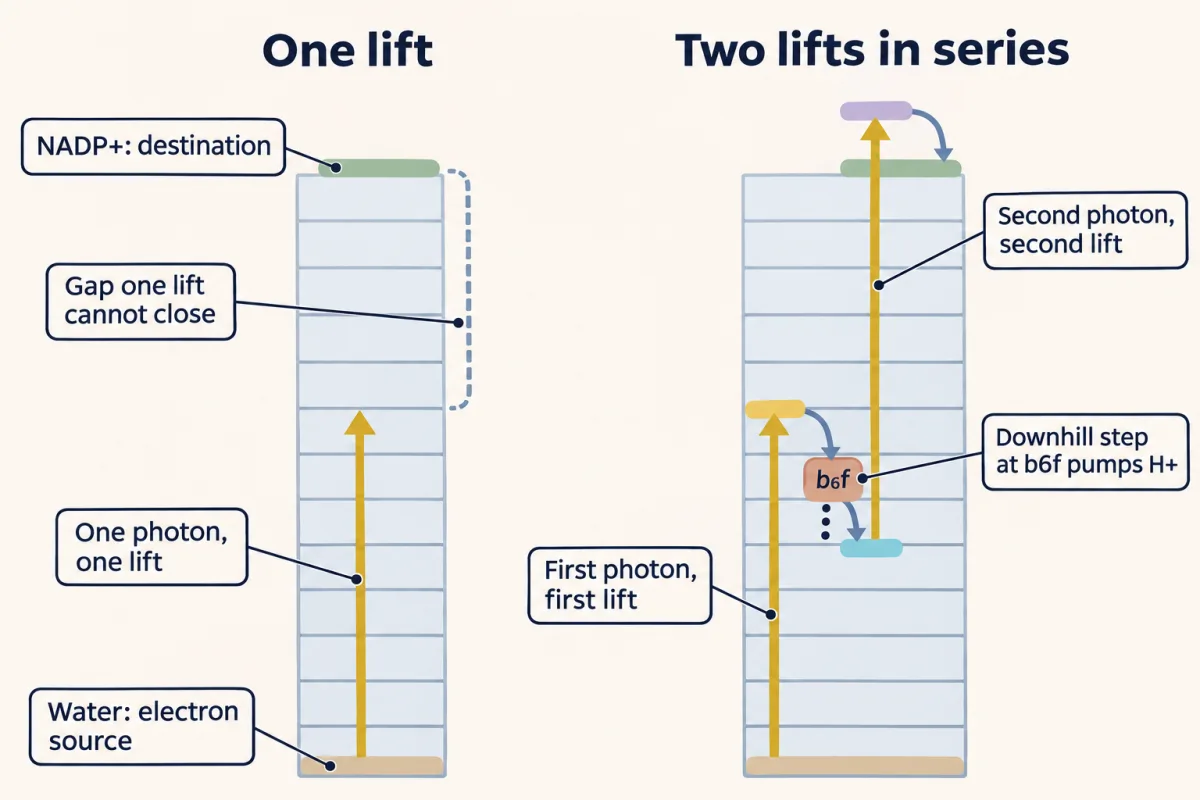
One photon lifts one electron, but each lift keeps only about 0.7 to 0.8 V of the 1.14 V climb from water to NADP⁺. Two lifts in series, joined by a downhill step at cytochrome b6f that pumps protons, carry every electron the whole way. AI-generated illustration -
Walking the Z
-
The tally: protons, ATP and the shortfall
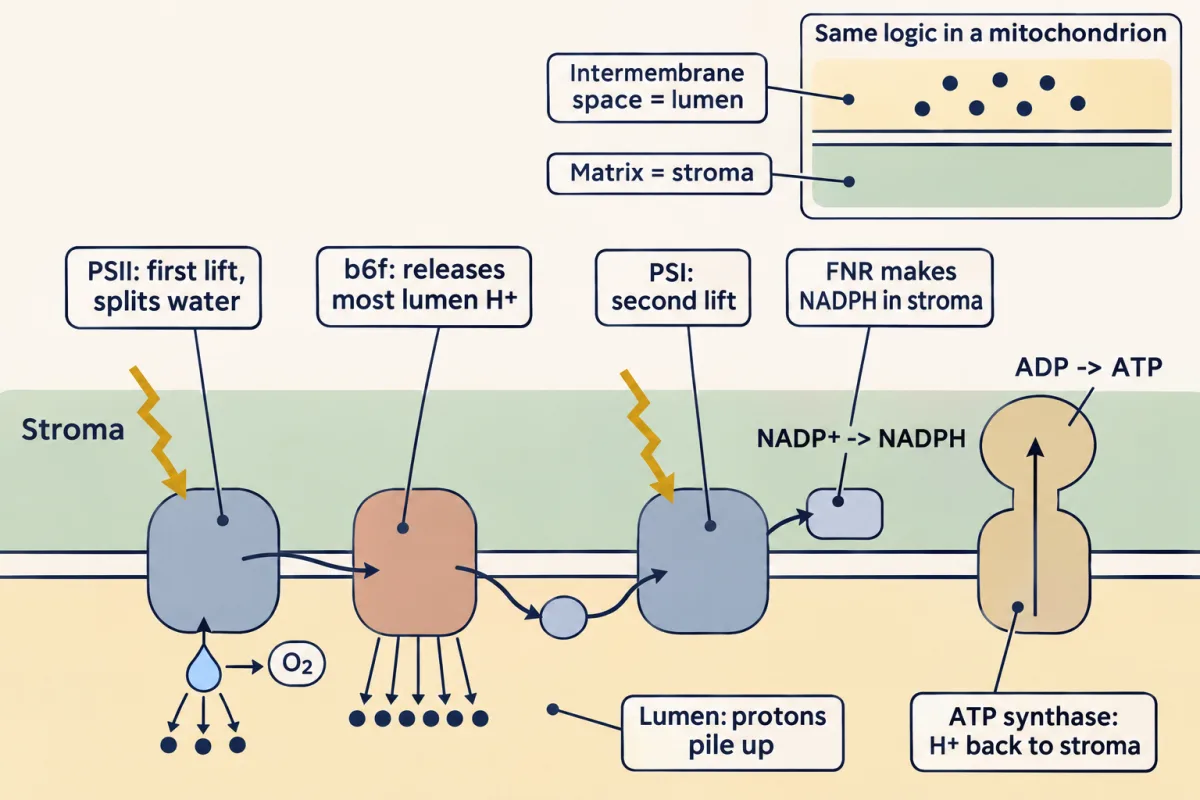
The two lifts happen at PSII and PSI; the protons come from two places, split water at PSII and, mostly, cytochrome b6f. They pile up in the lumen and return to the stroma through ATP synthase, while NADPH is made on the stromal side where the Calvin cycle waits. AI-generated illustration -
What comes next
-
Going deeper
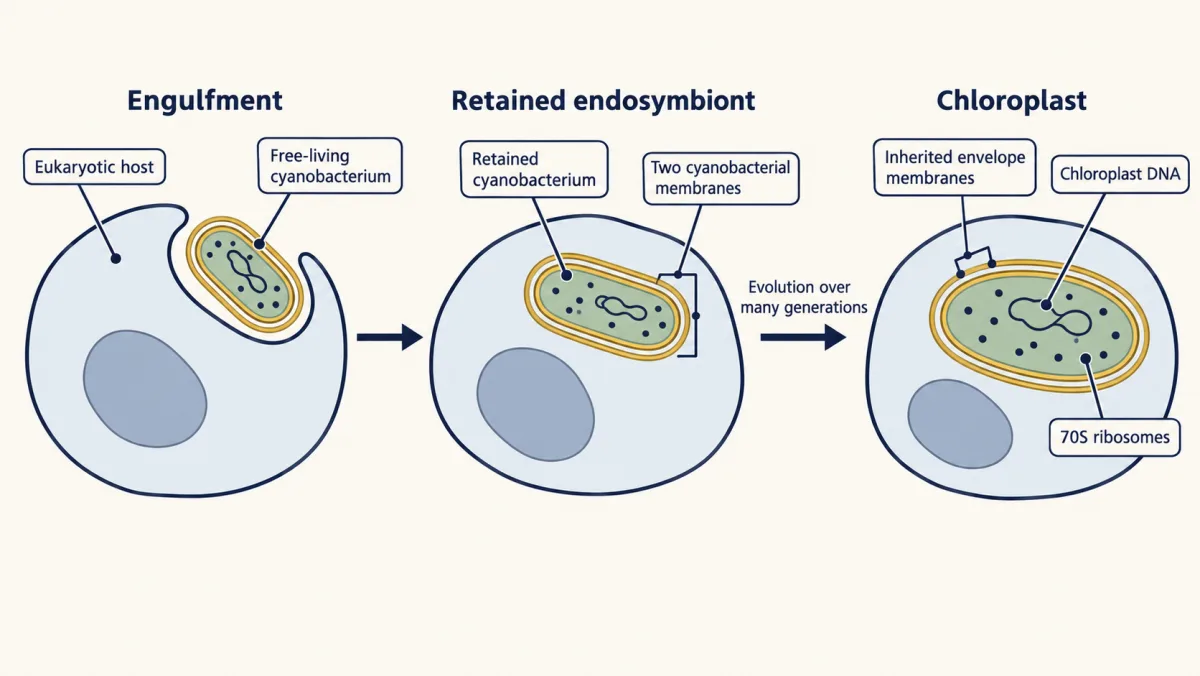
A eukaryotic cell engulfed a free-living cyanobacterium and never digested it, which is why the chloroplast has two membranes, its own DNA and bacterial-style 70S ribosomes. AI-generated illustration
Where this lesson fits
Before thisReview first
- Oxidative Phosphorylation: The Electron-Transport ChainThis course · Lesson 20
The Z-scheme reverses the electron-transport chain you met there, and the Q-cycle in cytochrome b6f is the one from Complex III.
- Metabolism: Basic Concepts and DesignThis course · Lesson 15
Reduction potentials, ΔG from ΔE and NADPH and ATP as energy currencies are used here without being re-taught.
After thisStudy next
- The Calvin Cycle: Fixing Carbon from Thin AirThis course · Lesson 23
It spends the ATP and NADPH made here in the stroma to fix carbon into sugar.
- The Pentose Phosphate Pathway: NADPH and Five-Carbon SugarsThis course · Lesson 24
It makes the same NADPH, here from sugar, which the light reactions make from light.
- Integration of Metabolism: How the Body Switches FuelsThis course · Lesson 30
It shows how the body balances ATP and NADPH supply against demand, much as cyclic flow balances the chloroplast's ratio.
Elsewhere on the siteFilms, simulations and method films in other courses
- Leaf-disk float raceSimulation · Biology
It shows how light energy is captured and carbon dioxide and water become glucose and oxygen.
- A Tree Made of AirFilm · Biology
It follows the atoms of photosynthesis and shows where the light energy goes.
- Two Jobs in One Green CellFilm · Life Science
It shows chloroplasts adding oxygen in light, the oxygen released by water splitting here.
Suggested by an AI model from the lessons themselves, then checked. How we use AI