Biology · Skim version
Homeostasis in Action
Read the full lesson → Skim the whole course →
The guiding idea
Why does your heart speed up when you run up the stairs, and then slow down again over the next few minutes?
When internal conditions drift, opposing responses move them toward their range.
From the film: When the Body Pushes Back
- When internal conditions drift, opposing responses move them toward their range.
- Homeostasis keeps internal conditions within a range, not at one fixed value.
- A negative feedback loop can be mapped as change, sensor, control center, effector and opposing response.
- Sweat cools the skin as it evaporates; without evaporation, it removes less heat.
From the film: Four Ways to Hold Steady
- Same goal, different routes: only some are complete feedback loops.
- Exercise control combines advance commands from the brain with feedback from sensors.
- Narrower stomata slow both water loss and carbon dioxide entry.
- Hydrotropism supports water supply but is not usually called a complete feedback loop.
- Selective membranes use passive and active transport to keep a cell's inside different from the outside.
-
Test the model in a simulation
-
Name the parts of negative feedback
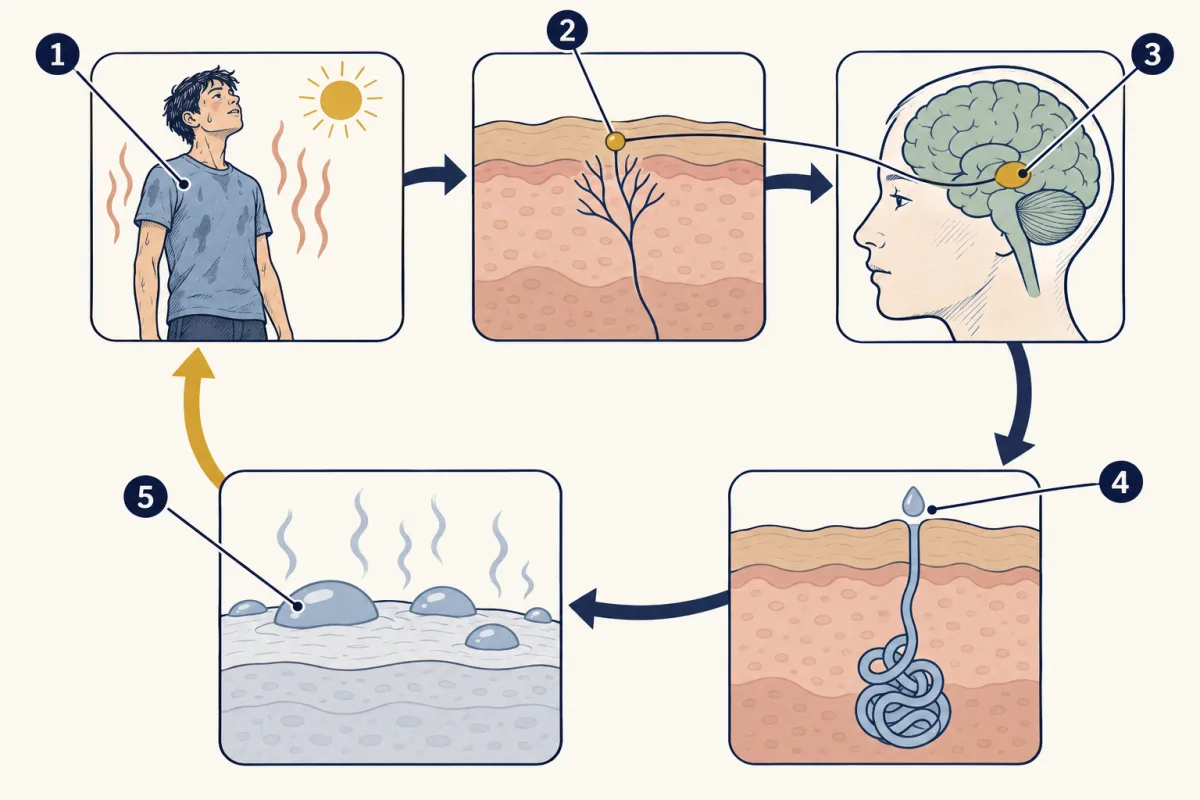
- body warms
- temperature sensors in skin and brain
- control center in the brain
- sweat glands
- skin cools
-
What the four pictures leave out
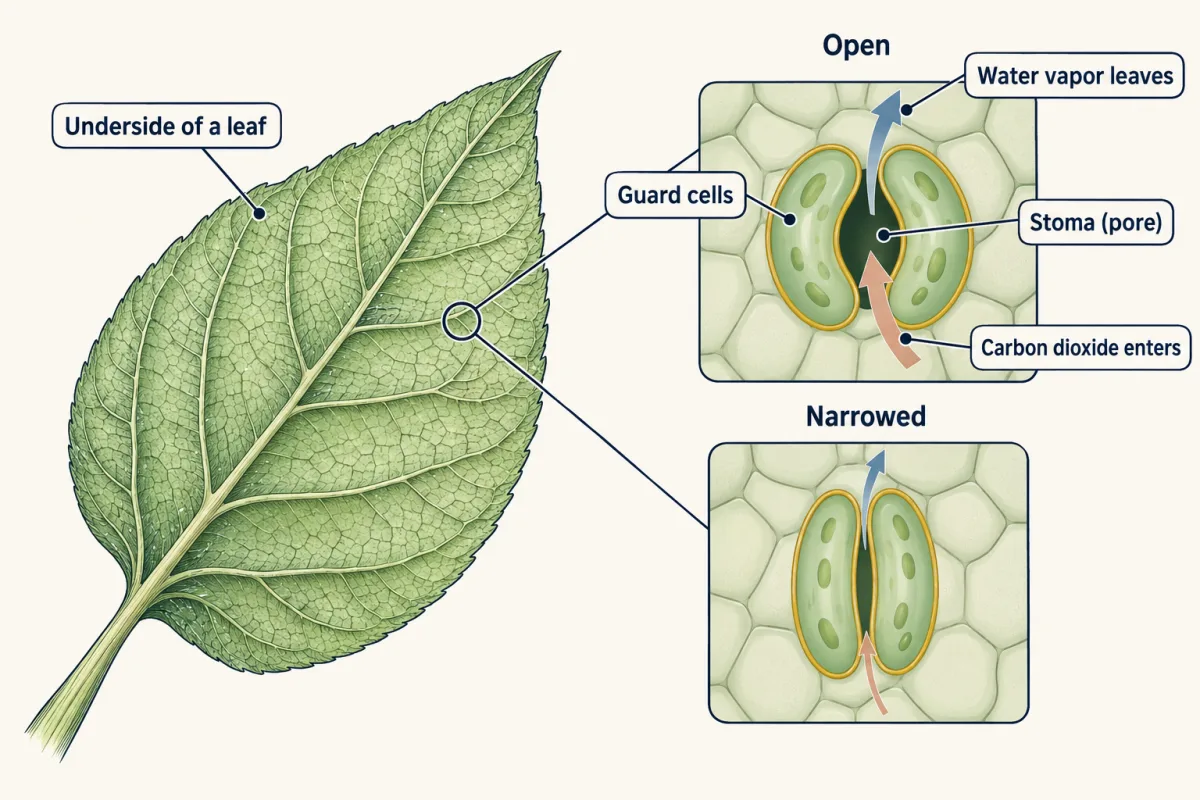
Each stoma sits between two guard cells. When dry air makes them narrow the pore, the leaf loses water vapor more slowly, and less carbon dioxide gets in. AI-generated illustration 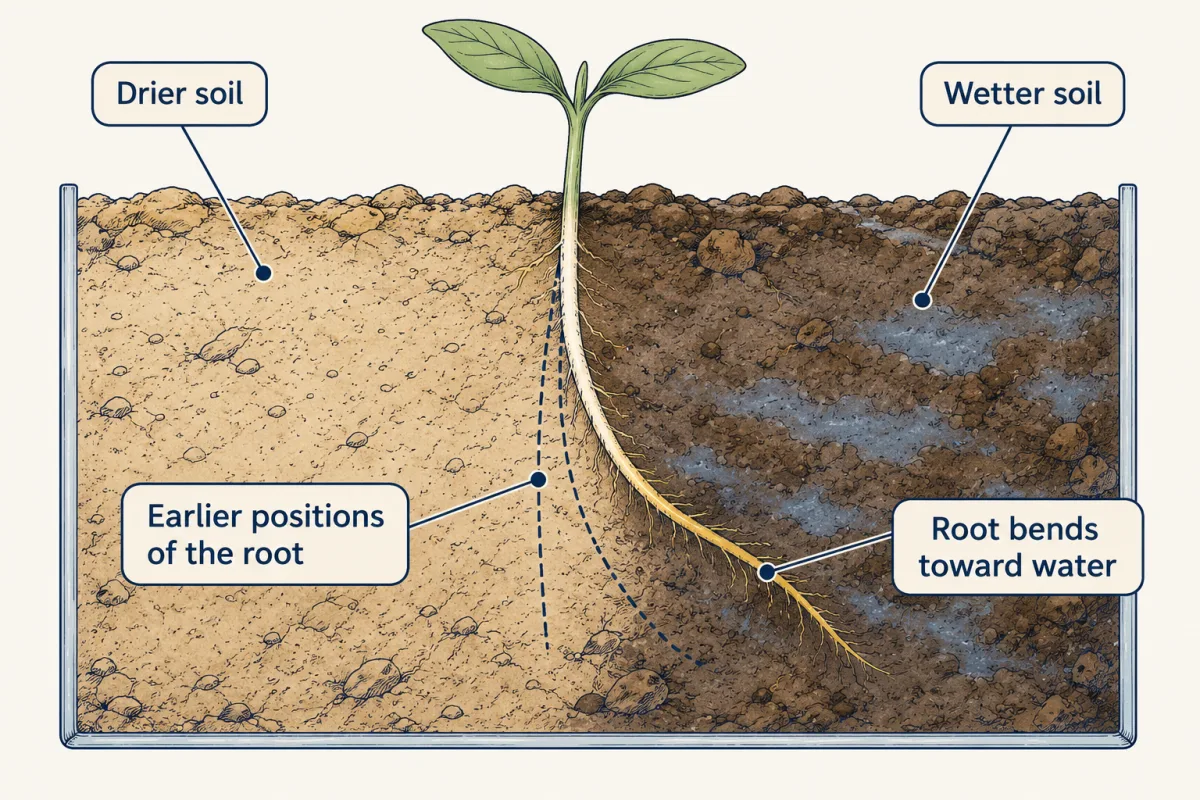
Hydrotropism: a root grows toward wetter soil. It changes the direction of growth, and biologists usually call it a response rather than a complete feedback loop. AI-generated illustration -
Read the evidence: how fast does heart rate come back?
-
Evaluate: check your thinking
Where this lesson fits
Before thisReview first
- Crossing the MembraneThis course · Lesson 8
You use passive and active transport there to see how a membrane keeps a cell's inside steady.
- Diffusion and OsmosisLife Science · Grade 7
It shows how substances move across a membrane, which the cell-membrane part here builds on.
After thisStudy next
- Populations and Carrying CapacityThis course · Lesson 29
Limits that push a population back toward a level work as feedback, like the loops here.
- Tissues, Organs and HomeostasisOne level up · Organismal Biology
It takes the feedback loop further with tissues, organs and a control loop for body temperature.
Elsewhere on the siteFilms, simulations and method films in other courses
- Adding up a reflexSimulation · Organismal Biology
The reflex route of receptor, centre and effector matches the sensor, control center and effector parts of a loop.
- Pulled From the TopFilm · Organismal Biology
It shows how leaf pores trade water loss against carbon dioxide entry, as in the stomata example.
Suggested by an AI model from the lessons themselves, then checked. How we use AI