Neuroscience · Skim version
Hearing and Balance
Read the full lesson → Skim the whole course →
The guiding idea
The same kind of cell tells you that a violin is playing an A and that your head is turning left. How does one cell type do both jobs?
A hair cell reports which way, and how far, its bundle is pushed; pitch, direction and head motion differ mainly in the mechanics in front of the cell and the circuits behind it.
From the film: One Cell, One Switch
- A hair cell reports which way, and how far, its bundle is pushed.
- Pushing the bundle toward its tallest stereocilia opens more channels and depolarizes the cell, and pushing it the other way closes channels and hyperpolarizes it.
- K+ is driven in at the top from the positive, potassium-rich endolymph and leaves at the base, and the cochlea's wall, not the cell, supplies the battery.
- Depolarization opens Ca2+ channels at the base, and Ca2+ entry drives transmitter release onto the nerve fibre.
From the film: Pitch Becomes Place
- Each place on the basilar membrane has its own natural frequency, high near the stiff base and low near the floppy apex, so frequency becomes position.
- The brain reads pitch mainly from where the active cells are.
- Outer hair cells use prestin to change length and add energy near the wave's peak, sharpening tuning and raising sensitivity most for quiet sounds.
From the film: Turning Heads, Steady Eyes
- Semicircular canals signal head rotation, roughly its velocity during everyday movements, and canals on opposite sides work as a pair, so a turn excites one and inhibits the other.
- In the vestibulo-ocular reflex, a left head turn drives both eyes to the right, keeping the eyes still in the world.
- Damage to one labyrinth unbalances the pair, so the brain reads a turn while the head is still, which is one mechanism of vertigo.
- Otolith organs alone cannot tell tilt from straight-line acceleration, and the brain uses the canals to help.
-
One cell, four puzzles
-
The hair bundle: force to current
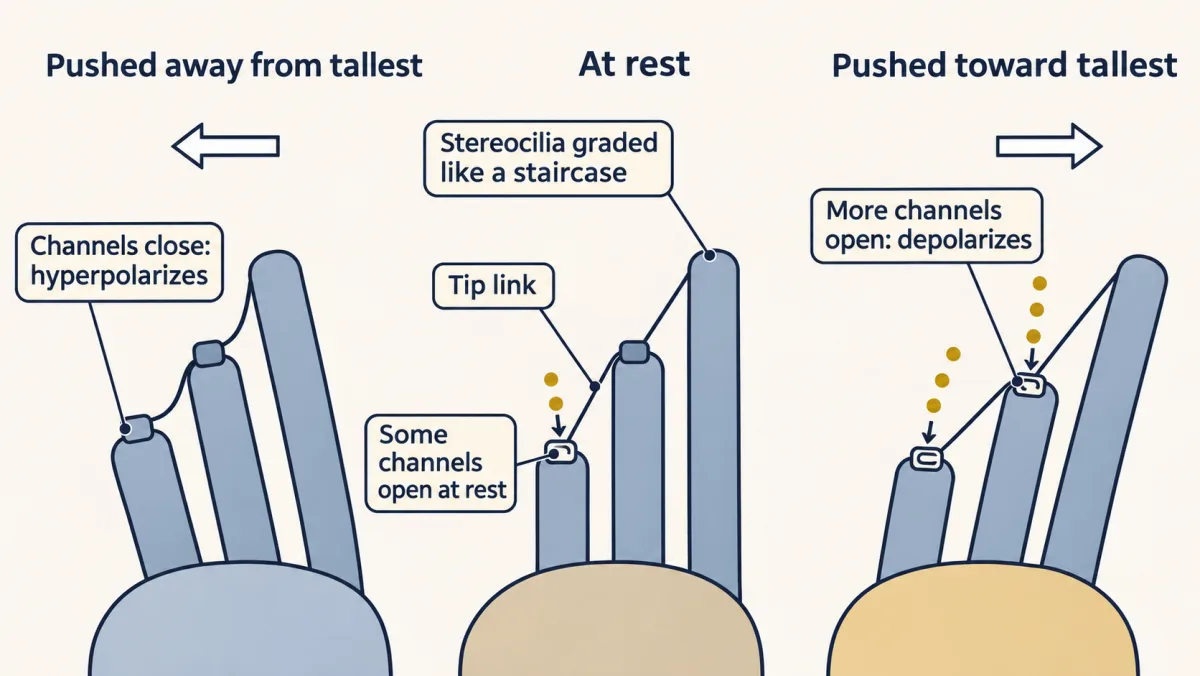
Because some channels are open at rest, pushing the bundle toward its tallest stereocilia opens more and depolarizes the cell, and pushing it the other way closes them and hyperpolarizes it. AI-generated illustration 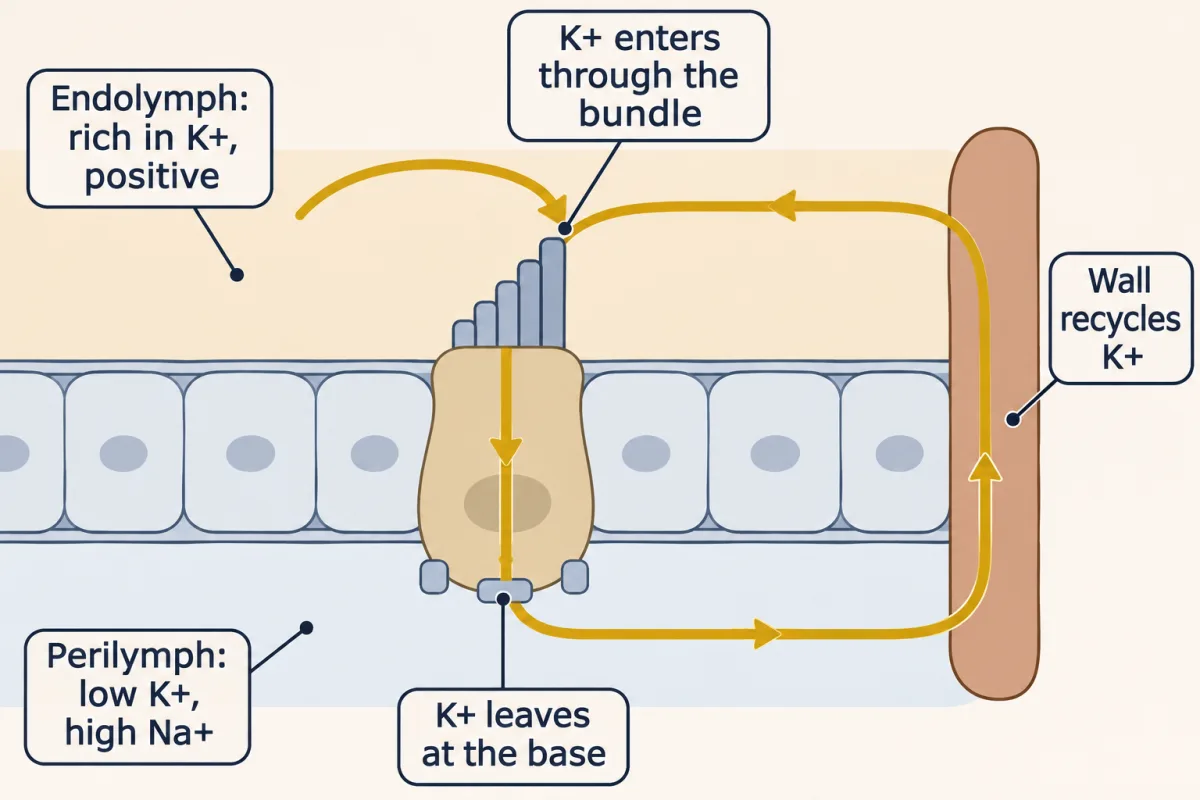
K+ runs downhill the whole way, in through the bundle from the positive, potassium-rich endolymph and out at the base into perilymph, and the cochlea's wall, not the hair cell, recycles it. AI-generated illustration -
The cochlea as a frequency map, and its amplifier
-
Two ears, two cues
-
Canals, otoliths and the VOR
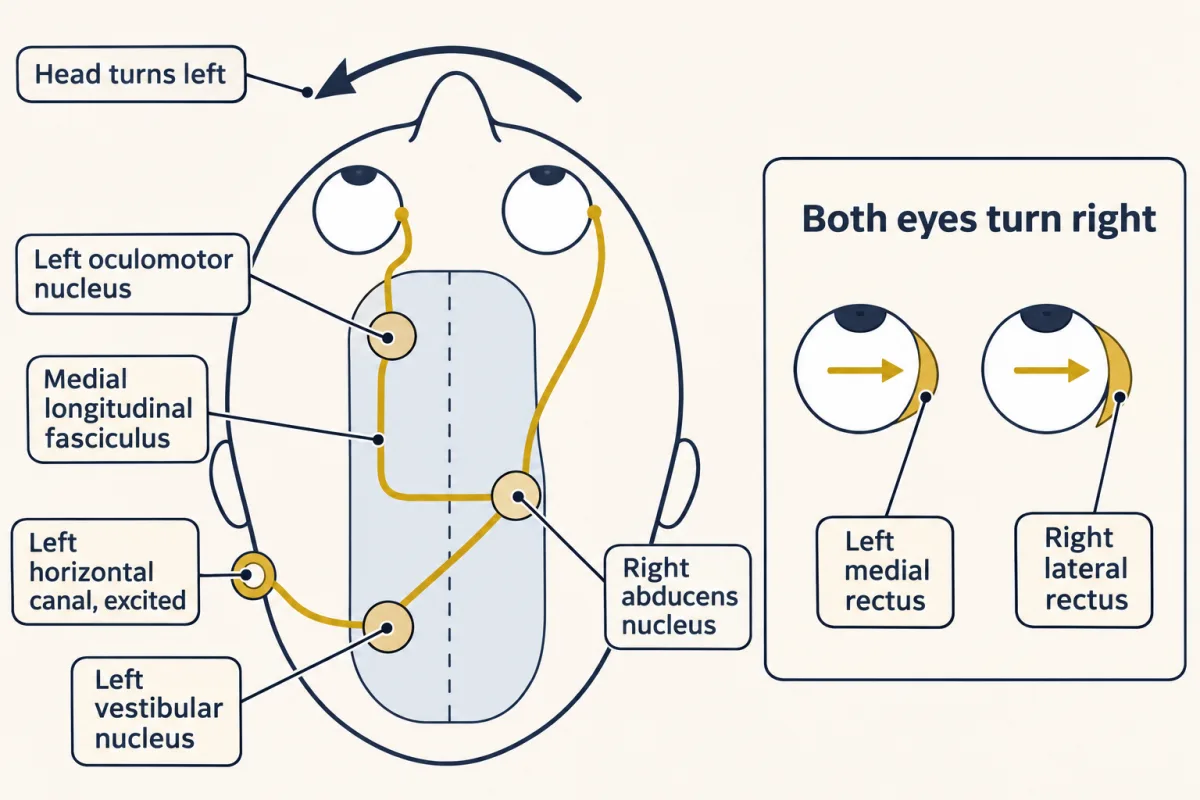
When the head turns left, the excited left canal drives the right abducens nucleus and, through the medial longitudinal fasciculus, the left oculomotor nucleus, so both eyes turn right and stay still in the world. AI-generated illustration -
Back to the opening question
-
Design problem
-
Going deeper
Where this lesson fits
Before thisReview first
- The Resting Membrane and Passive SignalsThis course · Lesson 3
You need driving force, g × (V − E) and equilibrium potentials from there to work out the K+ currents in the hair cell.
- Synaptic Transmission and Quantal ReleaseThis course · Lesson 5
Ca2+-triggered transmitter release at the hair cell's ribbon synapse uses the release machinery taught there.
- Principles of Sensory CodingThis course · Lesson 9
Receptor potentials and how firing rate and place carry stimulus information are used here without being re-taught.
After thisStudy next
- Motor Units, Reflexes and LocomotionThis course · Lesson 15
The vestibulo-ocular reflex is a reflex arc, and this lesson's canal-to-eye-muscle path is built on that reflex logic.
- The CerebellumThis course · Lesson 17
The cerebellum corrects the gain of the vestibulo-ocular reflex, and it adapts it, as prism adaptation shows.
- The Hair Cell's Transduction ChannelOne level up · Sensory Systems
It takes the tip-link and channel story further, asking what must be shown before TMC1 counts as the pore.
Elsewhere on the siteFilms, simulations and method films in other courses
- Prestin's charge and the capacitance bellSimulation · Sensory Systems
It explores the prestin-driven outer-hair-cell gain that sharpens tuning near the wave's peak.
- Report It TwiceFilm · Sensory Systems
It shows how canals and otoliths report head movement on two channels.
- A Gain That Death ErasesFilm · Sensory Systems
It shows that the living cochlea's gain depends on outer hair cells.
Suggested by an AI model from the lessons themselves, then checked. How we use AI