Report It Twice
Read the transcript of “Report It Twice”
Film transcript: Report It Twice
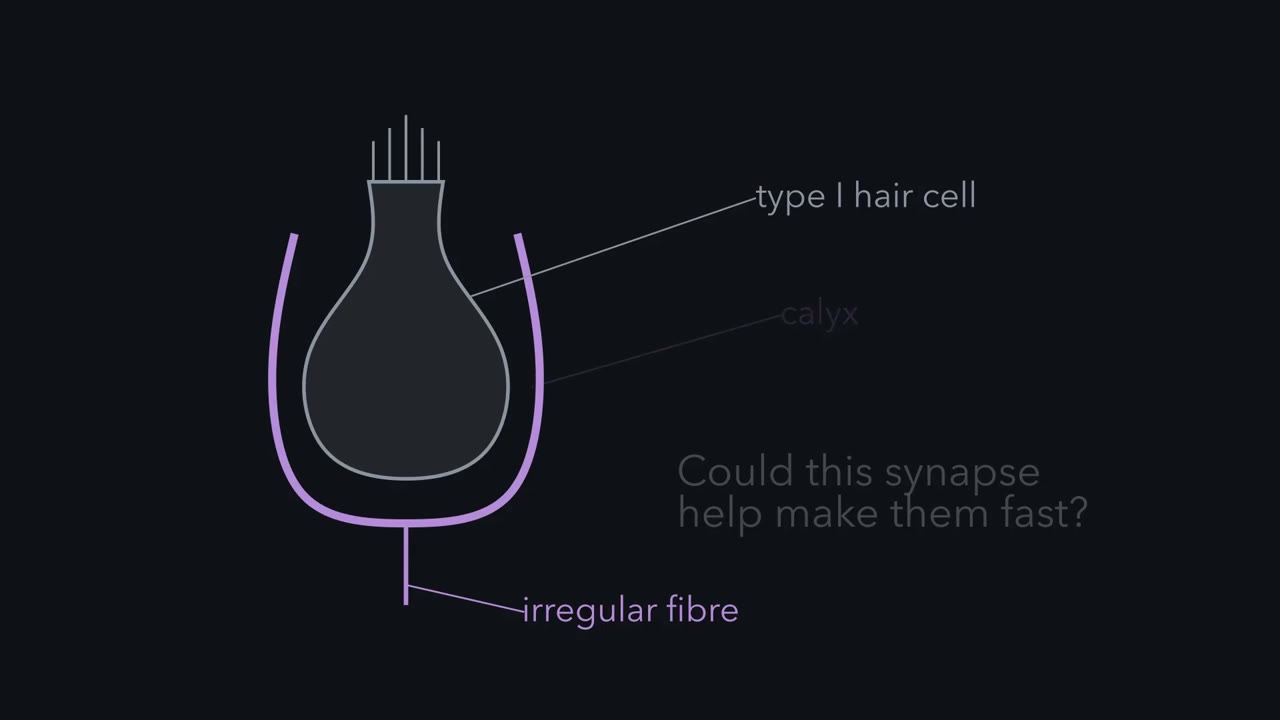
People with severe loss in both balance organs can see the world bounce as they walk. How does a healthy balance nerve prevent that? Canals sense rotation; otoliths sense linear acceleration and tilt. Each organ sends both regular and irregular fibres. From here on, we follow canal fibres and head rotation. With the head still, both fire fast. A regular fibre ticks like a clock. An irregular one fires with uneven gaps. Now a slow head turn. The regular fibre's rate rises and falls with head velocity, how fast the head is moving. Now a sudden change. The irregular fibre, with its higher gain, responds more strongly, and its spikes lock to the event.
Yet regular fibres detect small motions well. How can the lower-gain fibre win? Pause and predict. One made-up fibre has three times the gain, but ten times the CV. Which detects a small, slow turn first? A change in rate counts only if it stands out from the noise. For our made-up counting decoder, threshold is noise divided by gain. The quiet, low-gain fibre wins. Its threshold comes out lower. If our counting decoder must report within a tenth of a second, both thresholds rise, and the regular fibre's lead shrinks. So what is the irregular fibre good for? Replay the same jittery head motion many times. Pause and predict. If irregular spikes were just noise, could their timing tell one motion from another?
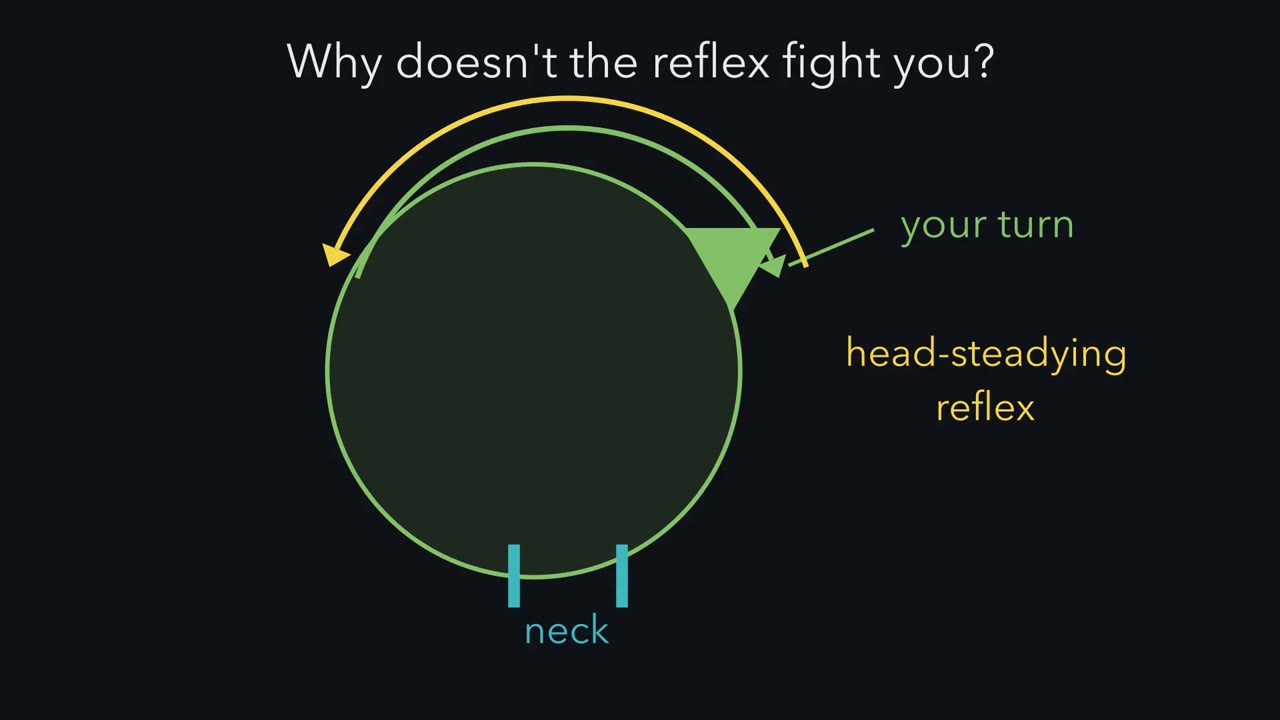
Their precisely timed spikes told different motions apart. Irregular at rest, precise when it matters. Neither channel keeps reporting a steady spin. In a long turn at constant speed, the canal signal fades in both. So here is the one idea. The nerve reports head motion on two overlapping channels, whoever caused it. In the canals, regular fibres follow how fast the head is turning, in a steady, precise rate. Irregular fibres add higher gain, more response to how quickly the turn changes, and well-timed spikes. In the head-posture neurons tested, your own turn is largely cancelled, when neck feedback matches the prediction. Fast, precise reports are thought to help hold the world still.
Muting matched, self-made turns in the tested neurons may help the head reflex spare the turns you intend.
People with severe loss in both balance organs can see the world bounce as they walk. Yet in monkeys, head-motion neurons go largely quiet for a turn the animal makes itself, which may keep the head-steadying reflex from fighting it. How does one nerve report motion fast and precisely, yet let the brain set your own turns aside?
Continue in the lesson: Balance: Two Codes for Every Head Movement →
2:57 · Free, with captions and a transcript. The lesson has the full text, the questions and the sources.
More films from this lesson
How this film was made. Narration: an AI narrator voice (Kokoro, af_heart) reading narration written from this lesson's text. Animation: AI-generated in code (Manim) by Claude, a schematic with no drawn molecular structures. Captions come from the narration script. See something wrong? Report it.