Sensory Systems · Skim version
Hairy Skin, Stroking and Affective Touch
Read the full lesson → Skim the whole course →
The guiding idea
Brush a forearm at a few centimetres per second and one slow, unmyelinated fibre fires hardest. Is that why it feels nice?
In human hairy skin, the C-tactile (CT) afferent fires most at caress speeds and pleasantness ratings follow its curve, making it the prime candidate for the pleasant side of touch.
From the film: The Fibre That Prefers a Caress
- In human hairy skin, the C-tactile afferent fires most at caress speeds of about 1 to 10 cm/s, while the myelinated touch fibres recorded fire harder the faster the brush moves.
- Average pleasantness ratings follow the same inverted U, so C-tactile input is the prime candidate for the pleasant side of touch.
- A candidate is not a proven cause: only taking the input away can show whether it is needed.
From the film: Take the Input Away
- In carriers of a nerve growth factor mutation with fewer thin fibres, caress-speed stroking was rated less pleasant, though the mutation affects more than C-tactile afferents.
- After cordotomy, pain, temperature and itch were markedly disrupted but pleasantness ratings were not significantly changed.
- So thin-fibre input seems to contribute and the anterolateral route is not needed, while C-tactile input remains a candidate with its route unresolved.
From the film: A Net, a Lineage and a Mouse That Cannot Say
- In mouse hairy skin, at least three afferent classes are candidates for detecting a stroke.
- A field afferent may respond to gentle stroking by summing many weakly sensitive endings, as the authors proposed.
- Mouse outcomes such as place preference are not feelings, and which mouse cell, if any, matches the human C-tactile afferent is unsettled.
-
The fibre that prefers a caress
-
Take the input away: what people show
-
Which cells detect a stroke in mice
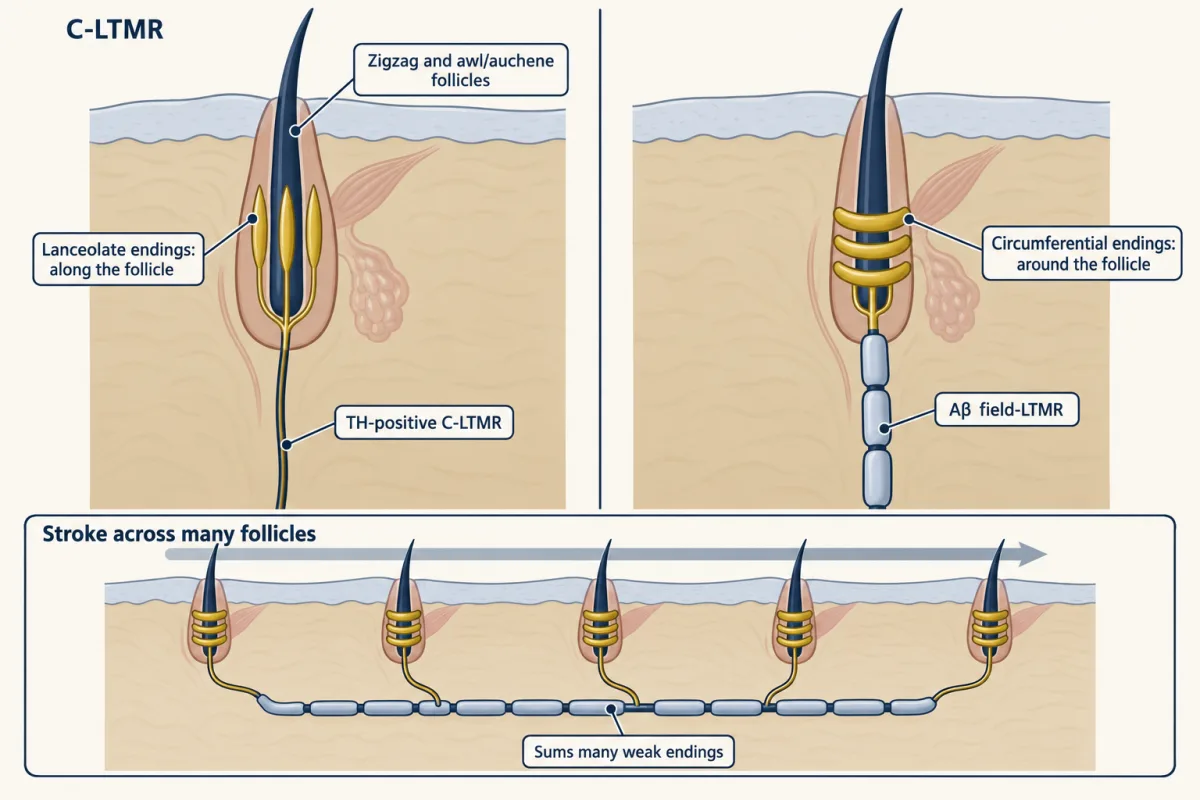
In mouse hairy skin, TH-positive C-LTMR terminals run lengthwise along the outside of a follicle, while Aβ field-LTMR terminals wrap around its outer region. One field-LTMR can form as many as 180 circumferential endings. Bai and colleagues proposed that summation across many weakly sensitive endings explains its response to gentle stroking despite its lack of response to single-hair deflection. Five follicles are shown schematically; this is not a complete receptive field. AI-generated illustration -
From skin to reward-like outcomes in mice
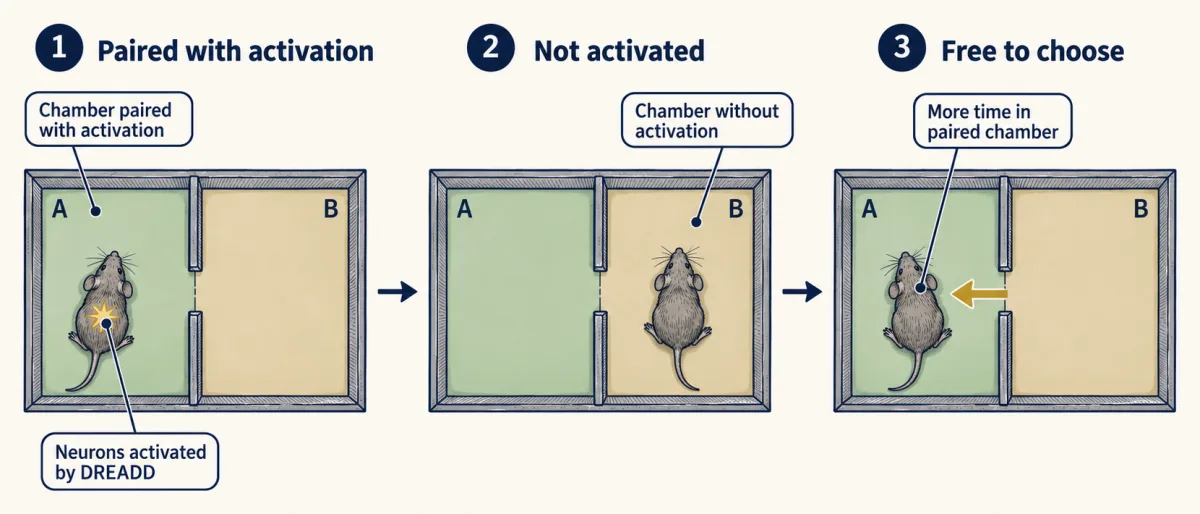
In Vrontou and colleagues' DREADD experiment, male mice about one month old spent more time after conditioning than before it in the compartment paired with MrgprB4 activation. Conditioning alternated activation and control pairings; the later test allowed free exploration. The authors interpreted the result as positive reinforcement, anxiolysis or both, not as a report of pleasure. AI-generated illustration -
Which mouse neuron is a CT afferent, and what “pleasant” can mean in a mouse
-
Going deeper
Where this lesson fits
Before thisReview first
- The Low-Threshold Mechanoreceptors: One Touch, Several SignalsThis course · Lesson 4
It introduces the LTMR classes, including C-LTMRs and the fast myelinated fibres, whose stroke responses this lesson compares.
- Sensory Neurons by Their Genes: the Atlas EraThis course · Lesson 3
You need its point that a gene-defined neuron class is not yet a function to judge which mouse cell matches a CT afferent.
- Piezo Channels and the Physics of ForceThis course · Lesson 2
It explains how touch force opens channels, which underlies why field-LTMRs need strong indentation before they respond.
After thisStudy next
- Where Touch Is First Processed: Dorsal Horn and Dorsal Column NucleiThis course · Lesson 8
It follows where stroke-driven input from these afferents is first processed in the spinal cord and brainstem.
- Touch Over-reactivity in Autism ModelsThis course · Lesson 9
It returns to these mouse touch afferents and tests how changes in them alter touch reactivity and behaviour.
- Itch: A Sense of Its OwnThis course · Lesson 13
It looks at related Mrgpr-expressing sensory neurons and how their identity is tied to what the animal does.
Elsewhere on the siteFilms, simulations and method films in other courses
- Cut half the cordSimulation · Neuroscience
It shows how a touch afferent's response to light stroking and pain input is read in the spinal cord.
Suggested by an AI model from the lessons themselves, then checked. How we use AI