Cell Signaling · Skim version
GPCRs and Trimeric G Proteins
Read the full lesson → Skim the whole course →
The guiding idea
Adrenaline strengthens the heartbeat but relaxes the airways. How can the same hormone give opposite orders?
GPCR subtype, G protein, and downstream proteins decide the first response.
From the film: How a Receptor Loads a Switch
- GPCR subtype, G protein, and downstream proteins decide the first response.
- An agonist can open a cytoplasmic receptor cavity where a trimeric G protein docks.
- The active receptor promotes GDP release, allowing GTP to bind Gα.
- Gα-GTP and βγ can regulate different targets.
From the film: Above, At, or Below Basal
- Basal activity separates agonists, neutral antagonists, and inverse agonists.
- An agonist raises signaling above basal activity.
- A neutral antagonist leaves basal activity unchanged while blocking other ligands.
- An inverse agonist lowers signaling below basal activity.
-
From an outside pocket to an inside switch
-
”All the pathways”: four G-alpha families, then many targets
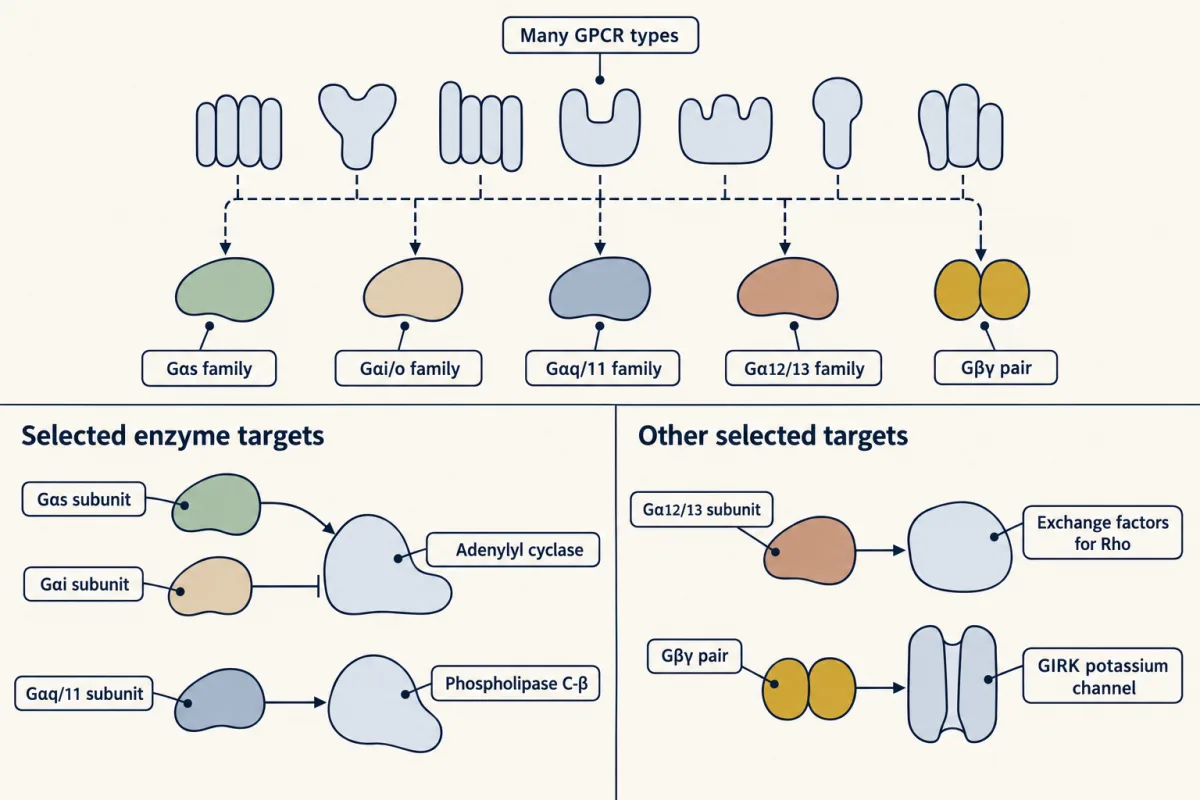
Many GPCRs narrow to four G-alpha families and beta-gamma, then fan out to distinct enzymes and ion channels. AI-generated illustration 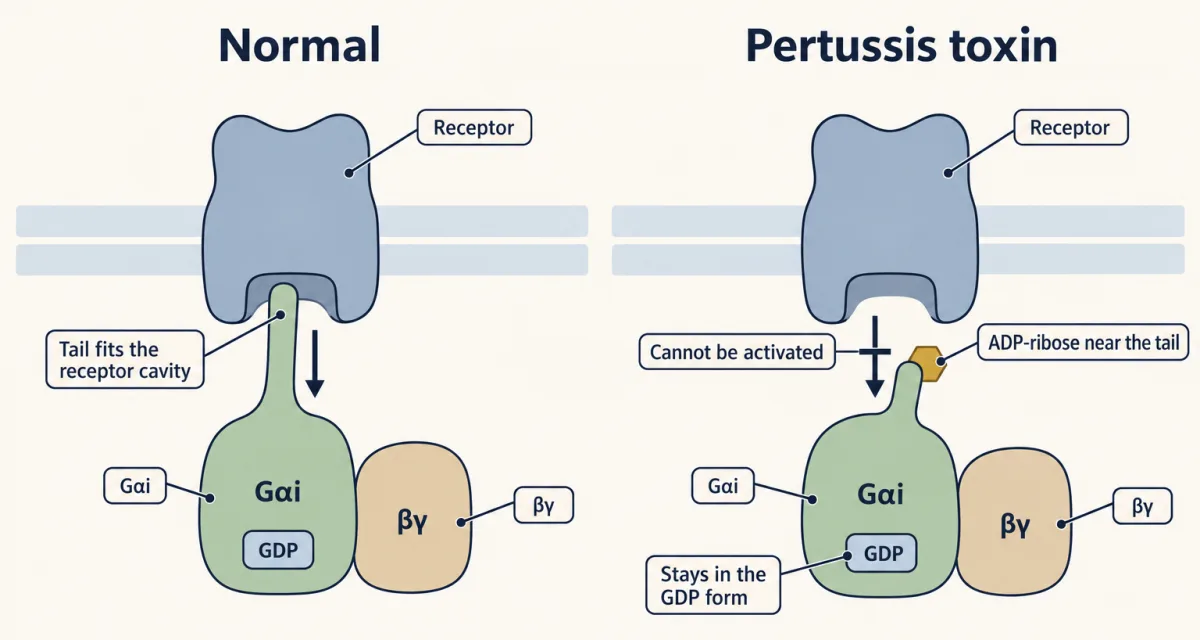
Pertussis toxin prevents susceptible Gi/o proteins from engaging their receptor, so they remain GDP-bound and the response disappears. AI-generated illustration -
One ligand, different cellular answers
-
Ligand efficacy, and why “GPCRs can be unfaithful to trimeric G proteins”
-
Going deeper
Where this lesson fits
Before thisReview first
- A Field Guide to ReceptorsThis course · Lesson 4
It introduces the seven-pass receptor architecture and the receptor classes that this lesson builds on.
- Binding: Affinity, Occupancy and Dose–ResponseThis course · Lesson 3
You need agonist, antagonist and occupancy from there to place the inverse agonist as a third kind of drug.
- GTPase Switches: The TimerThis course · Lesson 7
The active receptor acts as the GEF for Gα, so you need the GDP-GTP switch and its timer from there.
After thisStudy next
- cAMP and Protein Kinase AThis course · Lesson 13
It follows Gs and Gi through adenylyl cyclase to cAMP and the kinase that reads it.
- PLC, IP3, DAG and Protein Kinase CThis course · Lesson 14
It takes the Gq/11 branch onward: phospholipase C-β cuts PIP2 into IP3 and DAG.
- Turning the Signal Off: Arrestins, RGS Proteins and PhosphodiesterasesThis course · Lesson 16
It explains how receptor phosphorylation and arrestin block further G-protein coupling, the step this lesson only previews.
Suggested by an AI model from the lessons themselves, then checked. How we use AI