Biochemistry · Skim version
Glycolysis: The Investment-and-Payoff Pathway
Read the full lesson → Skim the whole course →
The guiding idea
Why does a cell spend ATP to make ATP? The first steps are a deliberate investment.
Why does a cell spend ATP to make ATP?
-
A ladder of phosphates
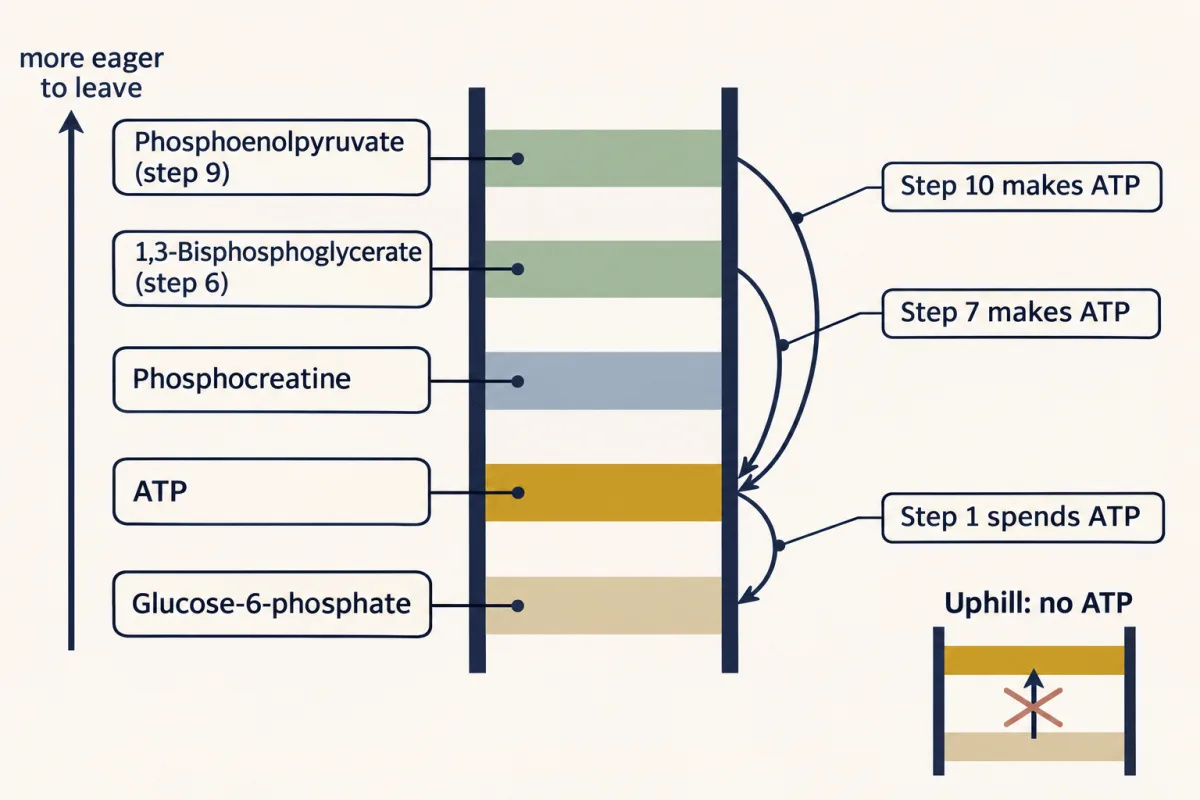
Under standard conditions, phosphates move favorably down the ladder (rungs are in order, not to scale). Glycolysis must build phosphates above ATP before a kinase can hand them to ADP. AI-generated illustration -
Investment, steps 1–5: trap, reshape, commit, split
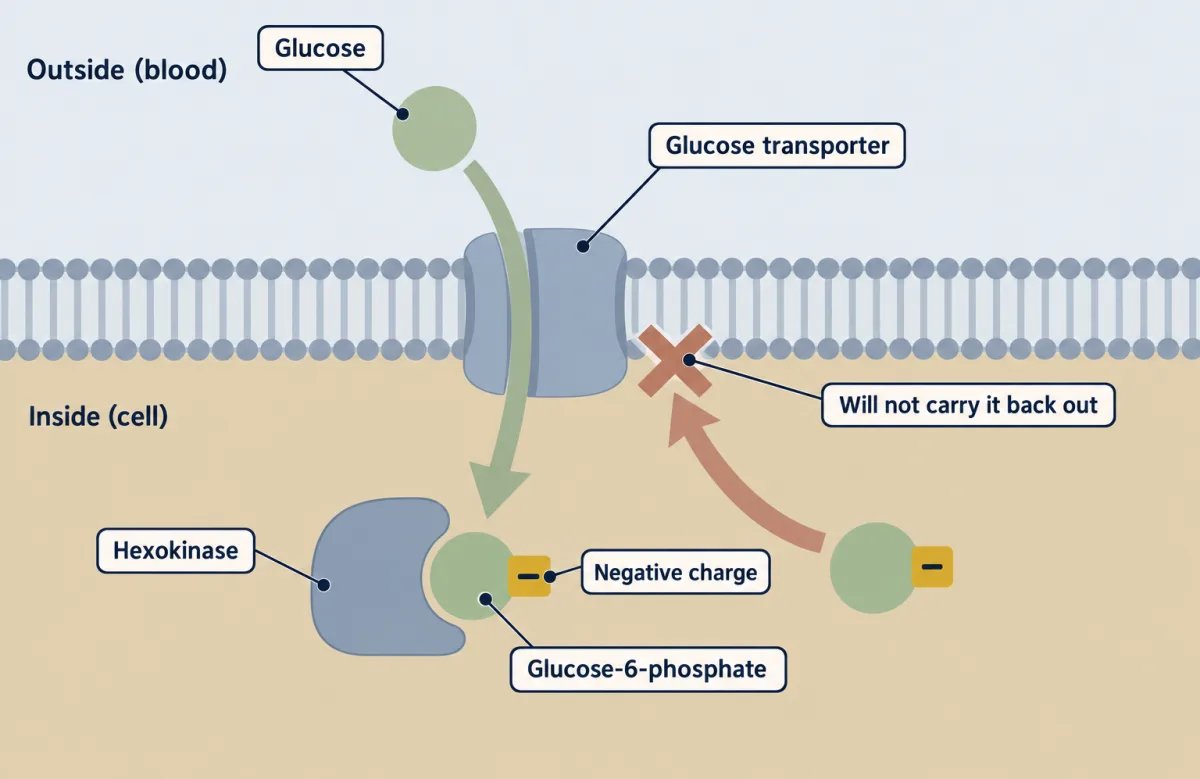
The first phosphate traps glucose: glucose-6-phosphate carries a negative charge, and the glucose transporters will not carry it back out. AI-generated illustration -
Payoff, steps 6–10: make a phosphate worth more than ATP’s, then cash it
-
The two ledgers
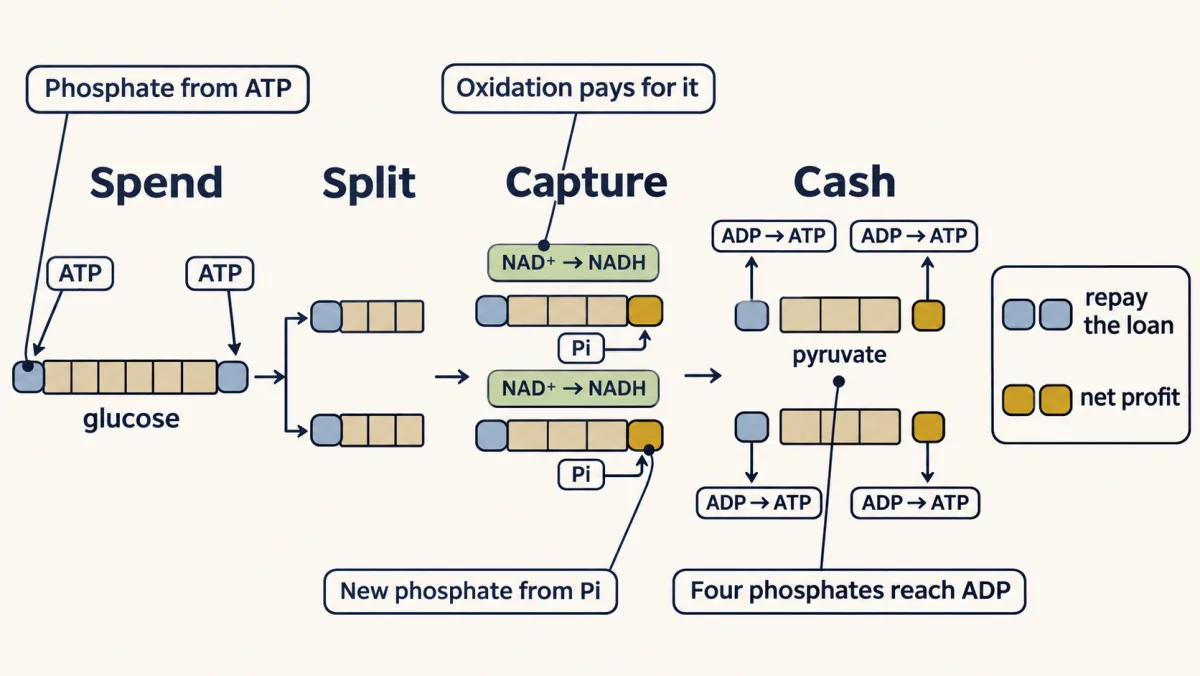
Follow the phosphate: two come from ATP and are paid back; two are new, captured from inorganic phosphate at step 6 and paid for by the oxidation. Those two are the net +2 ATP. AI-generated illustration -
Why pyruvate’s fate matters: the NAD+ bottleneck
-
Control: where the cell can turn the flow
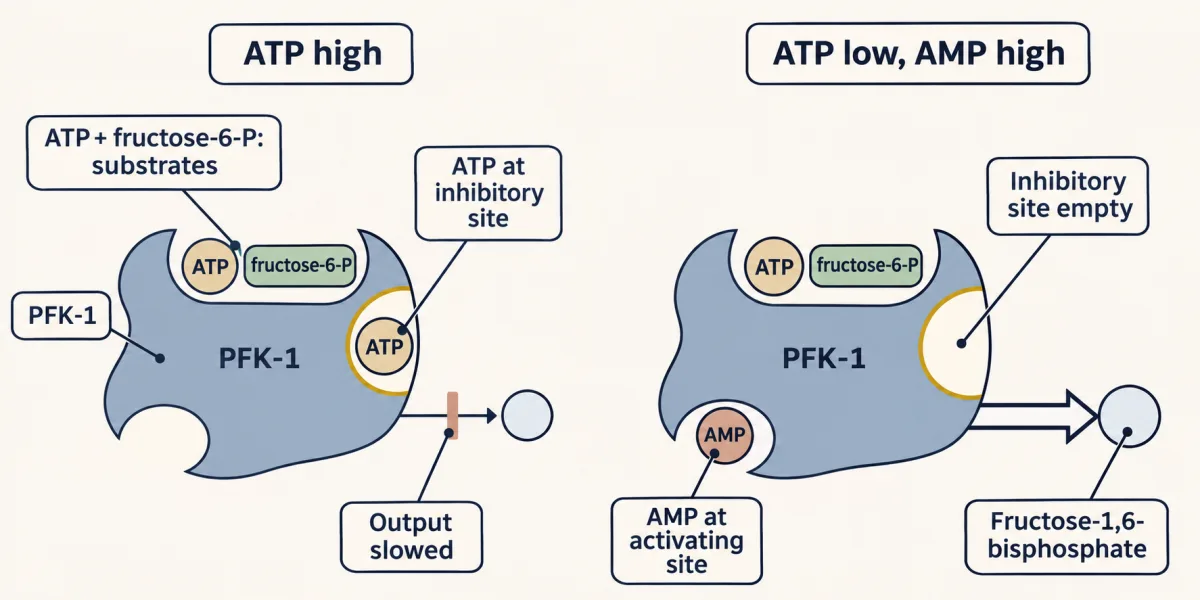
ATP is PFK-1's substrate and, at high levels, also an allosteric inhibitor at a separate site. When ATP falls and AMP rises, AMP binding at an activating site relieves the inhibition; ATP is still needed as a substrate. AI-generated illustration -
Going deeper
Where this lesson fits
Before thisReview first
- Metabolism: Basic Concepts and DesignThis course · Lesson 15
It teaches ATP as the energy currency and how coupling an uphill step to a downhill one works, which the phosphate ladder here uses.
- Basic Concepts of Enzyme ActionThis course · Lesson 7
You need to know how enzymes speed up reactions and how free energy governs direction before reading steps far from equilibrium.
- Carbohydrates: One Bond Decides Fuel or FiberThis course · Lesson 10
Glucose's ring form and the aldose and ketose distinction explain the isomerase step that turns glucose-6-phosphate into fructose-6-phosphate.
After thisStudy next
- Gluconeogenesis: Pushing Glucose Back UphillThis course · Lesson 17
It runs the pathway backward, using bypasses for exactly the three far-downhill steps you identified here as the control points.
- The Pyruvate Dehydrogenase Complex: The One-Way Gate to the CycleThis course · Lesson 18
It takes the pyruvate made at step 10 and shows what the cell does with it when oxygen is available.
- Integration of Metabolism: How the Body Switches FuelsThis course · Lesson 30
It uses PFK-1 and pyruvate kinase control by hormones to show how the body switches fuels between fed and fasting states.
Elsewhere on the siteFilms, simulations and method films in other courses
- Spending ATP, Rebuilding ATPFilm · Biology
It shows how a cell spends ATP and rebuilds it from glucose, the same ATP economy glycolysis runs on.
Suggested by an AI model from the lessons themselves, then checked. How we use AI