Physiology · Skim version
Glomerular Filtration and Renal Blood Flow
Read the full lesson → Skim the whole course →
The guiding idea
Squeeze the arteriole that drains the glomerulus and filtration can rise or fall. Which, and why?
What sets the rate at which the kidneys filter plasma, and how do they hold it steady while arterial pressure changes?
-
What passes and what stays
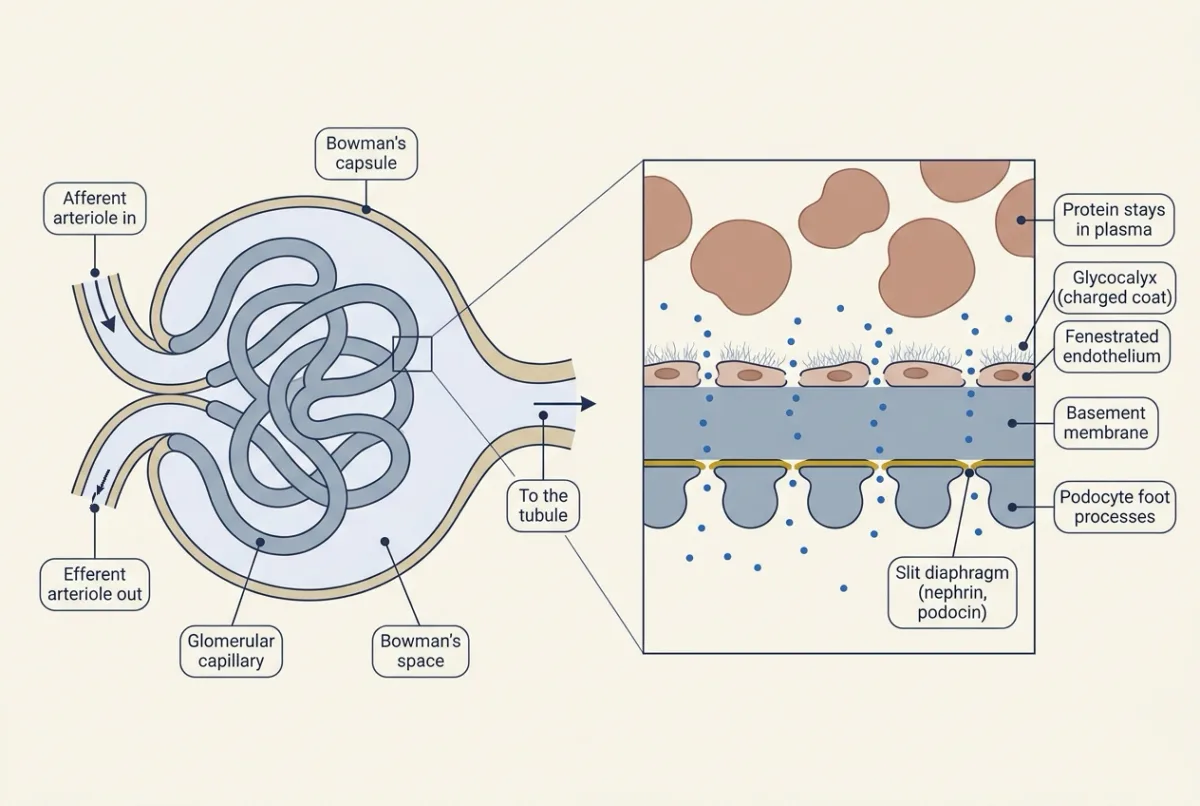
Water and small solutes cross all three layers of the glomerular wall, but plasma protein mostly stays behind, held back largely by the cell layers and the slit diaphragm; how the work is shared among the layers is still debated. Because protein stays, it grows more concentrated as plasma flows along the capillary. AI-generated illustration -
Push against pull along one capillary
-
Two taps on one hose: the afferent and efferent arterioles
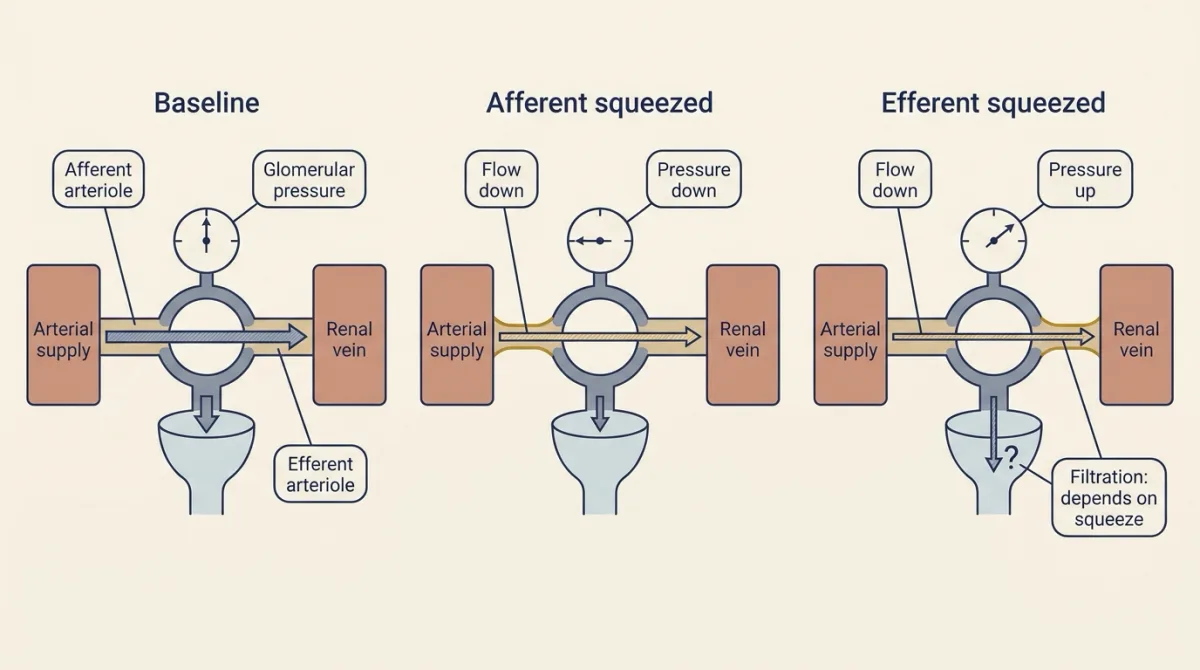
The two arterioles' total resistance sets plasma flow and the efferent share sets glomerular pressure, so squeezing the afferent arteriole lowers pressure and flow together while squeezing the efferent arteriole lowers flow but raises pressure, which is why its effect on GFR depends on how hard it is squeezed. AI-generated illustration -
Measuring it in a person: clearance
-
Holding GFR steady: myogenic response and tubuloglomerular feedback
-
Going deeper
Where this lesson fits
Before thisReview first
- Capillary Exchange, Lymph and EdemaThis course · Lesson 9
The four Starling forces across a capillary are taught there and reused here for the glomerular capillary.
- Resistance, Compliance and Local Blood FlowThis course · Lesson 8
You need two resistors in series, where total resistance sets flow, to treat the two arterioles here.
- Smooth Muscle and the Myogenic ResponseThis course · Lesson 4
The myogenic response in the afferent arteriole is the stretch-triggered contraction taught there.
After thisStudy next
- Tubular Transport, Segment by SegmentThis course · Lesson 16
It follows the filtrate down the nephron and treats SGLT2, which sets the macula densa signal used here.
- Water, Sodium and Potassium BalanceThis course · Lesson 17
Filtered load and its tubular handling decide how the kidney balances sodium and water.
Elsewhere on the siteFilms, simulations and method films in other courses
- Filter Far More, Take Most BackFilm · Organismal Biology
It shows why the kidney filters about 180 litres of plasma a day and takes most of it back.
- Starling forces along a capillarySimulation · Organismal Biology
It shows flow as pressure difference divided by resistance, which governs flow through the two arterioles.
- Radioactive and stable isotope tracersMethod film
Clearance of inulin and PAH works by following a marker substance through the kidney, which this film shows.
Suggested by an AI model from the lessons themselves, then checked. How we use AI