Biochemistry · Skim version
Enzyme Kinetics: The Michaelis–Menten Model
Read the full lesson → Skim the whole course →
The guiding idea
Why doesn't doubling the substrate keep doubling the rate? Enzymes saturate.
Why doesn't doubling the substrate keep doubling the rate?
From the film
- In the simplest model, velocity equals kcat times the amount of busy enzyme.
- More substrate adds speed only by filling empty enzymes.
- Km is the substrate concentration at half Vmax, not automatically binding affinity.
- Vmax equals kcat times total enzyme concentration in the simplest model.
-
Measuring the reaction: the assay and V₀
-
Building the curve: how much of the enzyme is busy
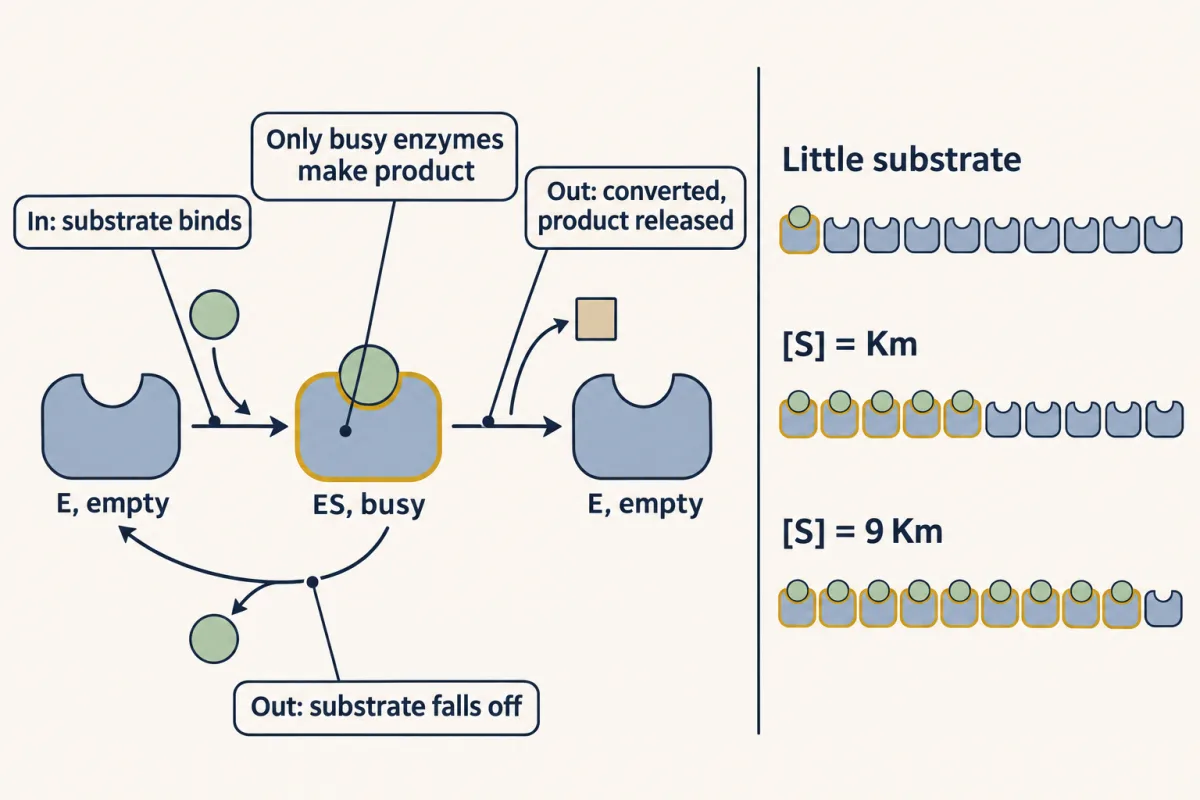
Every enzyme is empty or busy, and only busy ones make product. Substrate opens the one way in; falling off and turnover are the two ways out. Velocity is kcat times the number busy, so it saturates as the busy fraction, [S]/(Km + [S]), approaches 1: half busy at Km, 90% busy only at 9 Km. AI-generated illustration -
Speed and efficiency: kcat and kcat/Km
-
Reading the curve a second way: Lineweaver–Burk
-
When something gets in the way: inhibitors
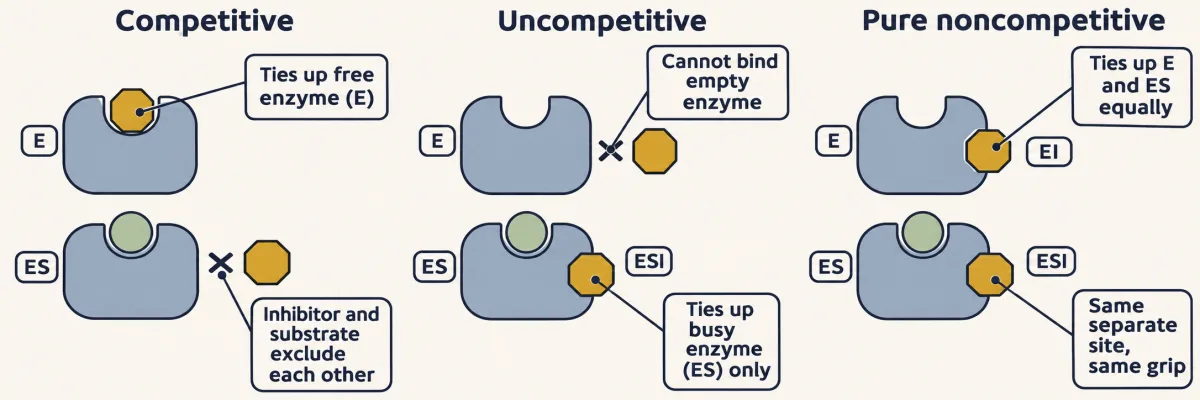
Three classic reversible inhibitors, sorted by the enzyme pool each ties up: a competitive inhibitor ties up free enzyme (E) and excludes substrate; an uncompetitive inhibitor ties up only busy enzyme (ES), forming ESI; a pure noncompetitive inhibitor ties up both equally, at a separate site with the same grip. Pure noncompetitive inhibition is a special case of mixed inhibition. AI-generated illustration -
Going deeper
Where this lesson fits
Before thisReview first
- Basic Concepts of Enzyme ActionThis course · Lesson 7
You need the idea that enzymes only speed up possible reactions and bind the transition state, which this lesson builds on.
- Protein Three-Dimensional Structure: The Sequence Sets the ShapeThis course · Lesson 5
The active site that grips substrate is a folded pocket, so knowing how sequence sets shape helps.
After thisStudy next
- Protein Binding and Allostery: How Hemoglobin Loads and Delivers OxygenThis course · Lesson 9
Cooperative enzymes break the single-site hyperbola here, and this lesson takes binding curves to sigmoidal ones.
- Metabolism: Basic Concepts and DesignThis course · Lesson 15
Metabolic enzymes run at substrate levels set against their Km, so pathway control uses this saturation idea.
- Glycolysis: The Investment-and-Payoff PathwayThis course · Lesson 16
Reading how each glycolytic enzyme's Km and Vmax shape flux uses the rate equation built here.
Elsewhere on the siteFilms, simulations and method films in other courses
- Dose–response explorerSimulation · Cell Signaling
Binding curves and occupancy there follow the same hyperbola as the busy-enzyme fraction in this lesson.
Suggested by an AI model from the lessons themselves, then checked. How we use AI