Cell Signaling · Skim version
Endocytosis and Signaling Endosomes
Read the full lesson → Skim the whole course →
The guiding idea
When a receptor is pulled into the cell, does its signal end, or does it move somewhere new?
Taking a receptor into the cell can end its signal or move it to a new place, and where the receptor is sorted decides which.
-
What’s endocytosis used for?
-
It all starts with endocytosis: a coat, then a cut
-
The early endosome is a sorting station
-
Headed to the lysosome: the receptor is sealed inside
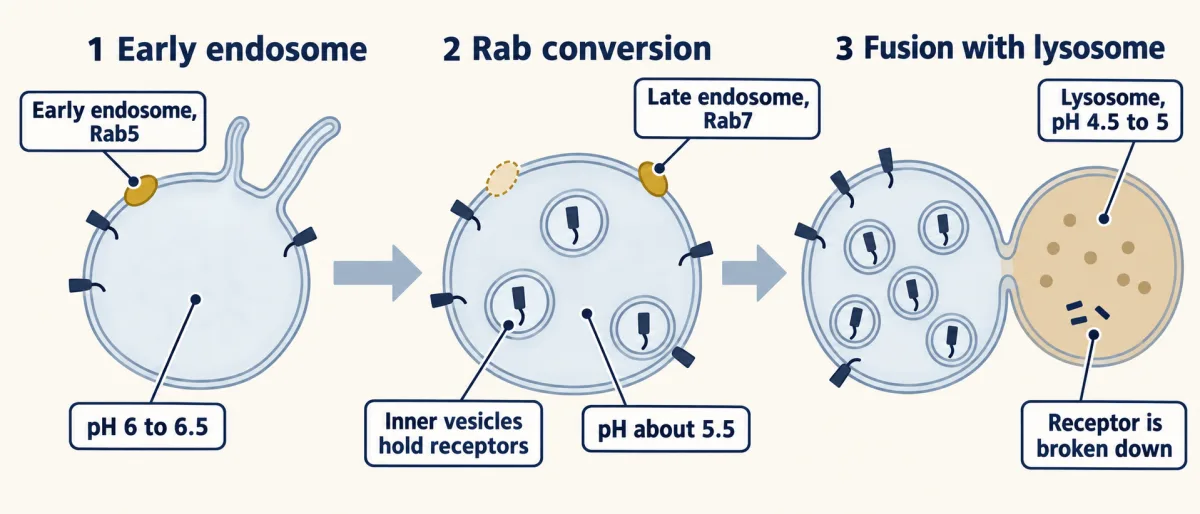
An endosome stays the same compartment but changes identity: Rab5 leaves and Rab7 arrives, the lumen grows more acid (about pH 5.5 in late endosomes) and fills with internal vesicles, and the late endosome fuses with a lysosome (pH 4.5 to 5), where the receptor is broken down. Receptor symbols are schematic. AI-generated illustration -
A receptor that keeps talking, and one that escapes
-
Going deeper
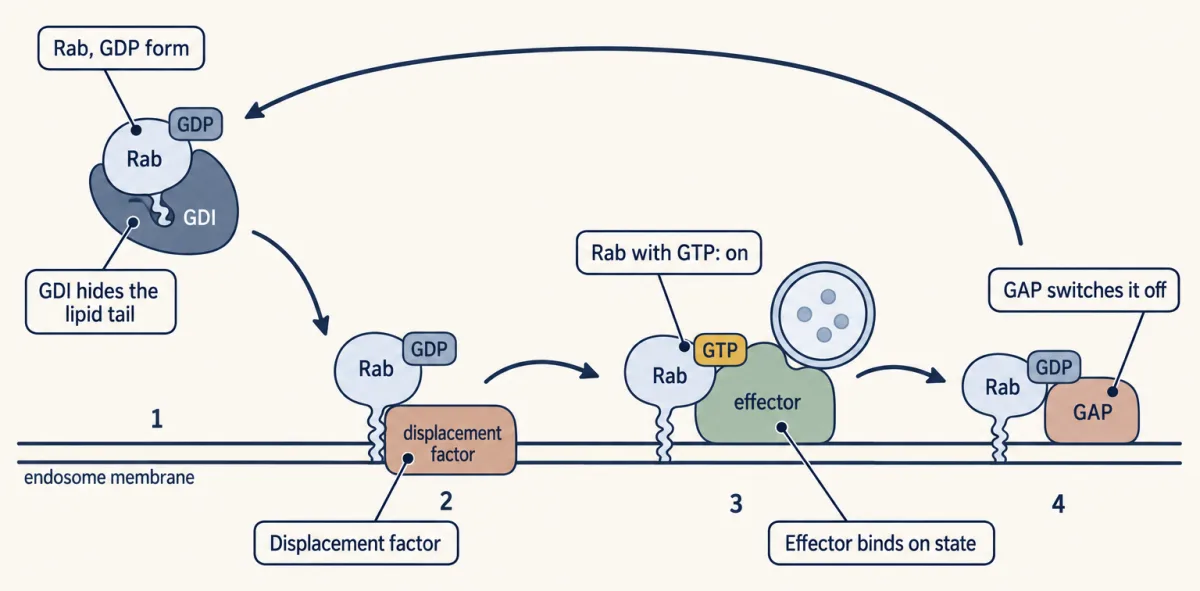
GDI keeps GDP-bound Rab soluble by hiding its lipid tail. A membrane displacement factor helps release it, and a membrane GEF then swaps GDP for GTP, helping fix where Rab is active. Active Rab recruits effectors until a GAP switches it off. The GEF is not drawn. AI-generated illustration
Where this lesson fits
Before thisReview first
- GTPase Switches: The TimerThis course · Lesson 7
Rab proteins are on-off GTPase switches flipped by GEFs and GAPs, and this lesson uses that timer logic directly.
- Ubiquitin and Regulated Proteolysis as SignalsThis course · Lesson 8
Ubiquitin is the tag that sends a receptor into the lysosome route, and the lesson assumes you know how it is added.
- Receptor Tyrosine KinasesThis course · Lesson 18
The EGF receptor, its activation and its tagging by Cbl are the main example followed through the endosome here.
After thisStudy next
- Long-Distance Signaling in NeuronsThis course · Lesson 37
It takes the idea of signaling endosomes and asks how they carry a signal the full length of an axon.
Elsewhere on the siteFilms, simulations and method films in other courses
- A Loop and a One-Way TripFilm · Cell Biology
This film follows the LDL receptor through coated pits and endosomes, showing the same sorting between recycling and lysosome.
- Binding or entry?Simulation · Cell Biology
The simulation lets you separate binding from entry for a receptor, the same trafficking step this lesson uses.
Suggested by an AI model from the lessons themselves, then checked. How we use AI