Genetics and Molecular Biology · Skim version
DNA Replication: Semiconservative Copying and Its Machinery
Read the full lesson → Skim the whole course →
The guiding idea
One generation after a switch from heavy to ordinary nitrogen, all of E. coli's DNA sat halfway between heavy and light. Why halfway?
Each daughter molecule keeps one old strand and builds one new strand.
From the film: What the Halfway Band Means
- Each daughter molecule keeps one old strand and builds one new strand.
- A single hybrid band after one generation rules out conservative copying.
- Hybrid and light bands after two generations rule out uniform dispersive copying.
- Band positions show how old label is distributed among DNA molecules.
From the film: Why One Strand Is Built in Pieces
- Polymerases extend a 3' end, so one strand is built in pieces.
- Both new strands grow 5' to 3', although they grow in opposite directions at a fork.
- Primase restarts the lagging strand as the fork exposes more template.
- Primer removal and ligase turn short fragments into one continuous strand.
-
Three models, one experiment
-
Testing the pieces
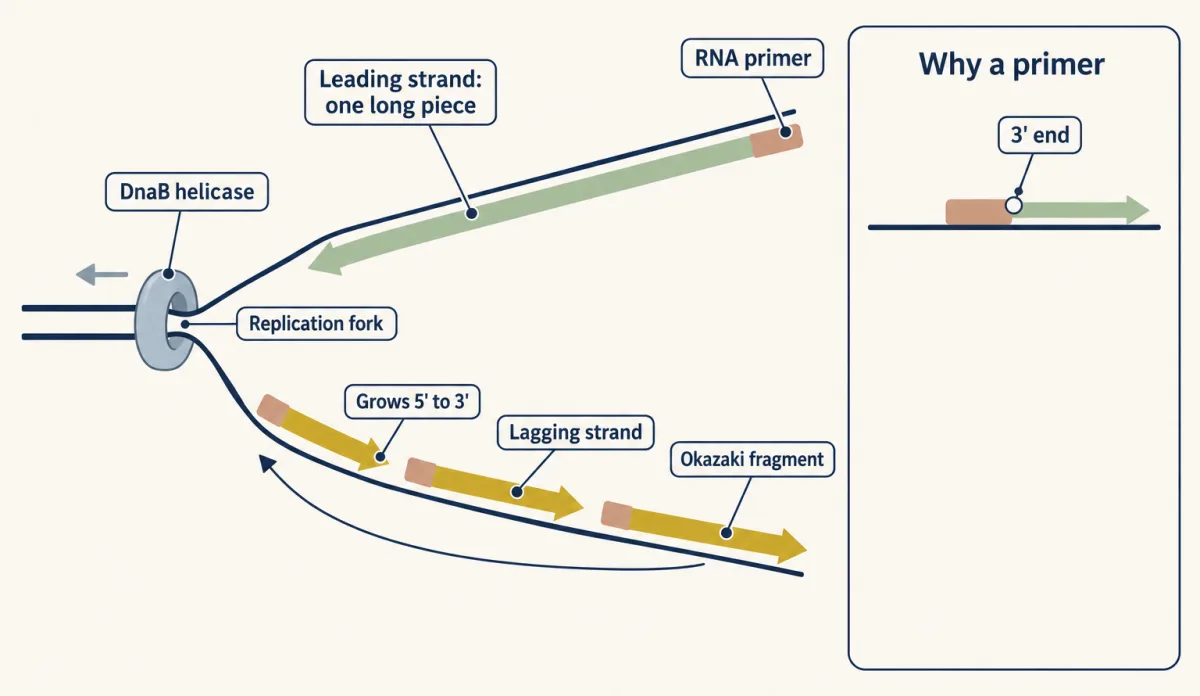
Both new strands grow 5' to 3', so one is made continuously toward the fork and the other in short primed pieces growing away from it. AI-generated illustration -
The fork’s jobs, organism by organism
-
Three layers of accuracy
-
Linear chromosomes need finishing work
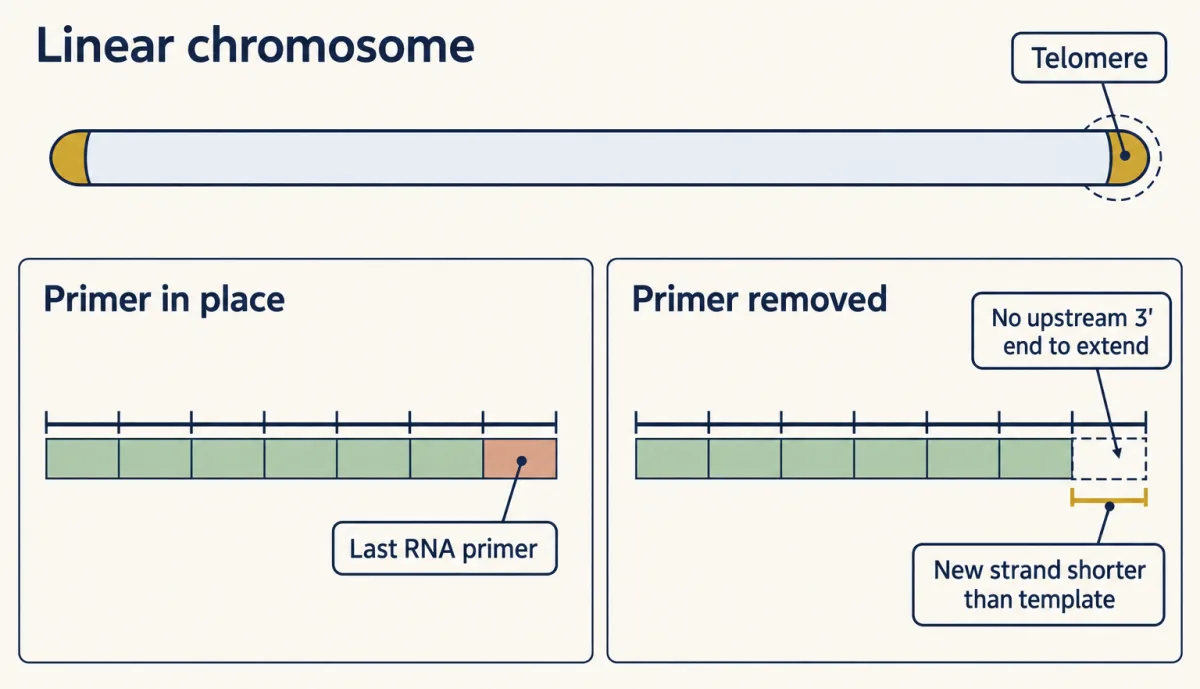
Removing a terminal primer can leave no 3' end to extend; real telomeres also require overhang restoration and C-strand fill-in. AI-generated illustration -
Going deeper
Where this lesson fits
Before thisReview first
- DNA Is the Genetic MaterialThis course · Lesson 12
You need to know DNA carries heredity and how its labelled forms were tracked before following old and new strands here.
After thisStudy next
- DNA Repair and RecombinationThis course · Lesson 15
Mismatch repair, the third layer of accuracy, is worked out there along with other ways cells fix DNA.
- Mutation: Where Variation Comes FromThis course · Lesson 14
Replication errors that escape proofreading and repair become the mutations whose rates and origins are studied there.
- Recombinant DNA, Cloning and PCRThis course · Lesson 22
PCR copies DNA with primers and a polymerase extending 3' ends, the same rules used at the fork.
Elsewhere on the siteFilms, simulations and method films in other courses
- One Strand Is EnoughFilm · Biology
It shows how each strand of the double helix can serve as a template for rebuilding its partner.
- Copy a piece of DNASimulation · Biology
You can copy a piece of DNA there and watch base pairing build the new strand.
- How One Set Becomes TwoFilm · Biology
It places DNA copying in interphase before the copies are separated into two nuclei.
Suggested by an AI model from the lessons themselves, then checked. How we use AI