Ecology and Evolution · Skim version
Diversity, Disturbance and Succession
Read the full lesson → Skim the whole course →
The guiding idea
Two plots hold the same four species. Can one be more diverse than the other?
A diversity index can be read as an effective number of species, how many equally common species would give the same value; above order zero it falls as a few species dominate, and it changes only when who is present, or how evenly they are shared, changes.
From the film: How Many Species Is It Worth?
- Richness counts species; diversity also asks how evenly the individuals are shared among them.
- An effective number of species is how many equally common species would give the same diversity value.
- At order zero it is the richness; above order zero it equals the richness only when every species is equally common, and it falls as a few species take over.
- These count-based indices use only counts, never names, so none of them sees which species are present: name the measure, its order and what it misses.
- A disturbance that kills the same share of every species leaves the shares, and so the effective number, unchanged; diversity changes only if who is present or how evenly they are shared changes.
From the film: Holding a Boulder Still
- On Sousa's southern California shore, winter waves overturned small boulders often and large ones rarely, and intermediate boulders carried the most diverse communities.
- Each overturning kills some or all of the algae on the upper face and sets succession on that surface back; how often it strikes helps decide how far a patch gets.
- Boulder size and how often a boulder is overturned travelled together, so the pattern alone could not say which mattered.
- Small boulders fixed so waves could not turn them were taken over by later red algae and became as species-rich and diverse as larger, intermediate-sized boulders, while loose ones stayed early.
- The test varied how often disturbance struck, not how hard, and it holds for one shore.
-
Counting a community: richness, evenness and effective species
-
Succession: three ways one community replaces another
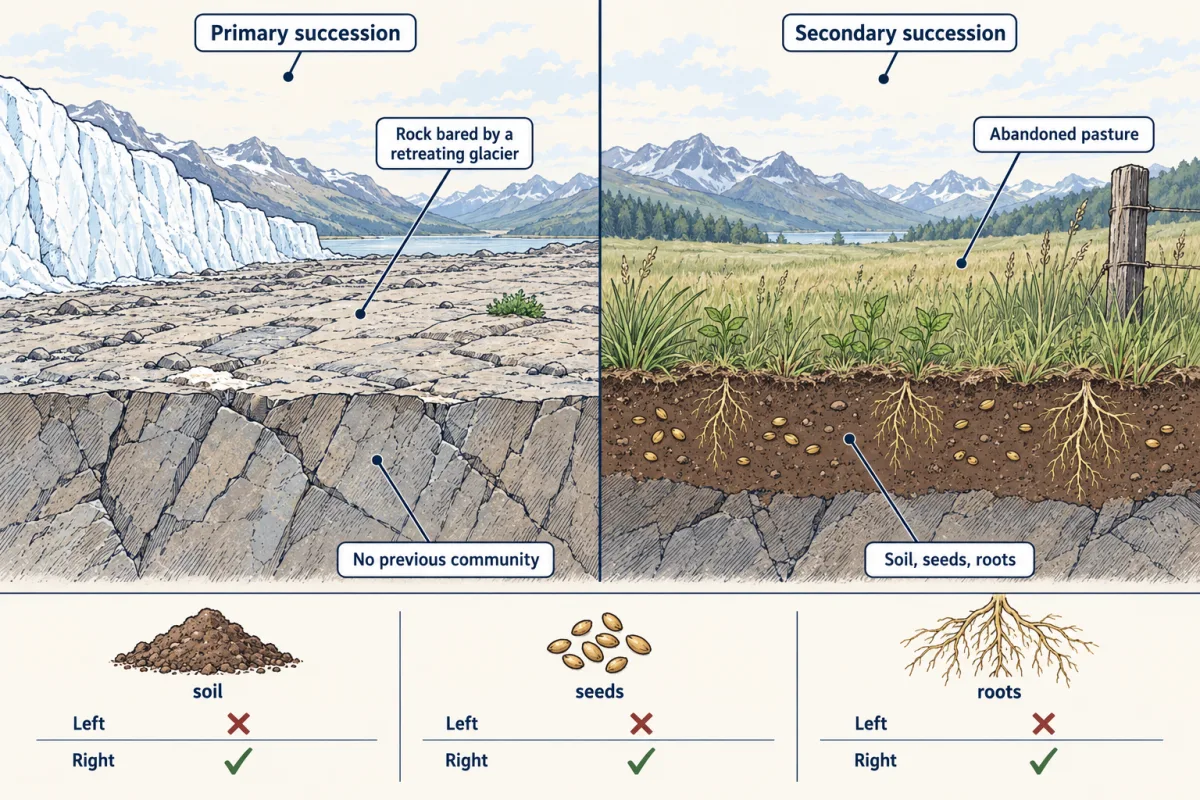
Primary succession starts on surfaces with no previous community, such as rock bared by a retreating glacier. Secondary succession follows a disturbance that leaves soil, seeds or roots behind, as on an abandoned pasture. AI-generated illustration -
Disturbance: Sousa’s boulders and the debate over the hump
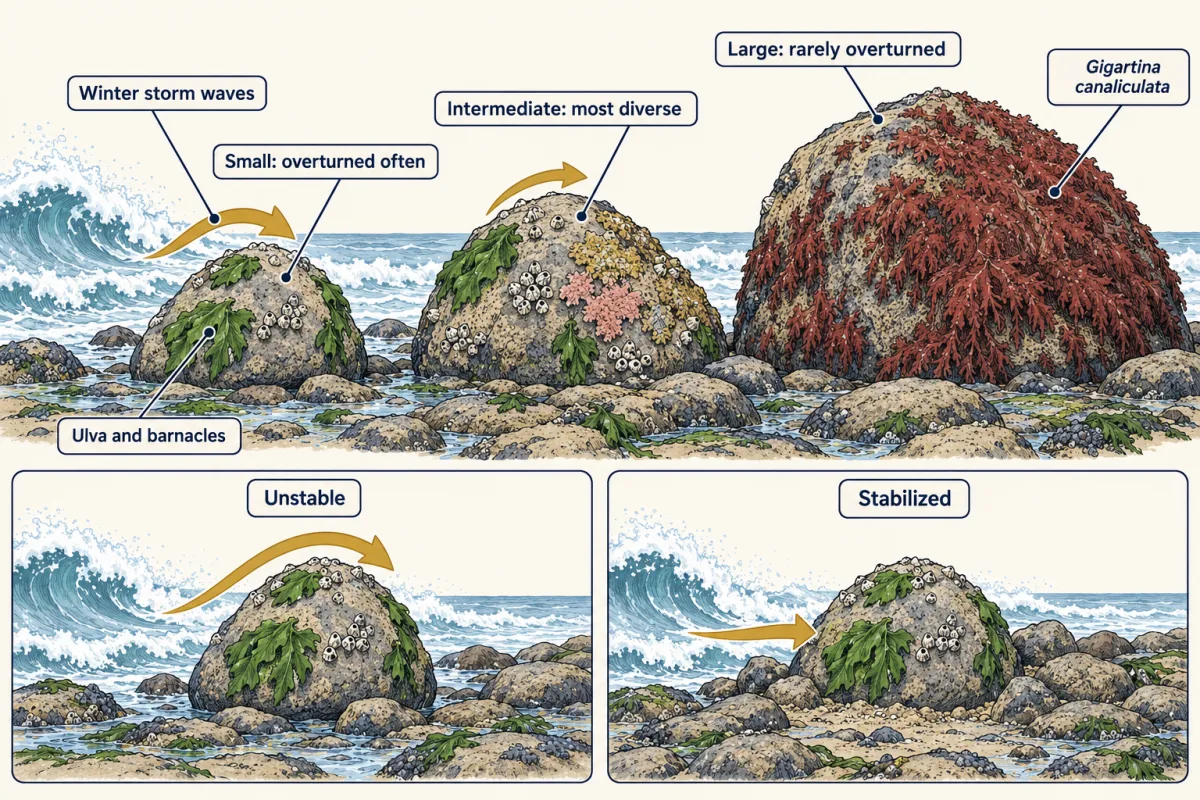
On a boulder shore, size and overturning travel together; holding small boulders still separated them. AI-generated illustration 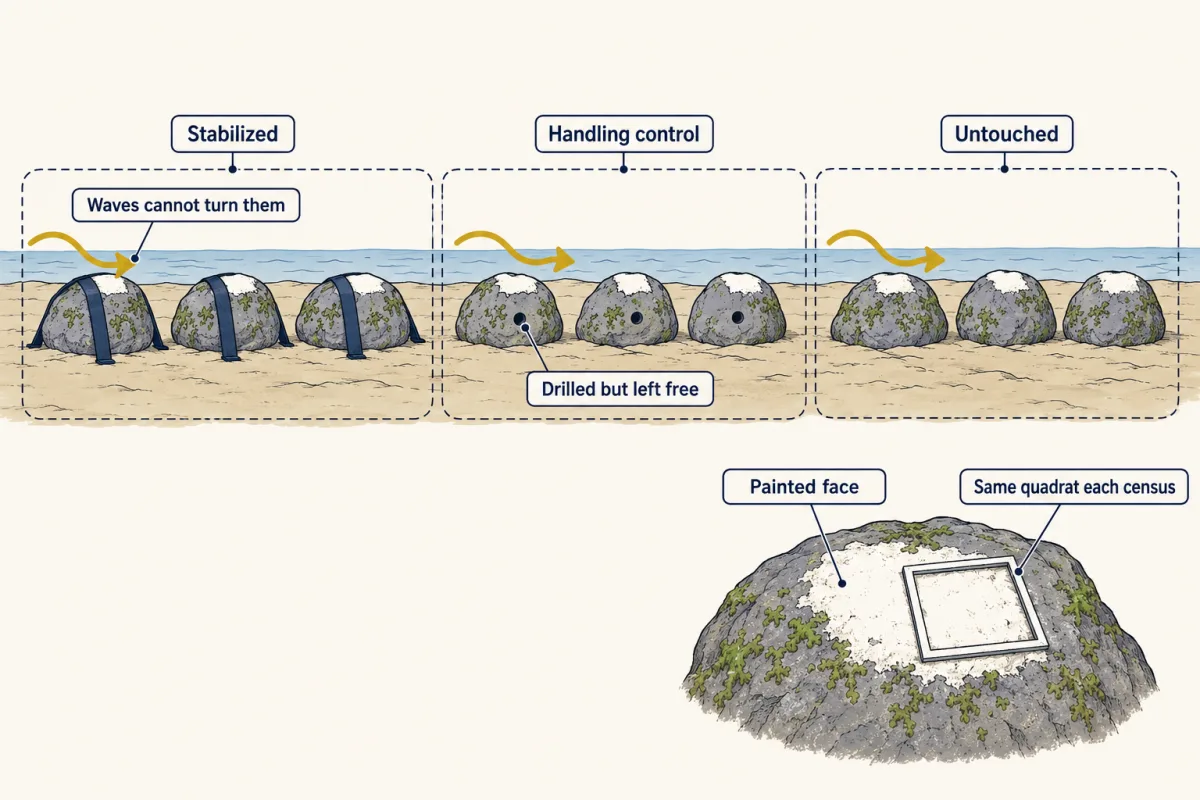
A design with a handling control, boulders drilled the same way but left free, lets a change be pinned on overturning rather than on the handling itself. Schematic. AI-generated illustration -
Description, mechanism and scale
-
Going deeper
Where this lesson fits
Before thisReview first
- CompetitionThis course · Lesson 16
The intermediate disturbance idea says the best competitors exclude others without disturbance, which uses competitive exclusion from there.
- Predation and Community EffectsThis course · Lesson 17
Disturbance and predation both remove individuals, and removal experiments from there show how to test what a species does.
After thisStudy next
- Island BiogeographyThis course · Lesson 20
It applies the same richness counting and colonization ideas to how species arrive at an emptied site.
- Biodiversity and Ecosystem FunctionThis course · Lesson 23
It uses diversity measures like these and asks what changes in ecosystem function when diversity differs.
- Nutrient CyclingThis course · Lesson 22
It follows how nutrients recover after a forest is disturbed, the same recovery you saw in succession.
Elsewhere on the siteFilms, simulations and method films in other courses
- How a Field Changes Its FutureFilm · Biology
It shows organisms changing conditions so later species replace earlier ones, which is the facilitation model of succession.
Suggested by an AI model from the lessons themselves, then checked. How we use AI