How a Field Changes Its Future
Read the transcript of “How a Field Changes Its Future”
Film transcript: How a Field Changes Its Future
If mowing stops, why does a sunny field not stay a field? Watch one Virginia Piedmont field. The mower leaves. Seeds already in soil stir, while others arrive by wind or birds. Many populations live here together, forming a community. Ecological succession is change, over years to centuries, in which species live in an area. It often follows a general pattern, but not a fixed schedule. Weeds and grasses grow quickly in the open field. Broomsedge and blackberry rise above shorter plants.
Pine seedlings appear where seed trees are nearby. Their crowns climb into the bright space, and the sunny field begins changing its own future. The pines grow taller and their crowns join. A canopy now blocks much of the sunlight. Near the ground, the light meter falls. New pine seedlings grow poorly there. Some young hardwoods cope with shade better and survive below. Two seedlings now stand under the same canopy. One is pine and one is hardwood. Which is more likely to persist in the shade? Make your prediction.
The pine seedling lags, while the hardwood survives. Later, an old pine dies and opens a bright gap. The hardwood grows faster into that space. No plant planned this change. Growth altered conditions, changing which plants survived well. Organisms change conditions, so suited species can become more common. Here, pine growth changed light. In other places, plants also change soil. The pattern comes from survival and growth, not from a goal or a finish line. Now compare two starting surfaces. An abandoned field still has soil, nutrients, seeds, and roots. This begins secondary succession. Bare rock has no soil.
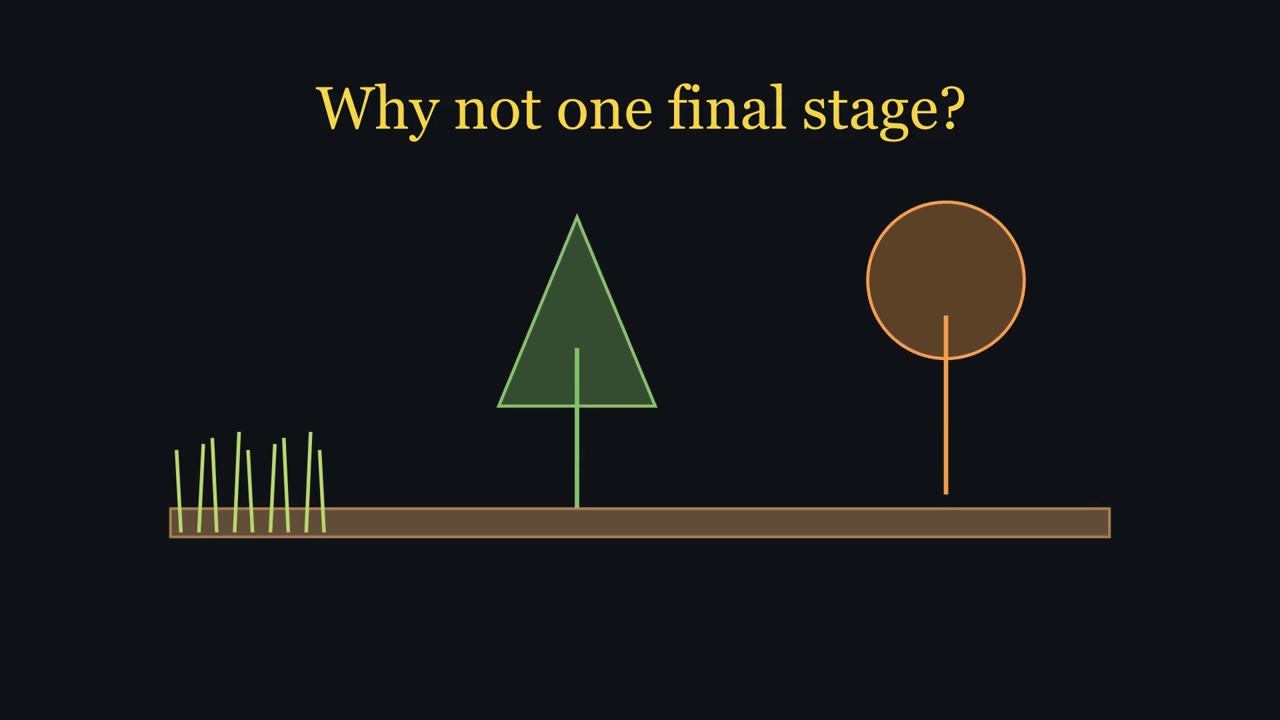
Primary succession begins there, with pioneer species that can start building soil. On bare rock, the pioneers are usually lichens and mosses. Glacial gravel can begin with other hardy plants. Soil develops slowly before many rooted plants can establish. Starting with soil is why secondary succession usually reaches forest faster. Back in the old field, pines may give way to hardwoods as light changes. In most of Virginia, the older model names oak-hickory forest as the late stage. Yet nearby seeds, soil, climate, and disturbance can change the route and timing. Follow the changing conditions, not only the plant names. That move explains why one stage can favor another.
It also keeps a common path from becoming a promise about every field.
If you stopped mowing a field in the Virginia Piedmont and walked away for a hundred years, what would be standing there when you came back?
Continue in the lesson: Succession in Virginia →
3:23 · Free, with captions and a transcript. The lesson has the full text, the questions and the sources.
More films from this lesson
How this film was made. Narration: written from this lesson's text and read by an AI narrator voice (Kokoro, af_heart). Animation: AI-generated in code (Manim) by Claude, a schematic with no drawn molecular structures. Captions come from the narration script. See something wrong? Report it.