Organismal Biology · Skim version
Digestive Systems and Nutrition
Read the full lesson → Skim the whole course →
The guiding idea
Why would a rabbit eat some of its own droppings?
A complete gut is a one-way line: large food molecules must be broken down before or within the stretch that can absorb them, and what a stretch does not absorb moves on, to be taken up downstream or lost in the feces.
From the film: Why Order Matters in a Gut
- A complete gut is a one-way tube, so each stretch can specialize and works on what the stretch before it hands on.
- Large food molecules must be broken down before or within the stretch that can absorb them; what a stretch does not absorb moves on, to be taken up downstream or lost in the feces.
- In humans the body's own digestion starts in the mouth and stomach and is mostly done in the small intestine, where pancreatic enzymes and bile salts act and most nutrients are absorbed; the colon takes back most of the water left.
- Microbes ferment fiber, and their fatty acids are absorbed where they are made. Their protein is recovered as amino acids mainly when it passes through the stomach and small intestine: a cow's microbes do, a rabbit sends them round again, and most of a horse's is lost.
From the film: How Does the Stomach Know Food Is Coming?
- Pavlov's sham-fed dogs poured acid juice from the stomach while they ate, though the food left at the neck and never reached the stomach.
- Cutting both vagus nerves abolished that juice, so in the dog the first, cephalic phase is driven by nerves that ready the stomach before food arrives; this does not rule out later phases.
- Acid reaching the duodenum releases the hormone secretin, which brings bicarbonate-rich fluid from the pancreas to neutralize it.
- Fat and protein reaching the duodenum release CCK, which brings pancreatic enzymes and bile from the gallbladder.
-
One tube, four jobs and two helpers
-
Mouth to anus in a human
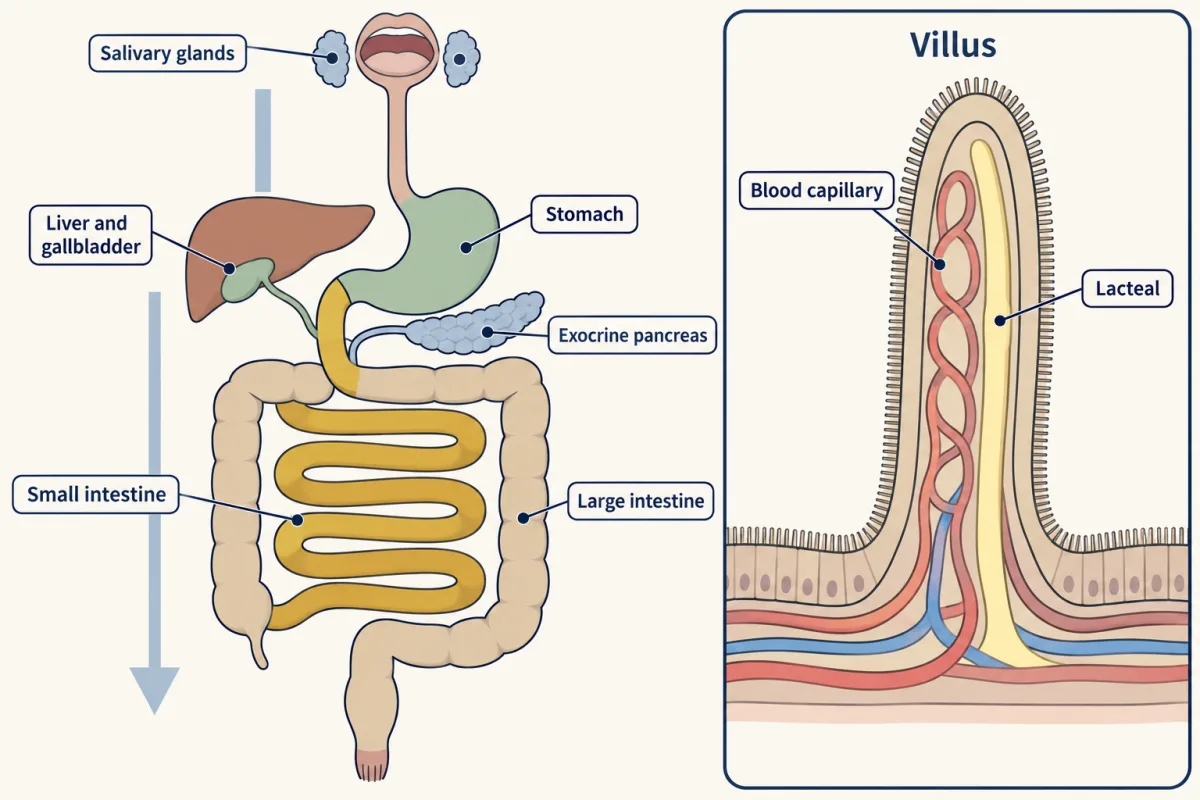
The body's own digestion starts in the mouth and stomach and is mostly done in the small intestine, where it overlaps with absorption; the liver, gallbladder and pancreas all feed the duodenum, its first part. AI-generated illustration -
The water budget: the one idea in numbers
-
Where the microbes sit: cow, horse, rabbit, hoatzin
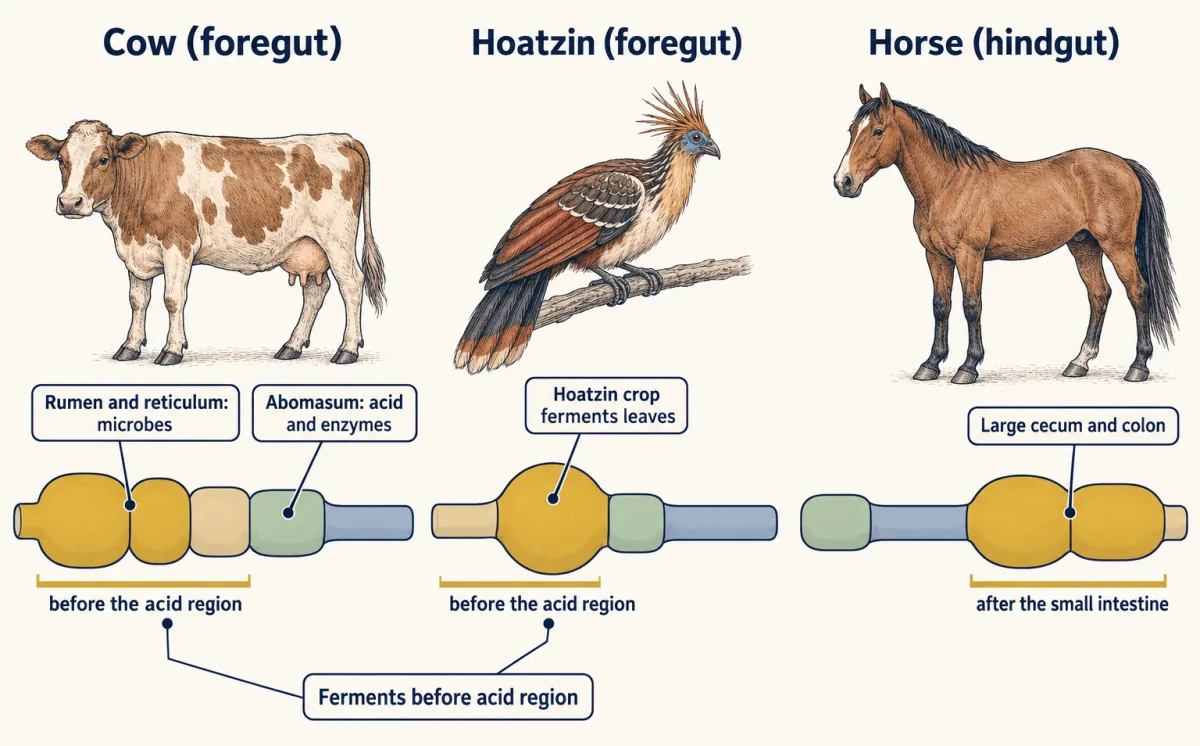
A cow and a hoatzin ferment before the acid stomach and small intestine; a horse ferments after them, in the cecum and colon. AI-generated illustration -
Nerves and hormones run the line
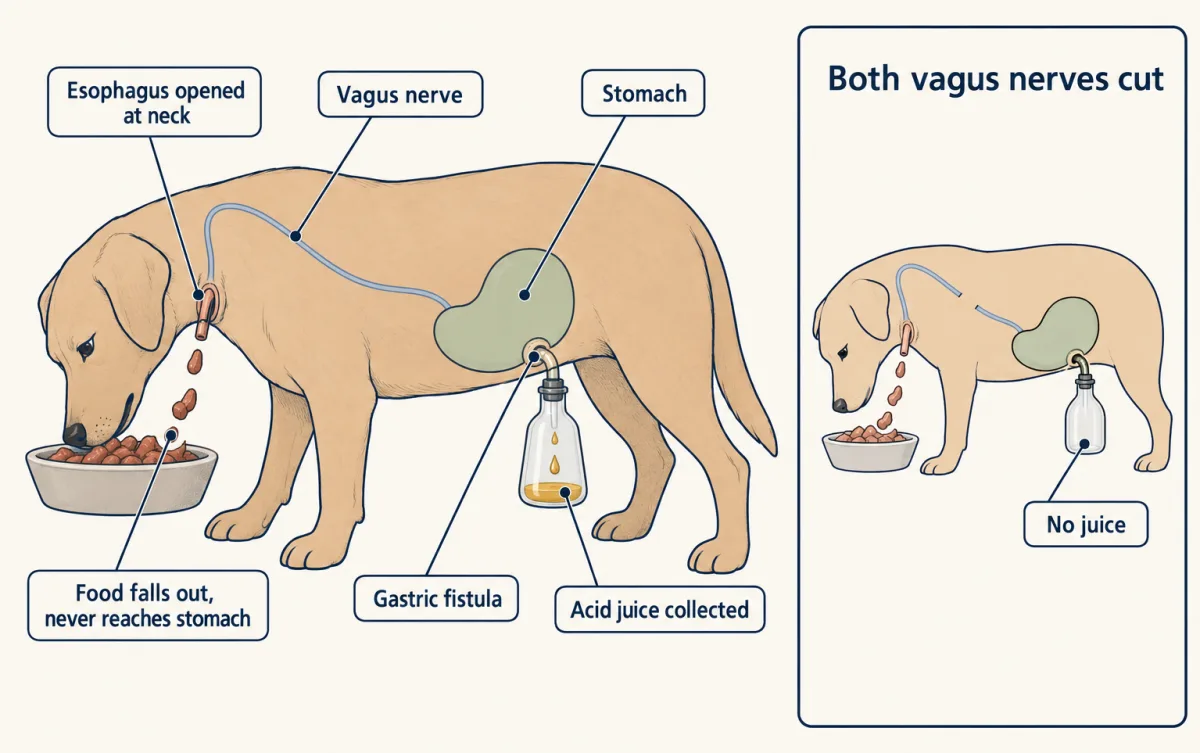
Sham feeding separates eating from food in the stomach: in the dog, eating alone brings acid juice only while the vagus nerves are intact. AI-generated illustration -
Essential depends on who is eating
-
Going deeper
Where this lesson fits
Before thisReview first
- Animal Body Plans: Similar Bodies, Different BranchesThis course · Lesson 4
It separates complete one-way guts from sac-like incomplete guts, which this lesson uses straight away.
- Tissues, Organs and HomeostasisThis course · Lesson 6
You need the layers of the gut wall and the idea of control loops from there.
- Nervous Control: A First LookThis course · Lesson 7
It introduces autonomic and reflex pathways, which this lesson uses for vagal and enteric control of digestion.
After thisStudy next
- Osmoregulation and Nitrogenous WasteThis course · Lesson 15
It takes the gut's water and salt handling further, showing how animals balance water and nitrogenous waste.
- The KidneyThis course · Lesson 16
It uses the same large-flow, small-leftover water accounting, applied to filtering plasma and taking almost all of it back.
- Soil, Nutrients and PartnersThis course · Lesson 24
It asks what an organism must take in from outside, here minerals from soil with microbial partners.
Elsewhere on the siteFilms, simulations and method films in other courses
- Build a big molecule from small blocksSimulation · Biology
It shows large food molecules being broken into small blocks by adding water, which is the hydrolysis step of digestion.
- Take It Apart, Build It AgainFilm · Biology
It shows digestion breaking starch and protein into small pieces by adding water, one water per broken link.
Suggested by an AI model from the lessons themselves, then checked. How we use AI