Biology · Skim version
Crossing the Membrane
Read the full lesson → Skim the whole course →
The guiding idea
Why does a slice of cucumber left in salty water get lighter and go limp, while a slice in plain water gets heavier?
With no energy spent, a substance that can cross a membrane moves down its own gradient, and for water that means toward the side with more trapped solute; moving a substance uphill costs the cell energy, often from ATP.
From the film: Downhill for Free
- Molecules move at random all the time; once they are spread evenly they still move, but there is no net movement.
- In open water, with no energy spent, a substance moves on balance down its concentration gradient, from where it is more concentrated to where it is less.
- The membrane's oily middle lets small molecules such as oxygen through, while charged ions such as sodium and chloride cross mainly through proteins.
- Whatever can cross runs downhill for free, and water runs toward the side with more dissolved particles that cannot cross. That net movement of water is osmosis.
From the film: Paying to Go Uphill
- Active transport uses energy from the cell, often from ATP, and it can move a substance against its gradient.
- Each cycle, the sodium-potassium pump uses one ATP to move three sodium ions out and two potassium ions in, both uphill.
- Sodium and potassium leak back down their gradients through channels all the time, so the pump must keep working to hold the differences.
- Without ATP the pump stops, and the sodium and potassium differences slowly shrink.
-
Explore: put a cell in salt water
-
Explain: a thin, choosy boundary
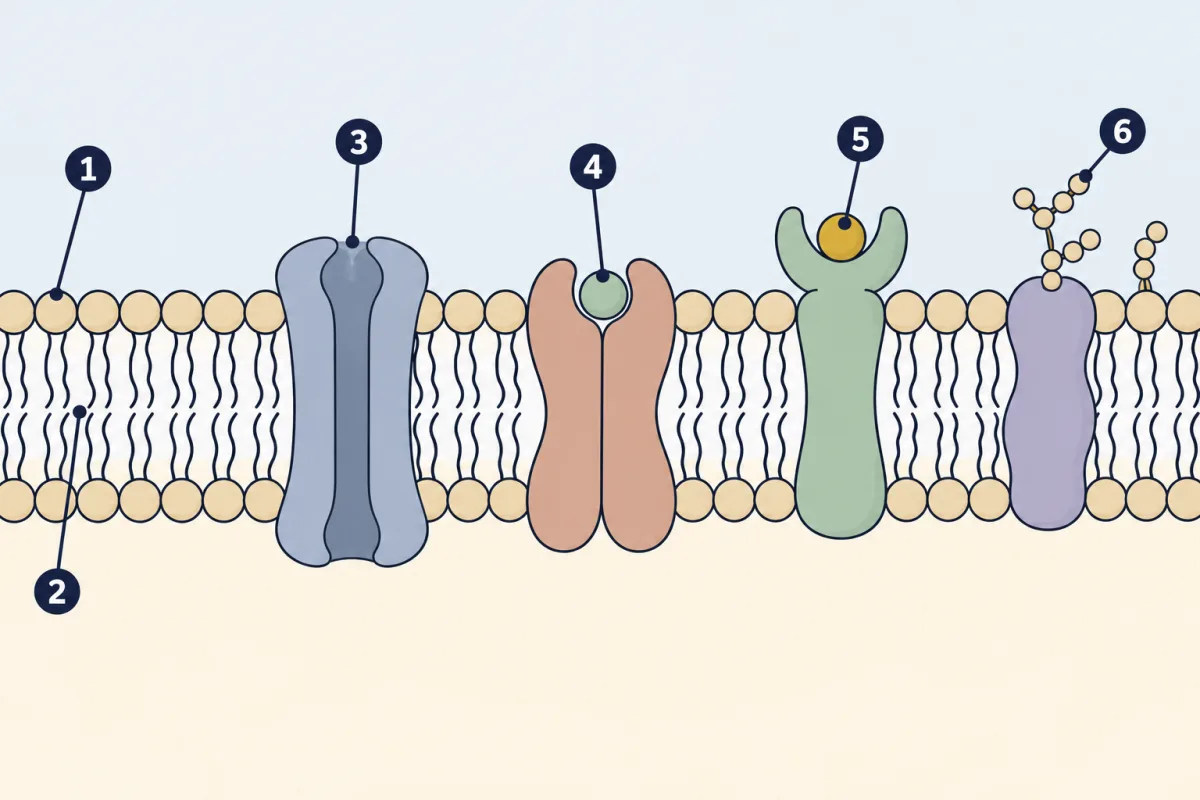
- phospholipid heads
- fatty tails
- channel protein
- carrier protein
- receptor protein
- sugar chains
-
Explain: moving downhill with no energy
-
Explain: paying to move uphill
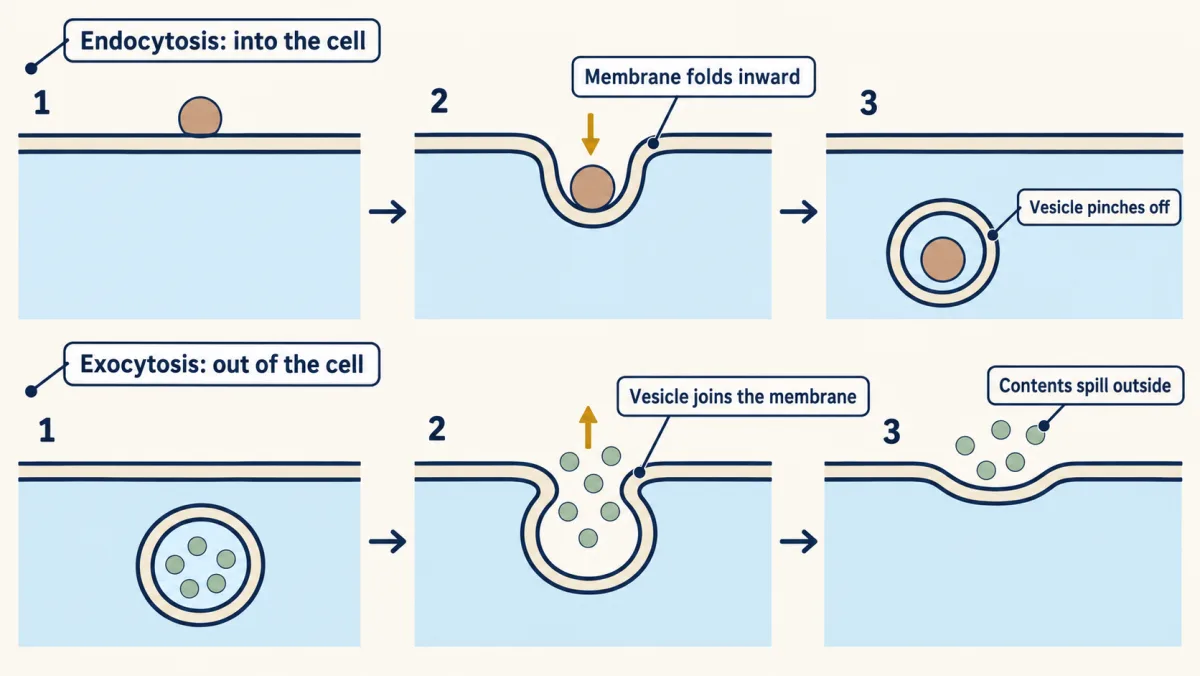
Endocytosis folds the membrane around a load and pinches off a vesicle inside the cell; exocytosis runs the other way. Both use energy from the cell. AI-generated illustration -
Elaborate: weighing cucumber slices
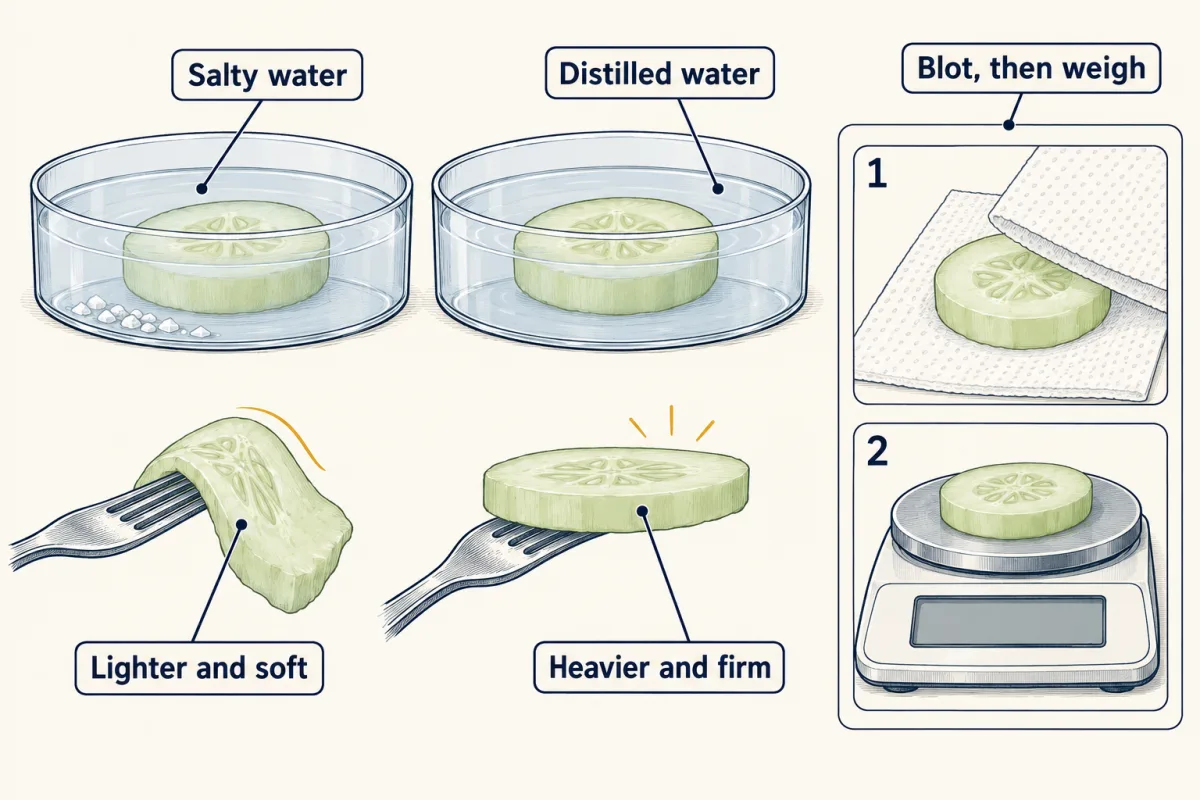
In salty water a cucumber slice loses water and goes soft; in distilled water it gains water and stays firm. AI-generated illustration -
Evaluate: check your thinking
-
Going deeper
Where this lesson fits
Before thisReview first
- Water and LifeThis course · Lesson 1
You need water's polarity and why it dissolves salts to see why trapped solute pulls water toward it.
- What Am I Made Of?This course · Lesson 2
Knowing lipids and proteins as building blocks helps you read the membrane as a lipid layer with proteins.
- Respiration and ATPThis course · Lesson 5
Active transport spends ATP, and this lesson uses what ATP is and where the cell gets it.
After thisStudy next
- Homeostasis in ActionThis course · Lesson 9
Cells holding sodium and potassium differences and water balance is part of how the body keeps conditions steady.
- One Cell or ManyThis course · Lesson 11
A single-celled organism must manage water and exchange across its membrane, putting transport to work.
Elsewhere on the siteFilms, simulations and method films in other courses
- Two sides of a membraneSimulation · Life Science
It lets you watch water cross a membrane toward the side with more trapped solute.
- Random Moves, One-Way DriftFilm · Life Science
It shows random particle motion giving a one-way drift down a gradient.
- Build a cell for a jobSimulation · Life Science
It lets you see water move in and out of cells, as with the cucumber slice.
Suggested by an AI model from the lessons themselves, then checked. How we use AI