Developmental Neuroscience · Skim version
Opening and Closing a Critical Period
Read the full lesson → Skim the whole course →
The guiding idea
A mouse that lacks one enzyme for making GABA keeps its critical period waiting for months. One drug starts it.
In mouse and rat visual cortex, the ocular dominance window follows the inhibitory cells, not the calendar: maturing inhibition starts it, and added brakes close it.
From the film: A Window That Follows the Cells
- In mouse visual cortex, a few days with one eye closed reshape the cortex strongly in youth and much less in adults.
- The window follows the inhibitory cells, not the calendar: in the working model, maturing inhibition, especially from parvalbumin basket cells, opens it once it passes a threshold.
- As inhibition keeps maturing and brakes build up around these cells, the window closes.
From the film: Switch It On with a Drug
- GAD65 knockout mice, which release too little GABA, showed no ocular dominance shift at the normal age, and diazepam restored it.
- Inhibition is permissive and the difference between the eyes is instructive: the shift went toward the eye that stayed open.
- In young cortex, a brief boost of inhibition can start a window without having to stay present.
From the film: Brakes, and Borrowed Cells
- In rodents, removing a brake such as the perineuronal net, the Nogo receptor or Lynx1 let plasticity persist or return, so the window is actively held shut rather than decaying.
- Transplanted inhibitory neuron precursors gave the young host a second window when the donor cells reached about the age of native interneurons, so the window follows the cells.
- These rodent results show mechanism, not an established treatment for amblyopia in people.
-
The readout, step by step
-
Is it the calendar? The GAD65 test
-
Why would more inhibition help?
-
Which inhibition: follow the basket cells
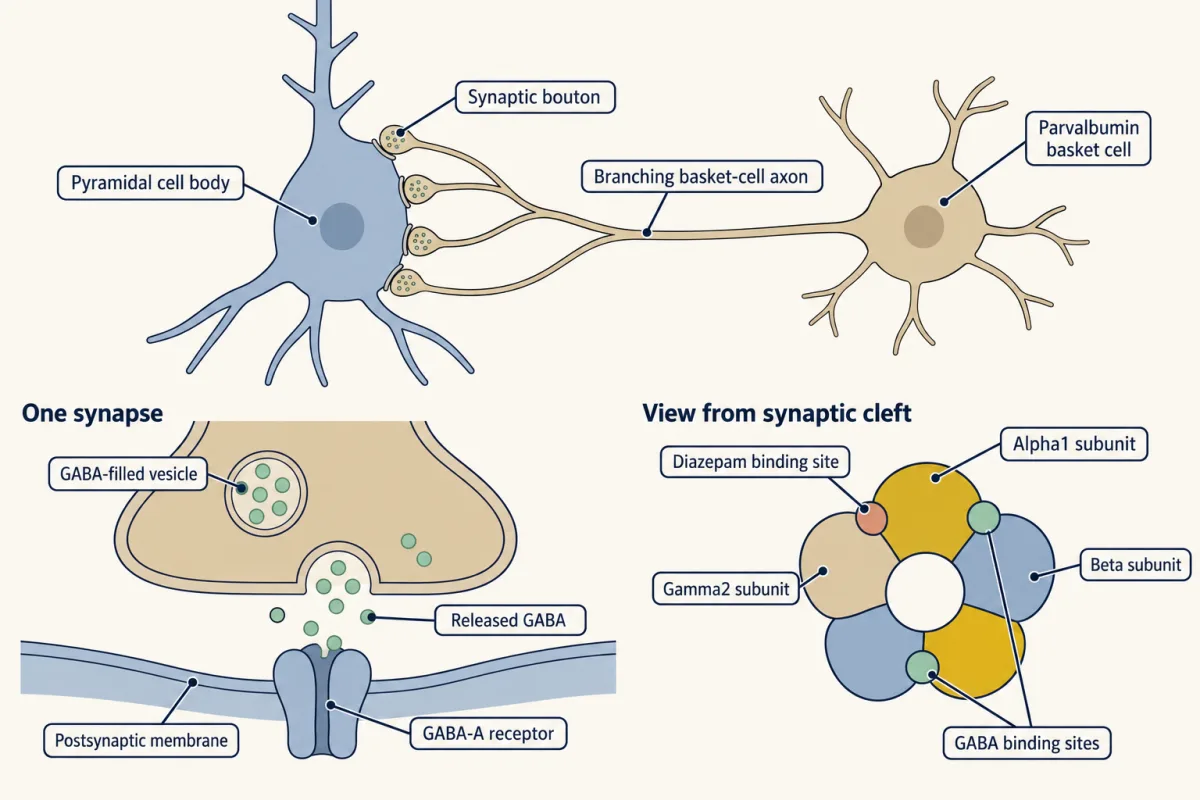
Parvalbumin basket-cell axons form synapses on pyramidal-cell bodies. GABA acts on postsynaptic GABA-A receptors, including receptors containing alpha1; diazepam binds at a separate site between alpha1 and gamma2 subunits and strengthens the response to GABA. In mouse visual cortex, making alpha1 insensitive to diazepam prevented the drug from opening the window early. AI-generated illustration 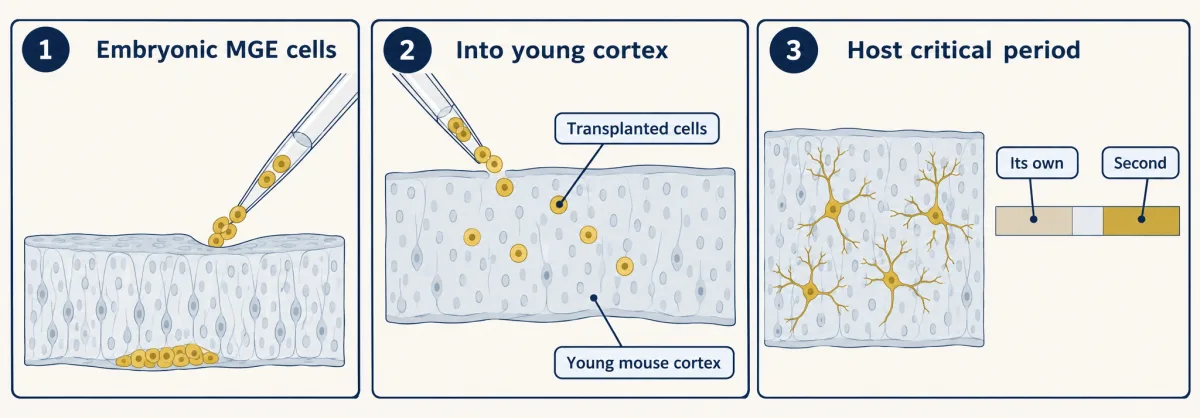
Embryonic medial ganglionic eminence (MGE) cells were transplanted into young mouse cortex. A second period of ocular dominance plasticity followed the host's normal critical period, when the donor cells reached about the age of native interneurons during it. Tissue and timeline are schematic. AI-generated illustration -
Closing the window: brakes, not decay
-
Reopening the window, and what it promises for amblyopia
-
Putting it together
-
Going deeper
Where this lesson fits
Before thisReview first
- Ocular Dominance and the Critical PeriodThis course · Lesson 39
This lesson takes the monocular deprivation shift and the ocular dominance index from there and asks what sets the window.
- Tangential Migration: Interneurons and the Long Way RoundThis course · Lesson 19
The inhibitory basket cells and MGE transplants in this lesson depend on interneurons being born outside cortex and migrating in.
After thisStudy next
- Microglia and Complement Prune SynapsesThis course · Lesson 41
It asks how non-neuronal cells prune synapses during the same experience-driven refinement, which this lesson's window regulation sets the timing for.
- Sensitive Periods in Behavior: Song, Language and SightThis course · Lesson 42
It extends the idea of a regulated window from visual cortex to song and language, which this lesson explicitly leaves for there.
- Disorders of the Synapse: Built, Then KeptThis course · Lesson 49
It uses the idea that a silenced state can be reversed in adults, as reopening plasticity is here.
Elsewhere on the siteFilms, simulations and method films in other courses
- Shunting inhibitionSimulation · Neuroscience
Shows how inhibition changes a cell's response, the property that opens the window here.
- Depletion and the paired-pulse ratioSimulation · Neuroscience
Shows how activity strengthens or weakens synapses, the plasticity the critical period gates.
Suggested by an AI model from the lessons themselves, then checked. How we use AI