Developmental Neuroscience · Skim version
Synapses in the Brain: Adhesion, Scaffolds and Astrocytes
Read the full lesson → Skim the whole course →
The guiding idea
A kidney cell that makes one neuronal protein, neuroligin, can persuade an axon to build a nerve terminal on it. So what happens to the synapses of a mouse that lacks neuroligins 1, 2 and 3?
At central synapses, a synapse that is there is not yet a synapse that works: presence, release and response are separate properties, and each experiment sees only those it measures.
From the film: There, but Not Working
- A synapse that is there is not yet a synapse that works.
- A finished synapse is there, releases transmitter and responds, and each property needs its own measurement.
- In stargazer cerebellar granule cells the synapses are present and release but give NMDA and no AMPA responses, so a count alone would miss the defect.
From the film: What a Dish Can Show
- In a dish, neuroligin on a kidney cell is sufficient, under those conditions, to start a presynaptic terminal on it.
- In mice lacking alpha-neurexins or neuroligins 1 to 3, most synapses were present but transmission was impaired.
- A dish tests what one protein can start, and a mouse tests what the brain cannot do without, so measure function as well as number.
From the film: Astrocytes Build and Switch On
- Astrocytes add to synapse formation but are not its sole cause, since neurons form some synapses without them.
- In purified retinal ganglion cell cultures, glia raised mini frequency about twelvefold but synapse count about 2.3 times, and the paper read most of the rise as more effective synapses.
- Thrombospondins build synapses that release but are silent near rest, and glypicans 4 and 6 recruit AMPA receptors and switch them on.
-
Three things a working synapse does
-
Why central synapses are harder than the neuromuscular junction
-
Signals that turn a growth cone into a nerve terminal
-
The receiving side: a scaffold that holds receptors
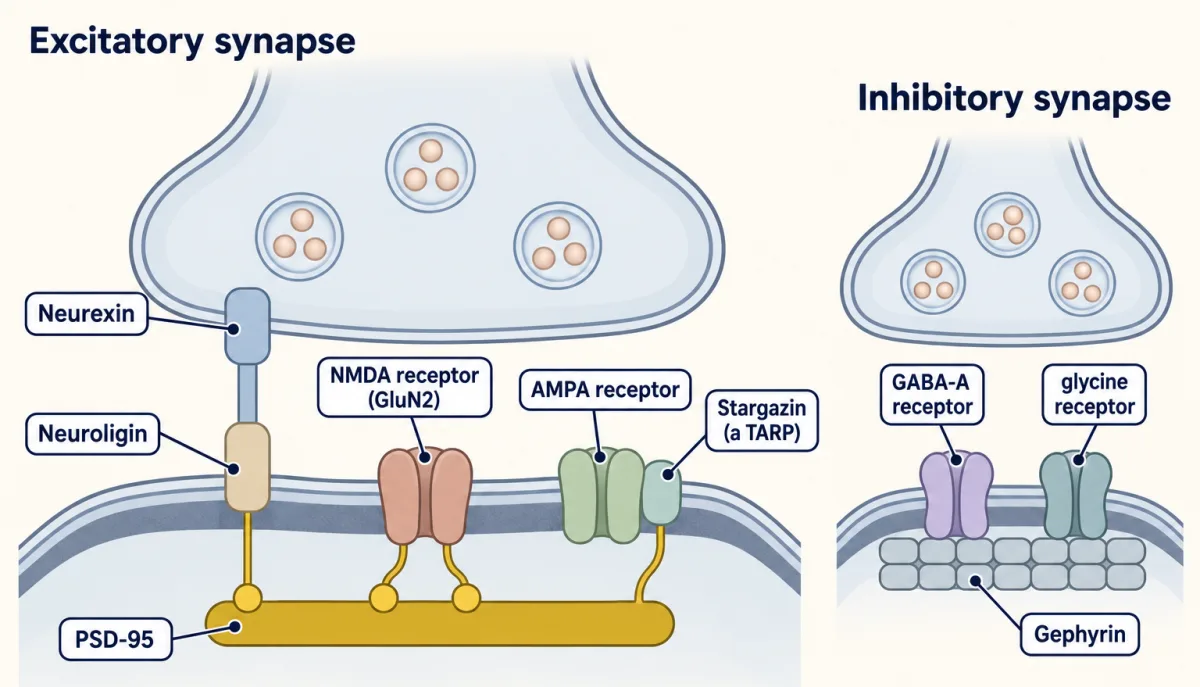
At an excitatory synapse, PSD-95 binds neuroligin and NMDA receptor GluN2 tails directly and anchors AMPA receptors through stargazin, one of the TARPs. At inhibitory synapses, gephyrin forms dense clusters that anchor glycine receptors and many GABA-A receptors. AI-generated illustration -
A dish shows what a protein can do; a mouse shows what the brain needs
-
Astrocytes: building and switching on
-
Maturation: GABA changes sign
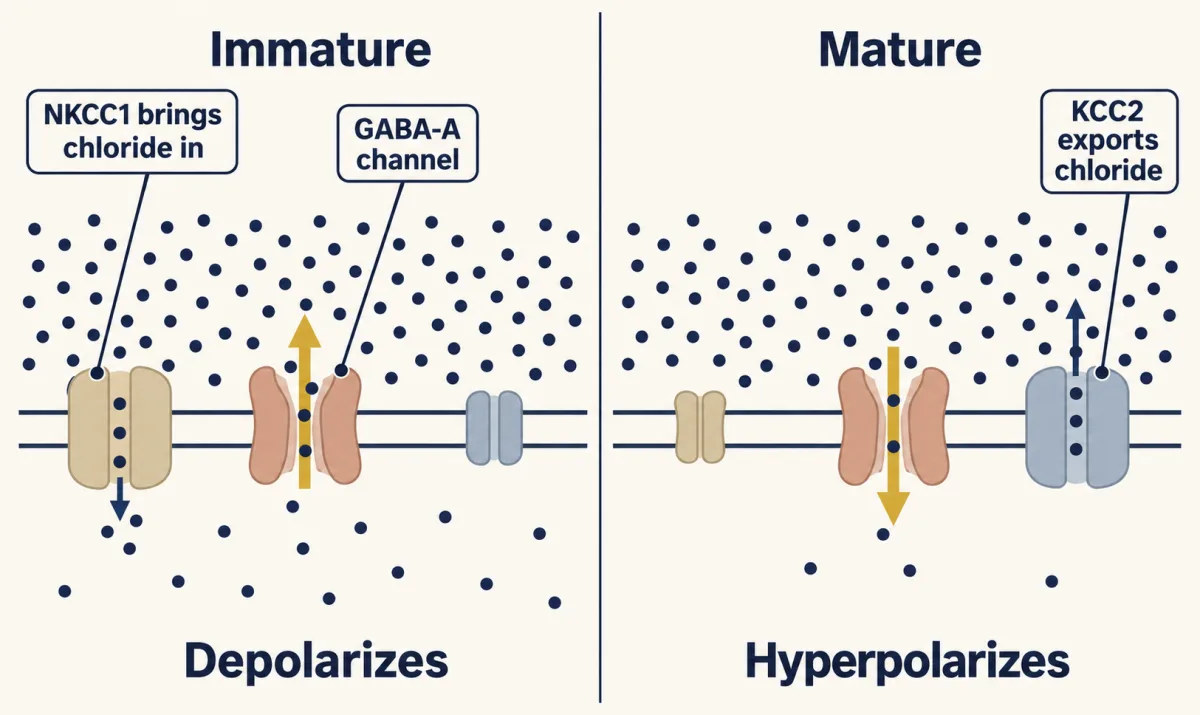
Schematic chloride regulation in rodent hippocampal and cortical neurons. In immature neurons, NKCC1 brings chloride in and KCC2 is scarce, so opening GABA-A channels lets chloride out and depolarizes the membrane. As KCC2 rises over the first postnatal weeks, internal chloride falls; opening GABA-A channels then lets chloride in and hyperpolarizes the membrane under the conditions described here. Depolarizing GABA can still inhibit by shunting. Protein sizes and ion counts are schematic. AI-generated illustration -
Putting it together
-
Going deeper
Where this lesson fits
Before thisReview first
- The Neurotrophic Hypothesis TestedThis course · Lesson 29
The lesson uses the sufficient versus necessary distinction that was set up there.
- The Growth Cone: The Tip That Steers the AxonThis course · Lesson 3
You need to know how a growth cone behaves before asking what turns it into a nerve terminal.
After thisStudy next
- Synapse Elimination: One Muscle Fiber, One AxonThis course · Lesson 37
Once synapses are built and working, this lesson asks how inputs on one target compete and lose sites.
- Microglia and Complement Prune SynapsesThis course · Lesson 41
It takes up what happens after formation, when glia remove synapses that were built.
- Opening and Closing a Critical PeriodThis course · Lesson 40
It uses the maturing GABA synapse and its shift in sign to explain when plasticity opens.
Elsewhere on the siteFilms, simulations and method films in other courses
- Blips from a Silent NerveFilm · Neuroscience
It shows quantal release and response at a synapse, the release and response properties this lesson separates.
- Three Steps, One DrugFilm · Neuroscience
It covers GABA receptors and how the transmitter is read, linking to GABA changing sign as synapses mature.
Suggested by an AI model from the lessons themselves, then checked. How we use AI