Look Alike, Far Apart
Read the transcript of “Look Alike, Far Apart”
Film transcript: Look Alike, Far Apart
A methanogen and E. coli look almost the same under a microscope. Are they close relatives? Both are small cells with no nucleus. A methanogen makes methane, and this one lives in a cow's rumen. For a long time, biologists lumped all cells without a nucleus together as prokaryotes. But that grouping rests on something missing. Two cells can both lack a nucleus and still be distant relatives. Carl Woese looked for a part that every cell carries, doing the same job in each. He chose the ribosome, the particle that makes proteins.
Inside its small subunit lies a strand of RNA. His laboratory pulled this small-subunit ribosomal RNA from many microbes. They cut each strand into pieces and compared the pieces, organism by organism. Each pair got a similarity score. Here is the logic. Small changes pile up in the RNA as lineages separate. So fewer differences usually mean a more recent common ancestor. Now the scores fill a grid, one cell for every pair. A stated grouping method can then propose a tree from the grid. Different methods make different assumptions, so the grid alone does not fix one tree. Methanogens look like bacteria. So where do you think they landed on the tree?
Close to E. coli, or somewhere else? Not among the bacteria. Woese and George Fox reported that methanogens formed their own group. It sat about as far from bacteria as from eukaryotes, the cells with a nucleus. They first called the new group archaebacteria.
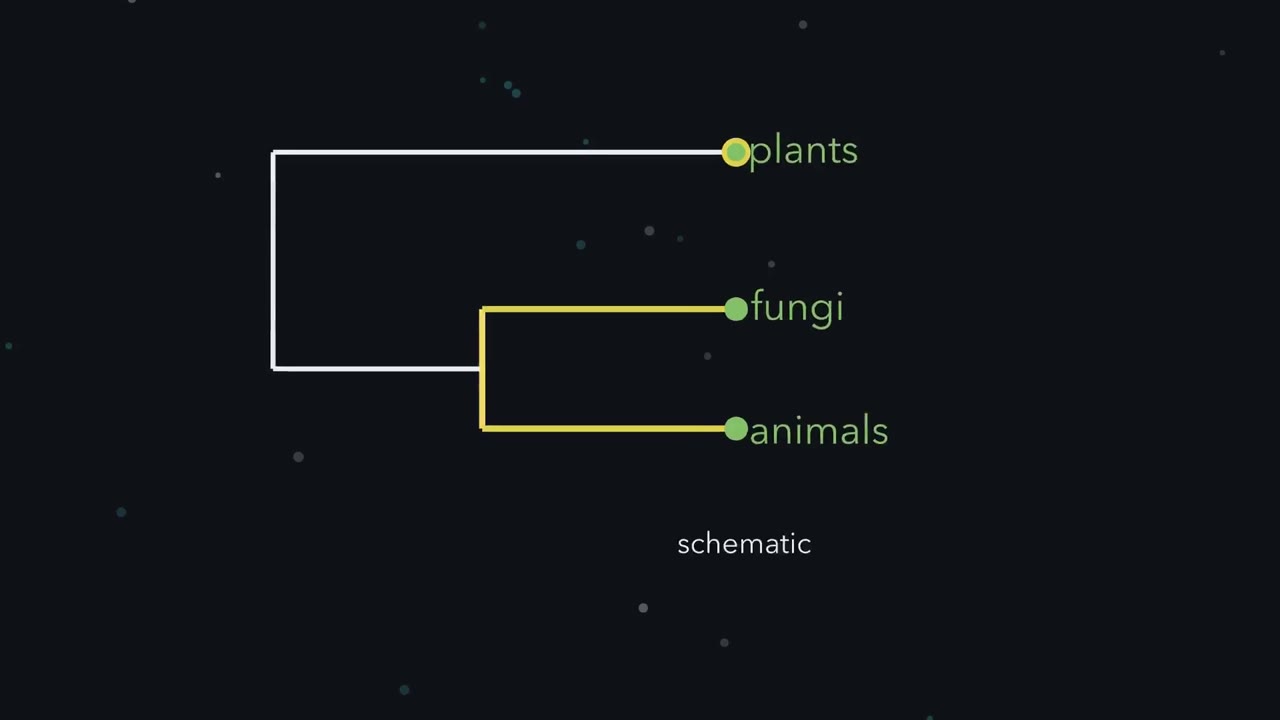
Later, Woese and colleagues proposed three domains: Bacteria, Archaea and Eukarya. Those names are still the standard labels. What do the scores tell us, and what don't they? They rank closeness. They do not date a split, and they do not reveal an ancestor. Across the deepest splits, repeated changes at one site can blur the signal in a single molecule. Many genes and better models of change sharpen the branching pattern. But which branch came off first also needs an outside reference. Most recent trees of this kind place eukaryotes inside the archaea, closest to a group called the Asgard archaea. Exactly where is still debated. On that view, life has two primary branches, Bacteria and Archaea.
So, back to the methanogen and E. coli. Their looks hid how far apart they are. A molecule every cell shares revealed it.
A methane-making microbe and E. coli look alike under a microscope. How can we tell whether they are close relatives?
Continue in the lesson: Microbes, Protists and Fungi →
3:18 · Free, with captions and a transcript. The lesson has the full text, the questions and the sources.
More films from this lesson
How this film was made. Narration: written from this lesson's text and read by an AI narrator voice (Kokoro, af_heart). Animation: AI-generated in code (Manim) by Claude, a schematic with no drawn molecular structures. Captions come from the narration script. See something wrong? Report it.