Cell Biology · Skim version
Checkpoints and Irreversible Transitions
Read the full lesson → Skim the whole course →
The guiding idea
A yeast cell missing one gene keeps dividing after irradiation and dies. Hold it back with a drug, and it can repair the damage. What was the gene for?
A checkpoint is a control that makes one cell-cycle event wait until another is finished, so that a cell does not divide with damaged, half-copied or unsorted DNA.
From the film: A Brake Wired to a Sensor
- A checkpoint is a brake wired to a sensor: while the sensor sees an unfinished job, the brake holds back the next step. Without it, a cell divides on time, not on completion.
- RAD9 was needed for waiting, not for repair: held in G2 with a drug, irradiated rad9 cells repaired their DNA.
- In G2, Chk1 and Chk2 (switched on by ATR and ATM) inhibit Cdc25, so Cdk1 keeps its inhibitory phosphates and the cell waits.
- One unattached kinetochore is enough to hold anaphase: it builds the MCC, a decoy key that fills Cdc20's slots and keeps APC/C from tagging securin and cyclin B.
- The step that follows is hard to undo, because destroyed securin and cyclin B must be made again and the Cdk1 feedback switch resists reversal.
From the film: Timing Securin's Destruction
- A fluorescent tag on securin lets you time its destruction in one living cell; in HeLa cells it starts to fall at metaphase, once the checkpoint is satisfied.
- If securin is destroyed at a constant fractional rate and none is made, each half-life halves what is left.
- The loss is a steady fraction, not a steady amount: in the made-up data, 100 falls to 50 in 10 minutes and to 25 in 20.
- The rate constant k is ln 2 divided by the half-life; a 10-minute half-life gives k of about 0.069 per minute.
-
The idea: a checkpoint makes one event wait for another
-
The map: three checkpoints, two engines
-
Damage and replication: kinases that keep a CDK off
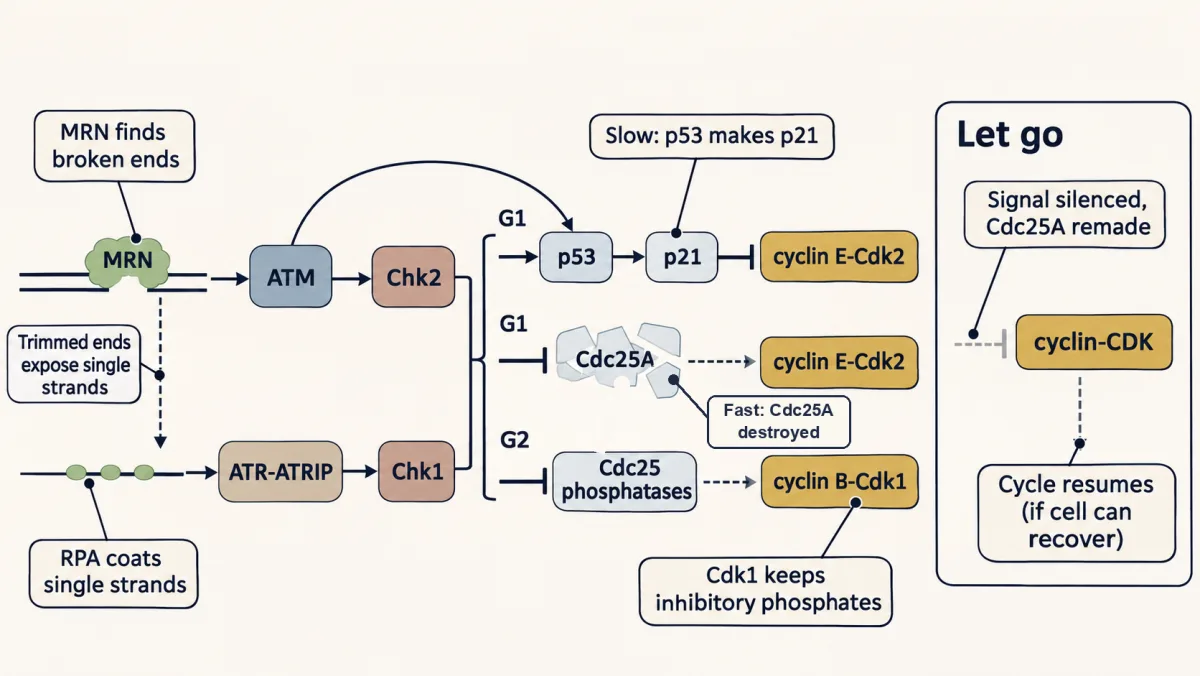
Both DNA checkpoints run one circuit: something finds the damage (MRN at broken ends, RPA on single strands), an upstream kinase switches on (ATM, ATR), a messenger kinase passes the signal on (mainly Chk2, Chk1), and a cyclin-CDK is held off. In G2, Cdc25 phosphatases are inhibited and Cdk1 stays off; in G1, Cdc25A is destroyed fast, and p53 makes p21 more slowly. When the signal is silenced, the brake can lift. AI-generated illustration 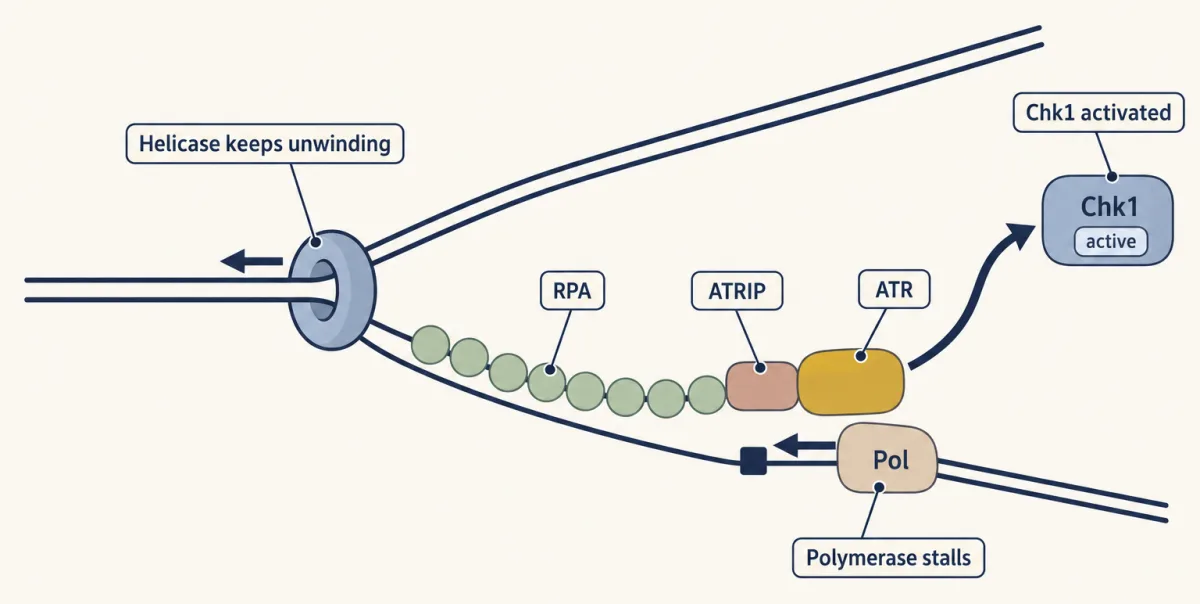
A stalled fork raises its own alarm: when a polymerase stalls but the helicase keeps unwinding, single-stranded DNA appears and is coated with RPA. RPA helps ATRIP and ATR reach it, activators such as TopBP1 switch ATR on, and ATR then activates Chk1. AI-generated illustration -
The spindle checkpoint: one kinetochore says wait
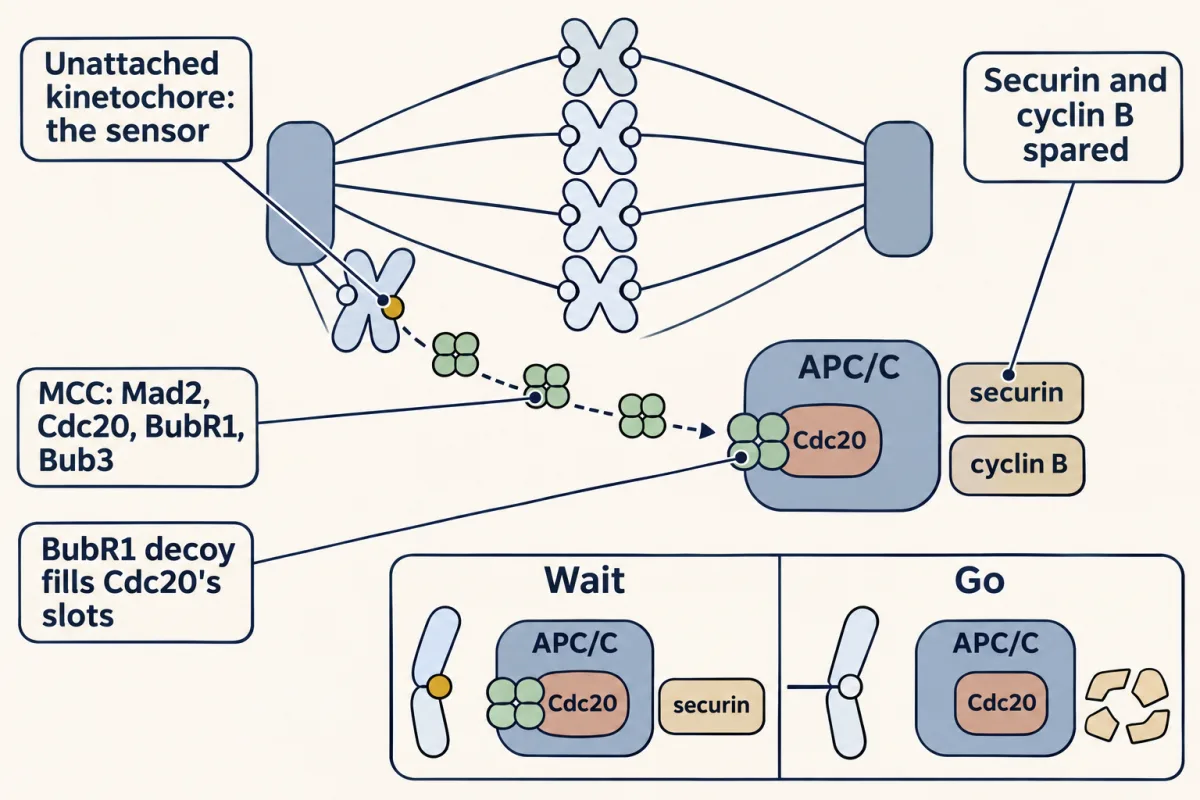
One unattached kinetochore is enough to hold the whole cell: it promotes assembly of the MCC, whose BubR1 acts as a decoy in Cdc20's substrate slots, so APC/C-Cdc20 spares securin and cyclin B. When the last kinetochore attaches, MCC production subsides and destruction can begin. AI-generated illustration -
One-way doors: destruction and feedback
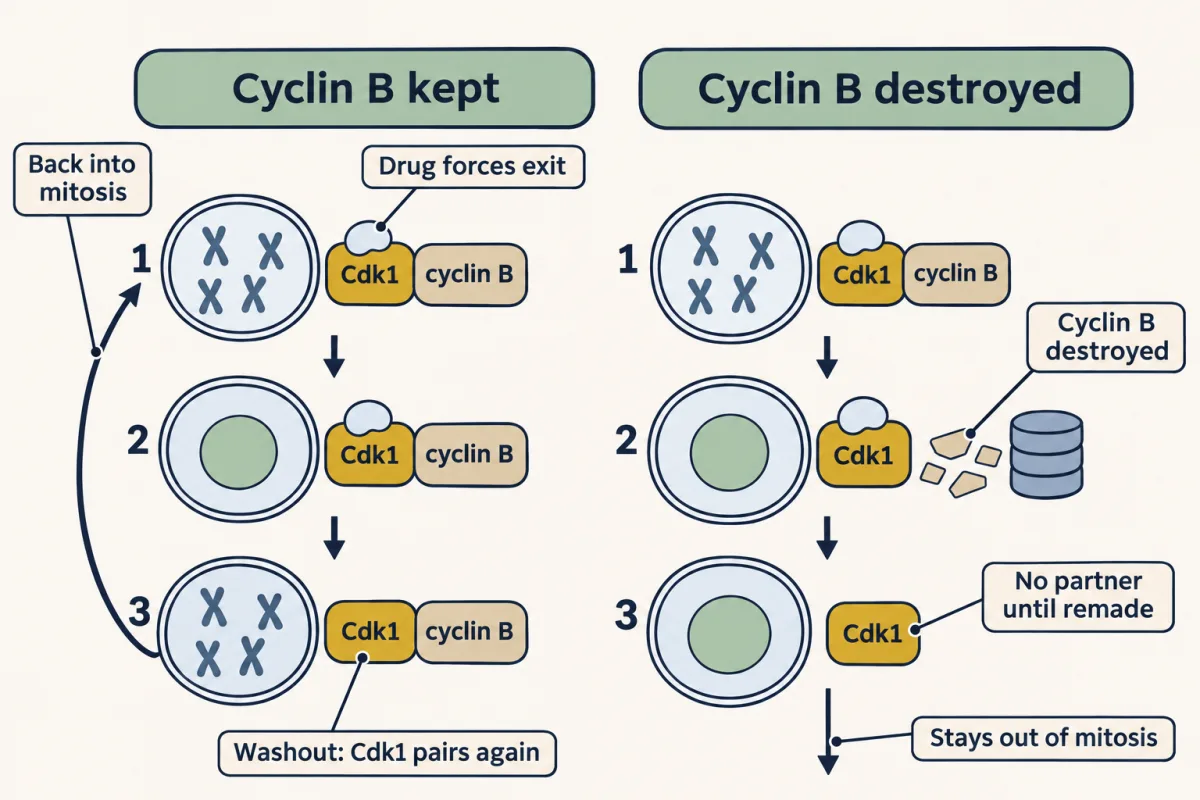
Destruction makes exit stick. Cells forced out of mitosis with a Cdk1 inhibitor went back into mitosis on washout if their cyclin B was intact, but stayed out if it had been destroyed, because Cdk1 has no partner until new cyclin B is made (inhibitory phosphorylation of Cdk1 can add a second lock). AI-generated illustration -
A worked problem: timing securin destruction
-
Going deeper
Where this lesson fits
Before thisReview first
- Cyclin-CDK Control of the Cell CycleThis course · Lesson 17
You need the cyclin-CDK engine and its inhibitory phosphates from there to see what each checkpoint holds back.
- Protein Quality Control and Organelle TurnoverThis course · Lesson 9
Regulated destruction of proteins and the ideas of flux and turnover from there are used when reading securin degradation.
After thisStudy next
- Mitosis and Chromosome SegregationThis course · Lesson 19
It uses the spindle checkpoint and APC/C-Cdc20 securin destruction to explain how sister chromatids separate at anaphase.
- Cell Death and ClearanceThis course · Lesson 21
Cells with damage that cannot be repaired may withdraw or die, so it picks up where the DNA damage response ends.
- Cell Identity, Cell State and DiseaseThis course · Lesson 25
It shows how losing checkpoint control and the damage response lets mutations build up in cancer.
Elsewhere on the siteFilms, simulations and method films in other courses
- Mitosis stepper and phase counterSimulation · Biology
This is not a real sim id; ignore.
Suggested by an AI model from the lessons themselves, then checked. How we use AI