Developmental Neuroscience · Skim version
Birth Order and Fate: Temporal Identity and the Inside-Out Cortex
Read the full lesson → Skim the whole course →
The guiding idea
In the mouse cortex, the first cortical-plate neurons born end up deepest. Why do the latecomers climb past them?
In the mammalian neocortex, the day a neuron is born predicts the layer it ends up in, and in the fly the order in which a stem cell makes its daughters helps set what each daughter becomes.
From the film: The Wall of the Brain
- In the cortical plate, the earlier a neuron is born, the deeper its layer.
- A birthday is a timestamp, and the progenitor's state at that time sets the neuron's temporal identity.
- That state has two parts: what the progenitor can still make, and the cues it reads.
- In normal development the progenitor's menu gets shorter with time.
From the film: Dating a Birthday
- A thymidine pulse dates a neuron's birth, because the label marks its last S phase.
- In the neocortex, later-born neurons pass earlier-born ones and settle above them, a strong tendency with overlap between days.
- The preplate is an exception: its cells are born first but end up both at the top and at the bottom.
From the film: Moving a Birthday
- A birthday is a record, not a cause.
- In ferret grafts, host cues still act on progenitors moved in S phase, but laminar fate is fixed by a later stage, before division.
- In these ferret experiments late progenitors lost deep-layer fates from their menu, though some mouse progenitors can go back.
From the film: A Clock in the Fly
- Most embryonic fly neuroblasts express Hunchback, then Krüppel, then Pdm, then Castor, in overlapping windows.
- Place sets the class of neuron, and time, read as these factors, picks the member.
- Removing or prolonging Hunchback in the nervous system changed first-born identities in the lineages examined.
From the film: Grow the Pool, Then Spend It
- In this simple model, the progenitor pool grows when Q is below 0.5, holds at 0.5 and shrinks above 0.5.
- Neuron output can keep rising for a cycle after the pool stops growing.
- The cortex first builds its progenitor pool and then spends much of it, and neurons made later go to more superficial layers.
- The model counts how many daughters leave, not which identity they take, so it does not give layer sizes.
From the film: What a Birthday Leaves Behind
- A neuron's layer is one record of its birthday, and identity-gene markers such as Tbr1, Ctip2 and Satb2 are another, though expression overlaps.
- In rodents, for most cortical neurons a dorsal birthplace goes with excitatory neurons and a ventral one with inhibitory interneurons.
- Whether mammalian progenitors run a transcription factor clock like the fly's is still open.
-
The layout
-
Dating a birthday
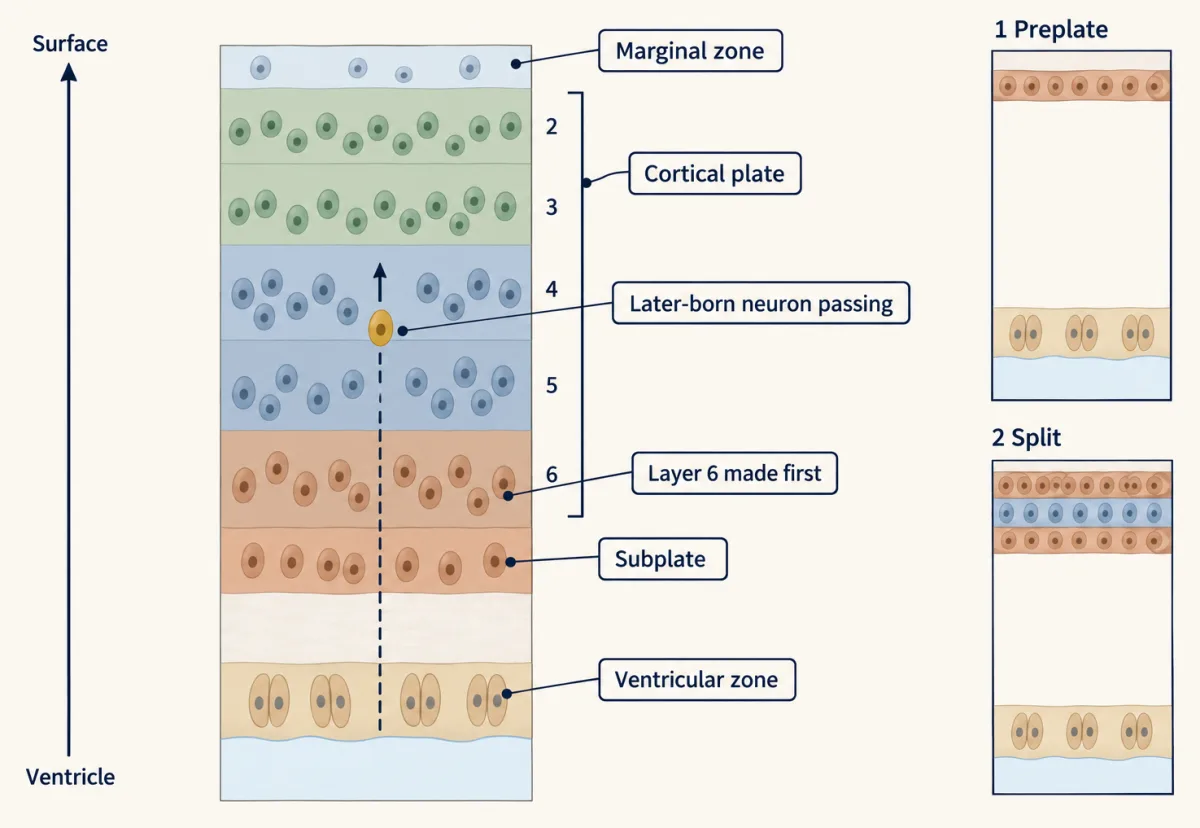
Excitatory cortical neurons arise from ventricular-zone progenitors, either directly or through intermediate progenitors in the subventricular zone, and migrate outward. The earliest neurons form the preplate; the next wave splits it into marginal zone and subplate, with the cortical plate between them. Within the cortical plate, later-born neurons pass earlier-born neurons: layer 6 forms first and layer 2 last. The schematic omits intervening developmental zones. AI-generated illustration -
Cause or record? Moving a birthday
-
What a clock is made of: the fly
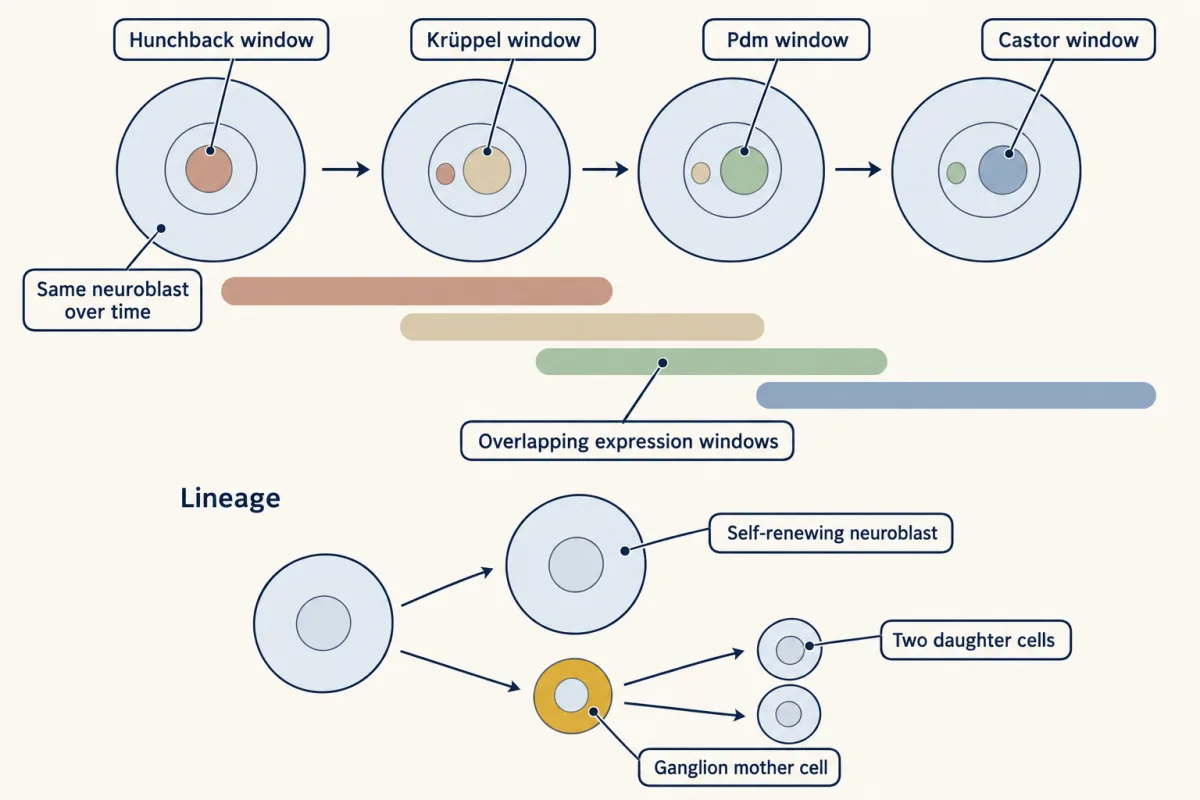
Most embryonic Drosophila neuroblasts express Hunchback, then Krüppel, then Pdm, then Castor in overlapping windows. Their progeny retain the transcription-factor profile present at birth. The snapshots summarize successive states of one self-renewing neuroblast; each ganglion mother cell is produced by the neuroblast and typically divides into two daughters. AI-generated illustration -
How many of each: the Q schedule
-
What a birthday leaves behind
-
Putting it together
-
Going deeper
Where this lesson fits
Before thisReview first
- The Ventricular Zone: Radial Glia as Stem CellsThis course · Lesson 13
The progenitors whose output and state this lesson times are the radial glia and intermediate progenitors introduced there.
- Asymmetric Division: Numb and the NeuroblastThis course · Lesson 15
You need to know how one division gives two sisters different fates before asking what tells later daughters apart.
- Tools for Following Cells and GenesThis course · Lesson 4
Labeling and following cells to learn when and where they were born is assumed when reading the birth-dating experiments.
After thisStudy next
- Radial Migration: Climbing the Glial LadderThis course · Lesson 17
It explains how later-born neurons climb past earlier ones, the movement that builds the inside-out order.
- Reelin and the Reeler MouseThis course · Lesson 18
The reeler mouse shows what happens when the inside-out order fails because migrating neurons cannot stop in the right place.
- Tangential Migration: Interneurons and the Long Way RoundThis course · Lesson 19
It follows the ventrally born interneurons that reach the cortex from the ganglionic eminences.
Elsewhere on the siteFilms, simulations and method films in other courses
- How One Set Becomes TwoFilm · Biology
The thymidine label marks S phase, so knowing the cell cycle's DNA-copying phase makes the dating logic clear.
Suggested by an AI model from the lessons themselves, then checked. How we use AI