Developmental Neuroscience · Skim version
Asymmetric Division: Numb and the Neuroblast
Read the full lesson → Skim the whole course →
The guiding idea
A stem cell has to keep making new cells and also keep itself. How does one cell divide into two sisters that are different from the moment they are born?
In the fly, the mother cell puts Numb on one side and aims its spindle at it; the daughter that inherits Numb cannot hear Notch, so it takes the Notch-off fate of that division.
From the film: Two Jobs, One Division
- A stem cell can keep itself and make differentiating cells in one division if the mother marks a side and only one daughter inherits it.
- Asymmetry can be built inside the cell, from a segregated determinant, or supplied from outside by a niche.
- The daughter that inherits Numb cannot hear Notch, so it takes the Notch-off fate of that division.
From the film: Four Cells and One Switch
- In the fly bristle lineage, Notch acts twice: once to pick the precursor and again to split its progeny.
- At every division one daughter hears Notch and the other, the Notch-off daughter, does not.
- The neuron is a Notch-off fate; the outer branch that makes the shaft and socket needs Notch.
From the film: A Crescent in One Daughter
- Numb forms a crescent on one side of the dividing precursor and goes into one daughter only, the Notch-off daughter.
- Losing numb turns the neuron and sheath branch into outer support cells, and giving both daughters Numb does the opposite.
- Opposite changes from loss and gain are strong evidence that Numb decides between the two fates.
From the film: A Veto, Not an Instruction
- Numb is a veto, not an instruction: it carries no message of its own and only blocks Notch.
- In the Notch; numb double mutant the cell makes the Notch-mutant fate, because there is nothing left to veto.
- The rule names a side, not a fate: the Notch-off fate may differ from lineage to lineage.
From the film: How the Neuroblast Picks a Side
- In the fly neuroblast, the top cortex is marked, the spindle is aimed at it, and determinants are kept off the top.
- aPKC phosphorylates Numb and Miranda at the top so they let go, leaving them bound only at the bottom cortex.
- The small daughter, the ganglion mother cell, inherits the cargo, and Prospero then shuts down genes for self-renewal and division.
From the film: When the Division Is Rigged
- In fly mutants where sorting fails, neuroblast-like daughters can form tumours.
- A small leak of self-renewal at every division, compounded over rounds, can multiply the dividing cells.
- In mammals the picture is less clear, and a mouse phenotype is not automatically a Notch veto.
-
Two ways to make sisters differ
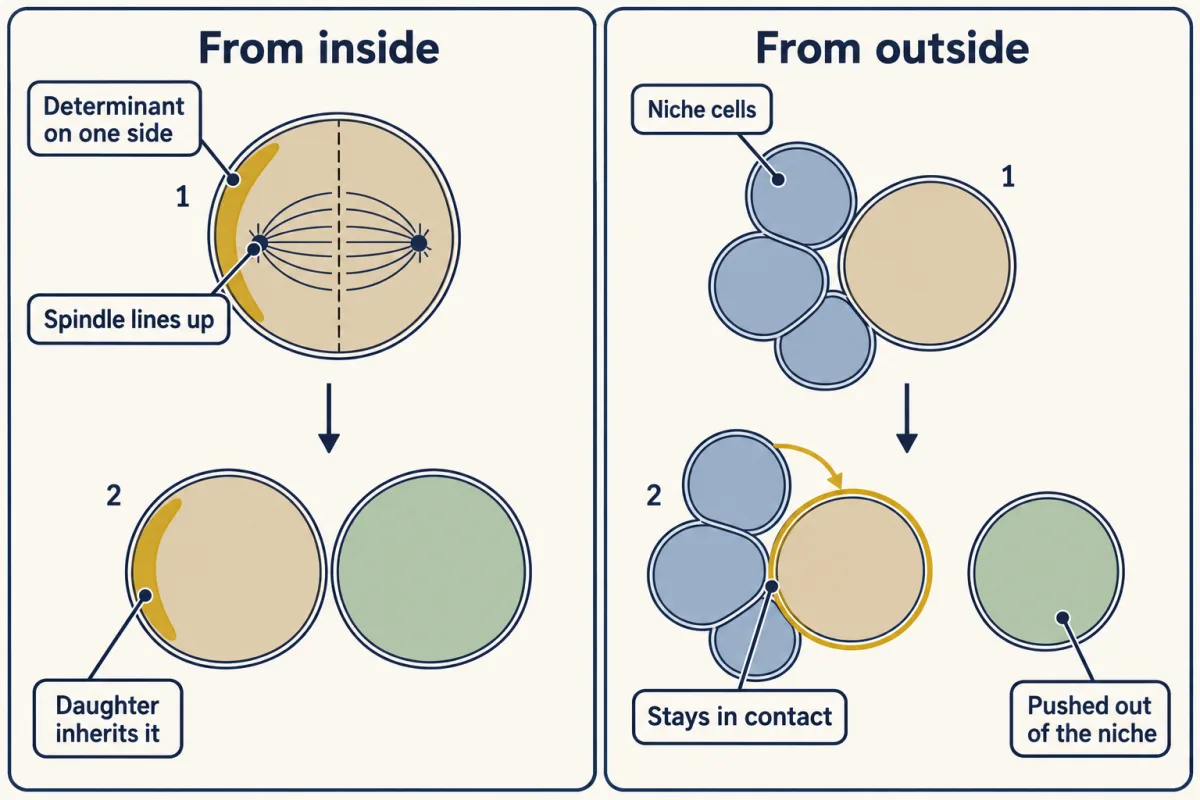
A division can become asymmetric from inside, when the mother cell gathers a determinant on one side and one daughter inherits it, or from outside, when only one daughter stays in contact with the niche. AI-generated illustration -
The layout
-
Notch splits the lineage at every division
-
A crescent in one daughter
-
A veto, not an instruction
-
How the neuroblast picks a side
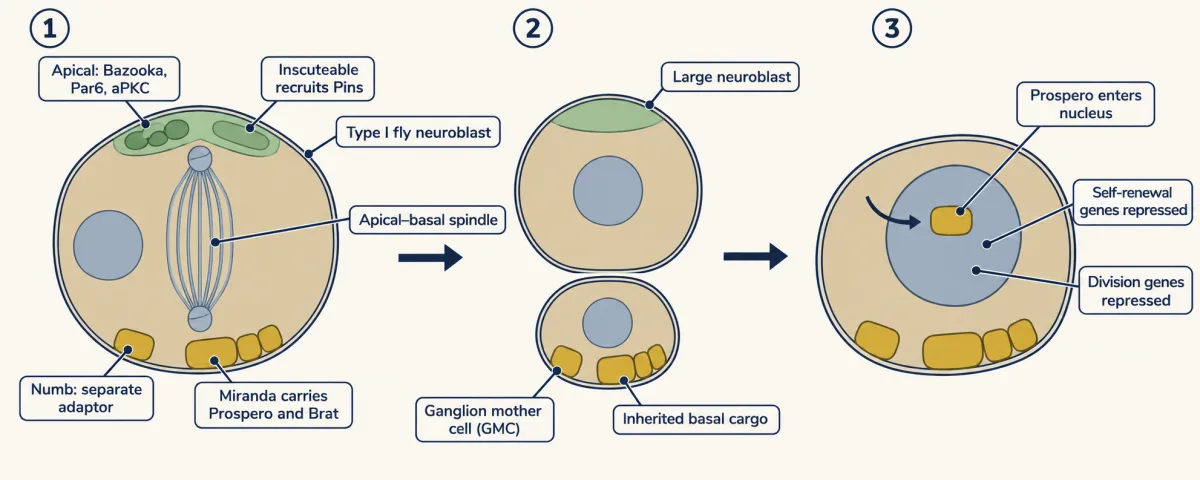
In a type I fly neuroblast, apical polarity and spindle-orientation machinery align the division along the apical–basal axis. Basal Numb and Miranda, carrying Prospero and Brat, segregate into the smaller ganglion mother cell (GMC). Prospero then enters the GMC nucleus and represses genes for self-renewal and division. AI-generated illustration -
When the division is rigged
-
In mammals
-
Putting it together
-
Going deeper
Where this lesson fits
Before thisReview first
- Proneural Genes and Lateral InhibitionThis course · Lesson 14
You need Notch signalling between touching cells from there, since Numb works by vetoing that signal in one sister.
- The Ventricular Zone: Radial Glia as Stem CellsThis course · Lesson 13
Radial glia and neuroblasts are the stem cells whose divisions this lesson explains, so know them first.
- Tools for Following Cells and GenesThis course · Lesson 4
Temperature-sensitive timing of Notch loss and reading double mutants rely on the genetic tools described there.
After thisStudy next
- Birth Order and Fate: Temporal Identity and the Inside-Out CortexThis course · Lesson 16
Numb and Notch only make two sisters differ; this lesson explains which neuron types the GMC's progeny become, by birth time.
- One Axon, Many Dendrites: Neuronal PolarityThis course · Lesson 21
It takes the idea of a cell marking one side with polarity proteins further, to make one axon and many dendrites.
- When Building Goes Wrong: Microcephaly, Zika and LissencephalyThis course · Lesson 48
It takes the stem-cell division and spindle-orientation machinery further, showing how errors in dividing progenitors shrink or distort the brain.
Elsewhere on the siteFilms, simulations and method films in other courses
- The Receptor Is the MessageFilm · Cell Signaling
It shows Notch acting between neighbouring cells, which is the signal Numb vetoes in one daughter.
- How One Set Becomes TwoFilm · Biology
It shows how mitosis divides the chromosomes, the process whose spindle orientation sets the plane of the unequal division here.
Suggested by an AI model from the lessons themselves, then checked. How we use AI