Cell Signaling · Skim version
Adaptors, Docking Proteins and Scaffolds
Read the full lesson → Skim the whole course →
The guiding idea
A receptor activates Ras without ever touching it. How does the message cross the gap?
Binding proteins route signals by controlling which partners meet, where they meet, and when they can act.
From the film: How a Receptor Reaches Ras
- Adaptors route signals by linking partners, not by catalyzing reactions.
- Grb2 uses its SH2 domain to bind a receptor phosphotyrosine.
- Grb2 uses its SH3 domains to hold the exchange factor Sos.
- Recruiting Sos to the membrane lets it meet Ras and exchange GDP for GTP.
From the film: How a Scaffold Keeps Signals on Route
- Scaffolds route shared parts by controlling partners, place and activation.
- Ste5 organizes Ste11, Ste7 and Fus3 in the yeast mating pathway.
- Ste5 helps Ste7 activate Fus3; proximity alone does not explain specificity.
- In the simplest model, excess scaffold splits partners across incomplete complexes and lowers output.
-
Three ways to organize a signal
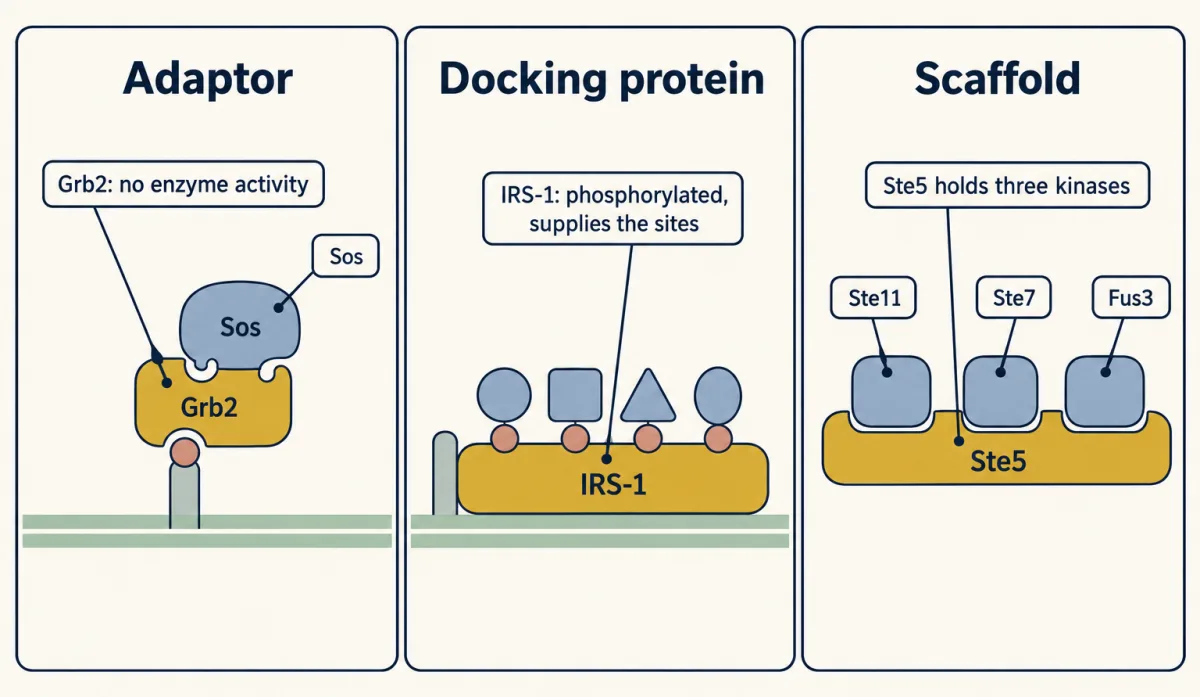
An adaptor supplies a link, a docking protein supplies regulated phosphosites, and a scaffold organizes successive members of one pathway. AI-generated illustration -
Grb2 routes a receptor signal to Ras
-
IRS-1 turns one input into several branches
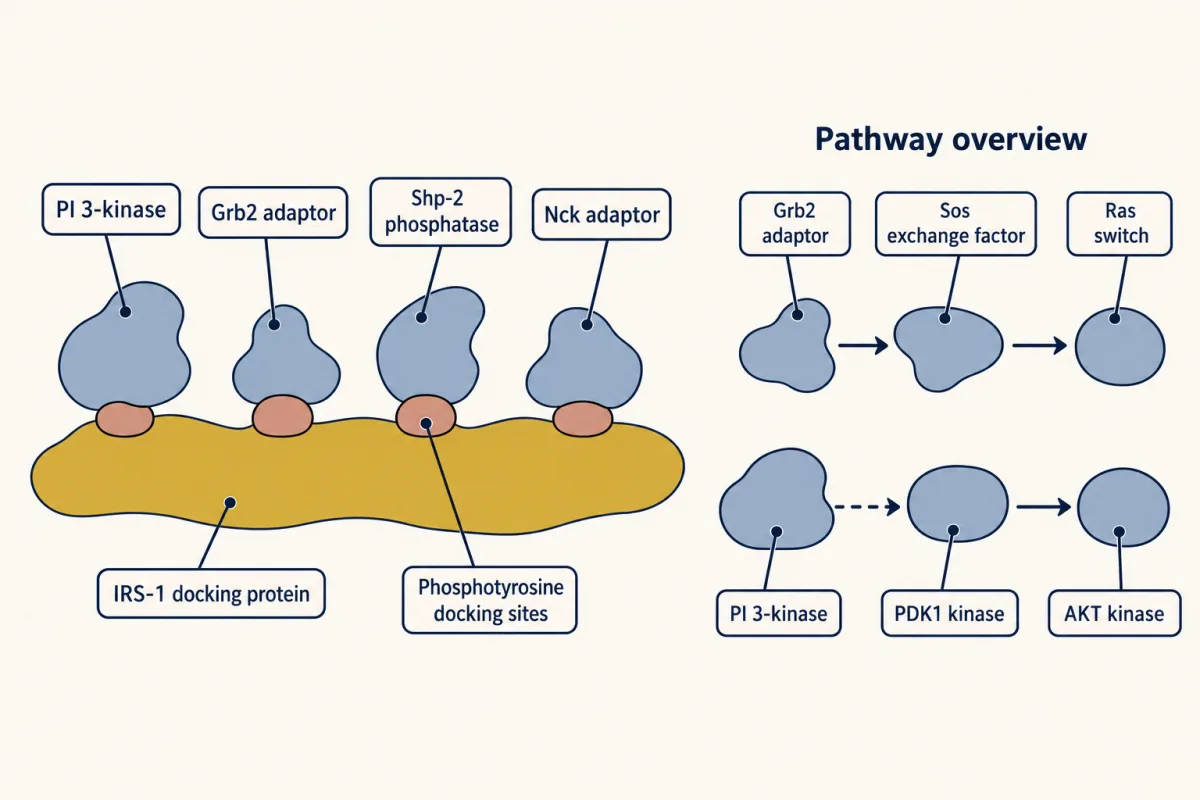
Different phosphotyrosines on IRS-1 recruit different partners, allowing one insulin signal to enter several branches. The arrows summarize pathway order; they do not specify every intermediate or a direct phosphorylation reaction. AI-generated illustration -
Ste5 routes shared kinases
-
Local signals and rewiring
-
Going deeper
Where this lesson fits
Before thisReview first
- Phosphorylation: Kinases and PhosphatasesThis course · Lesson 6
You need to know how tyrosine phosphates are added and removed, since adaptors read those phosphotyrosine marks.
- GTPase Switches: The TimerThis course · Lesson 7
Sos is an exchange factor that turns Ras on, so you need how GDP-GTP switches work.
- Protein Modules: SH2, SH3, PTB, PDZ and PHThis course · Lesson 9
Grb2 works through its SH2 and SH3 domains, which that lesson explains.
After thisStudy next
- Receptor Tyrosine KinasesThis course · Lesson 18
It shows how an activated receptor creates the phosphotyrosine sites that Grb2 and docking proteins grab.
- Ras to MAPK: The Kinase CascadeThis course · Lesson 19
It follows Ras-GTP into the three-kinase cascade, where scaffolds like KSR hold the kinases together.
- PI 3-Kinase, Akt and InsulinThis course · Lesson 20
It takes the IRS-1 docking platform further, following the PI 3-kinase to AKT branch.
Suggested by an AI model from the lessons themselves, then checked. How we use AI