Press play to start at .
Potassium on Two Clocks
From the film
- About 98 percent of the body's potassium is inside cells, mostly in skeletal muscle.
- Insulin through its receptor, and epinephrine through beta2 receptors, drive potassium into muscle within minutes by stimulating the sodium-potassium pump.
- Less than 10 percent of filtered potassium reaches the distal nephron, so the part that rises with intake is secreted.
- Secretion through ROMK and flow-activated BK channels is set by aldosterone-type activity and sodium and water delivery.
- Aldosterone is high after volume loss and with high plasma potassium, but only the second raises potassium secretion.
Read the transcript of “Potassium on Two Clocks”
Film transcript: Potassium on Two Clocks
Tap a sentence to play from there.
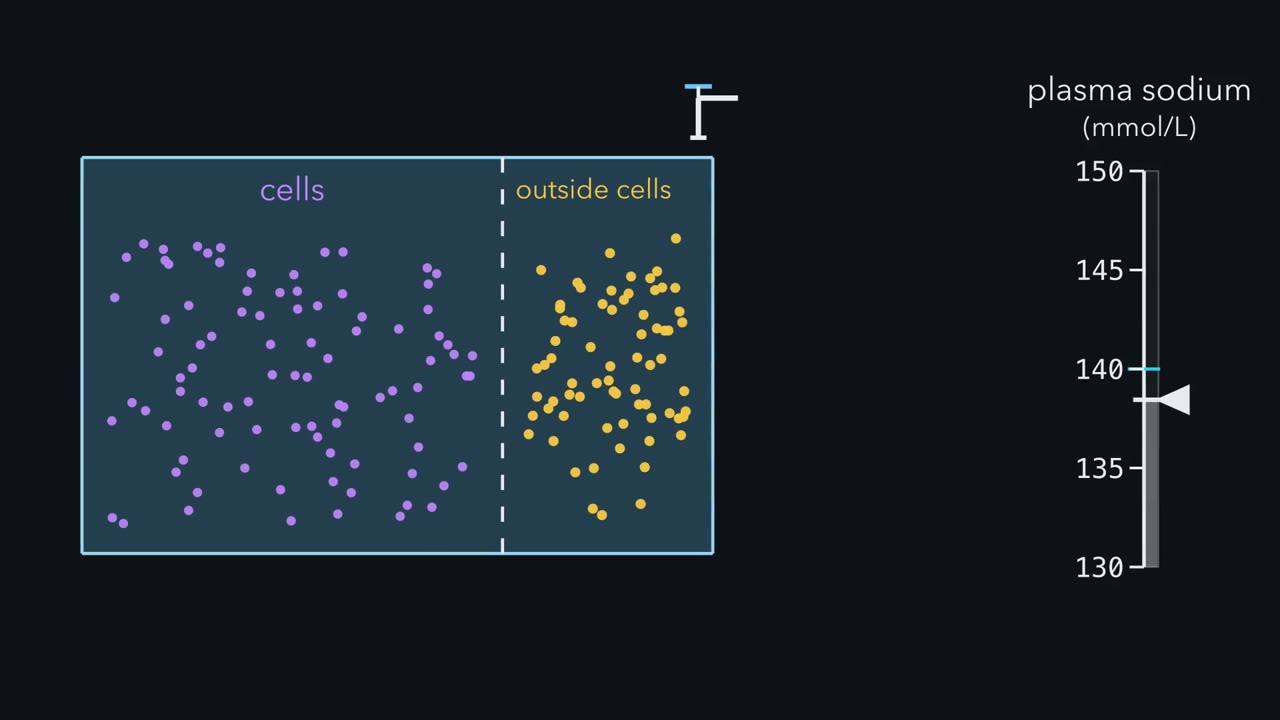
- 0:00 We saw water spread into every compartment, so plasma sodium concentration reports water. Potassium breaks that pattern.
- 0:10 Almost all of it sits inside cells.
- 0:13 So what guards the little that is left outside?
- 0:19 About 98 percent of the body's potassium is inside cells, mostly skeletal muscle.
- 0:27 Outside, 14 litres hold about 4.2 mEq per litre.
- 0:32 That is about 59, roughly 1.7 percent of the body's 3,500.
- 0:39 A day's intake is about 70 mEq, more than the whole pool outside the cells.
- 0:45 So the first defence is the muscle cell, not the kidney.
- 0:50 Insulin and epinephrine drive potassium into muscle by stimulating the sodium-potassium pump.
- 0:57 Insulin acts through its receptor.
- 1:00 Epinephrine acts through beta2-adrenergic receptors.
- 1:05 This shift works in minutes.
- 1:07 Here is the one idea.
- 1:10 Potassium is defended first by shifting into cells, in minutes.
- 1:15 Then the kidney secretes it, over hours.
- 1:18 The kidney's arm is secretion, not filtration.
- 1:22 Glomeruli filter about 756 mEq a day.
- 1:28 The proximal tubule and loop take most of it back.
- 1:32 Less than 10 percent reaches the distal nephron, a fraction that changes little with diet.
- 1:38 Yet urinary potassium follows intake.
- 1:42 So the part that rises with intake is secreted.
- 1:46 Principal cells release potassium into the tubule through ROMK channels.
- 1:52 At high flow, BK channels add more, much of that in intercalated cells.
- 1:58 Two major influences set the rate: aldosterone-type activity, and the sodium and water delivered to these cells.
- 2:06 Higher flow raises secretion.
- 2:09 Aldosterone runs high in two states: after a volume loss, and when plasma potassium is high. In which does the kidney secrete more potassium?
- 2:25 When potassium is high.
- 2:28 Delivery of sodium and water is normal or higher.
- 2:32 Angiotensin II has not risen, and potassium itself stimulates secretion.
- 2:38 After a volume loss, delivery is low and angiotensin II is high, which restrains secretion.
- 2:46 Aldosterone is high in both.
- 2:49 What differs is what comes with it.
- 2:52 One hormone, two outcomes: this is the aldosterone paradox.
- 2:57 So potassium has two lines of defence on two clocks.
- 3:02 Within minutes, muscle takes up the load.
- 3:05 Over hours, the kidney secretes it, steered by aldosterone and by sodium and water delivery.
Potassium balance: the same idea, other levels
A level is a place to start, not a rank. If this loses you, the rung below teaches the same idea, told more simply.
College, upper level · the level you chose
Water, Sodium and Potassium Balance · this lesson
About 98 percent is inside cells; insulin shifts it in minutes, kidneys over hours.
Physiology · about 30 min · film 3:16 · 6 practice questions
Next door
- Resting potential: The Standoff · 2:55 The gap in potassium between the inside and outside of nerve and muscle cells sets their resting voltage.
- Active transport: A Path Is Not a Pump · 3:24 A pump that moves sodium out and potassium in is what keeps most potassium inside cells.
- The adrenal glands: An Enzyme Guards the Receptor · 2:34 The salt hormone aldosterone from the adrenal glands makes the kidney give up potassium.
More films from this lesson
Continue in the lesson: Water, Sodium and Potassium Balance →
Free, with captions and a transcript. The lesson has the full text, the questions and the sources.
How this film was made. Narration: an AI narrator voice (Kokoro, af_heart) reading narration written from this lesson's text. Animation: AI-generated in code (Manim) by Claude, a schematic with no drawn molecular structures. Captions come from the narration script. See something wrong? Report it.