Turn Release Down to See the Packets
Read the transcript of “Turn Release Down to See the Packets”
Film transcript: Turn Release Down to See the Packets
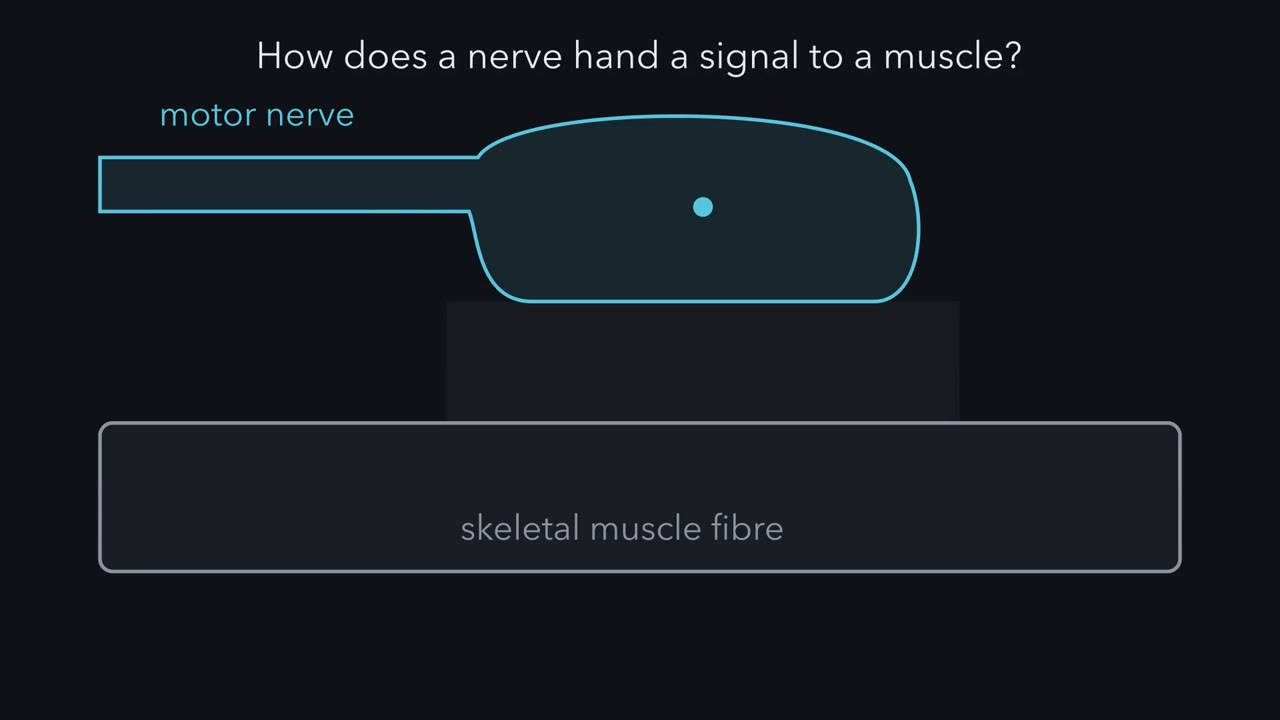
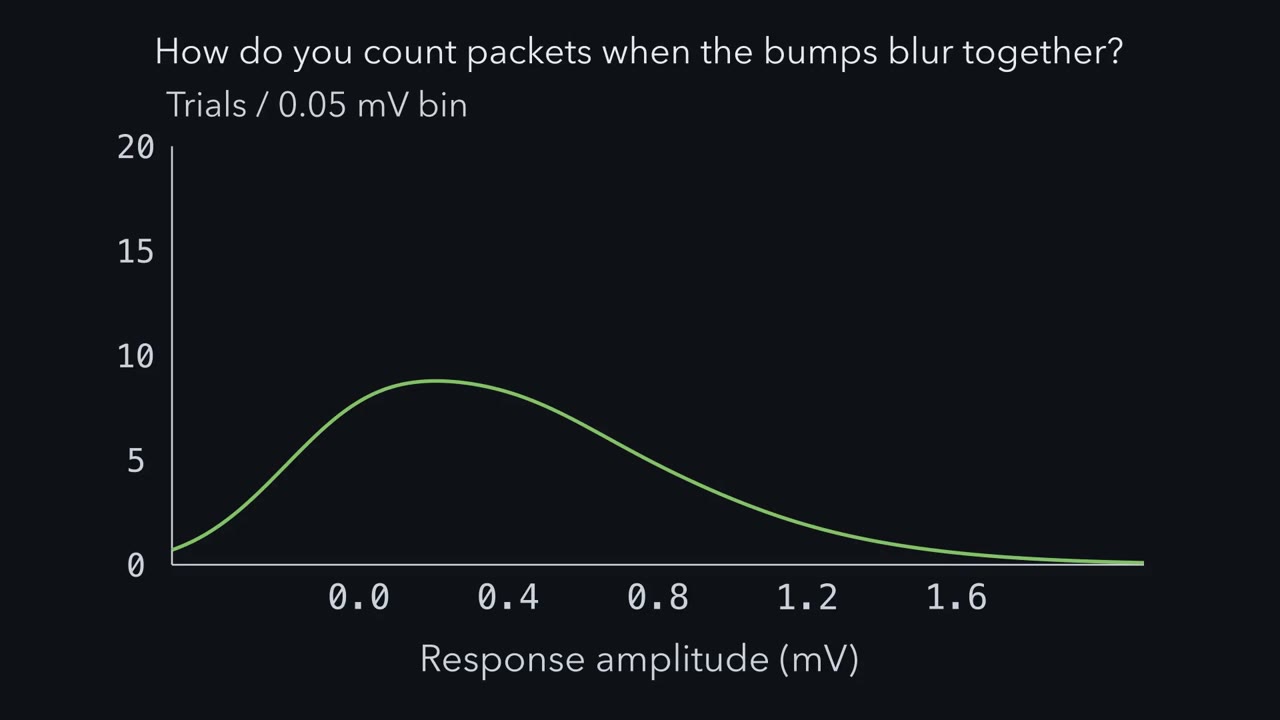
If the nerve's response is built from miniatures, why can't you just see them? In normal calcium, one impulse releases dozens of units or more at once. They merge into one smooth response. It is like a downpour, where you cannot count the drops. To count drops, you need a drizzle. So del Castillo and Katz lowered calcium and raised magnesium in the bath around a frog junction. That cut release to a trickle. Now an impulse often produced nothing at all. That is called a failure. When a response did come, it was small. So they stimulated many times and sorted the sizes. Picture a histogram. Response size runs along the bottom. The number of trials runs up the side.
If release were a smooth flow, just turned down, what shape would this histogram have? One simple smooth-flow model would give one smooth spread of sizes, with no regularly spaced peaks. The telling sign of packets would be peaks spaced at one miniature. That is not what they found. Watch the trials drop in. A tall bar builds at zero. These are the failures. A bump grows near the size of one miniature. The miniature histogram lines up over it. A smaller bump grows near twice that size. A smaller one again near three times. The bumps are broad, because one unit is not exactly the same size every time, and the recording has noise. But the sizes cluster near whole-number multiples of the miniature.
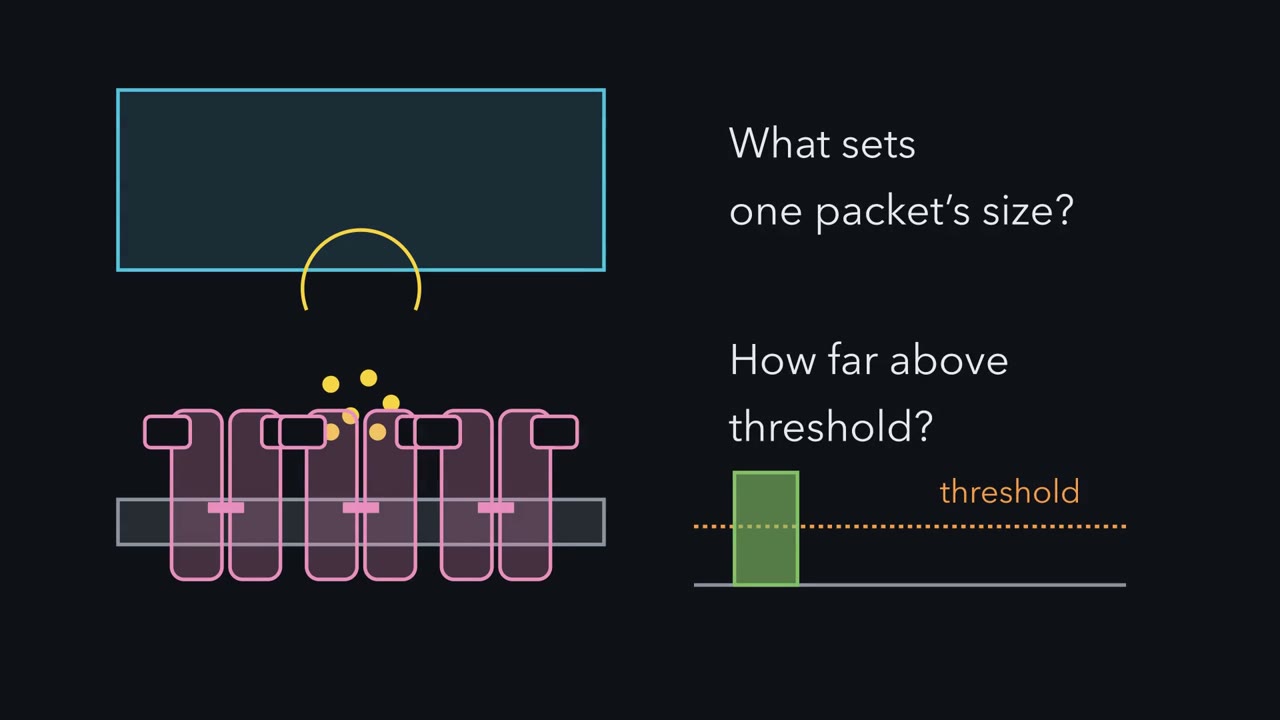
The response comes in packets. Each packet is called a quantum. Its effect on the muscle, the miniature, is the quantal size, A quantum holds thousands of acetylcholine molecules. It was later tied to the contents of one vesicle. It is not one molecule. Think of coins dropped into a jar on a scale. You cannot see the coins. But if every reading is a multiple of one coin's weight, you can count them.
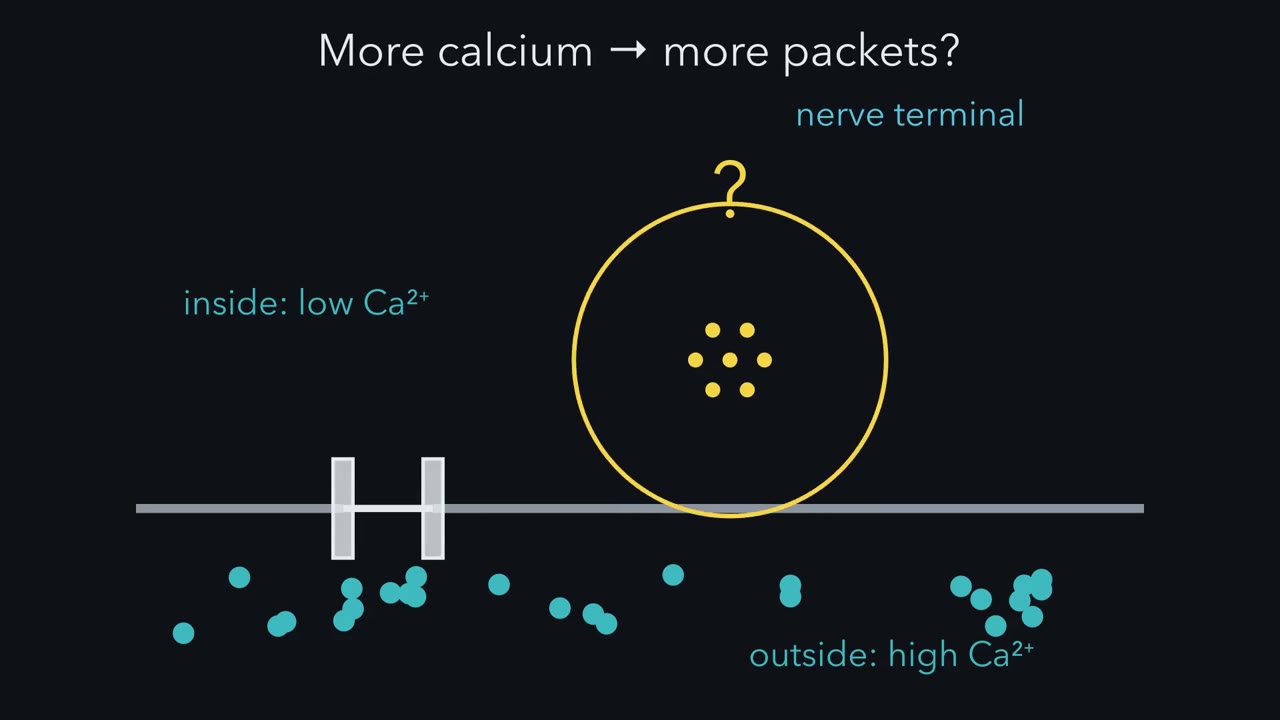
That gives the one idea of this lesson: each response ≈ count × size. The nerve terminal sets the count, Calcium sets it steeply. One vesicle's transmitter, acting on the receptors, sets the size, Big responses fall short of this rule. A later chapter shows why. The count is random from impulse to impulse. What we track is its average, So when transmission changes, ask first. Did the count change, the size, or both?
A resting frog muscle fibre shows small voltage blips at its endplate with no nerve impulse at all. Those blips are the units of the evoked response at this junction.
Continue in the lesson: Synaptic Transmission and Quantal Release →
2:58 · Free, with captions and a transcript. The lesson has the full text, the questions and the sources.
More films from this lesson
How this film was made. Narration: an AI narrator voice (Kokoro, af_heart) reading narration written from this lesson's text. Animation: AI-generated in code (Manim) by Claude, a schematic with no drawn molecular structures. Captions come from the narration script. See something wrong? Report it.