Counting with Zeros
Read the transcript of “Counting with Zeros”
Film transcript: Counting with Zeros
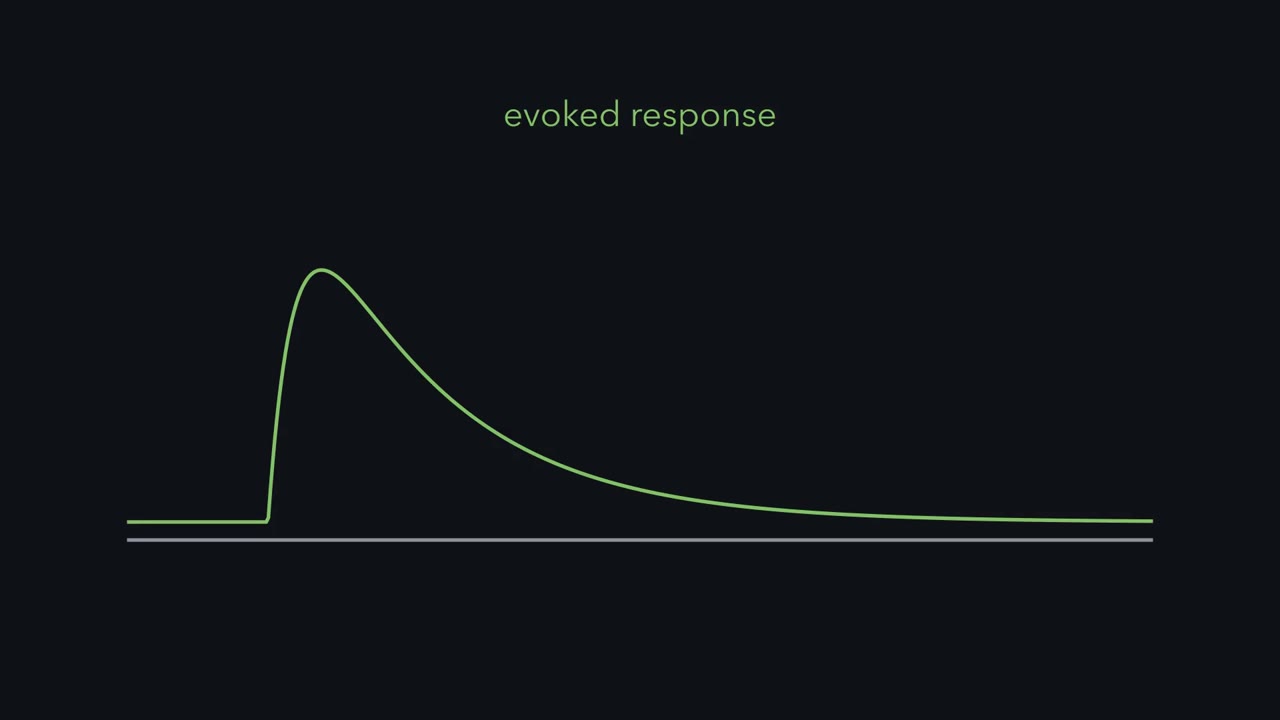
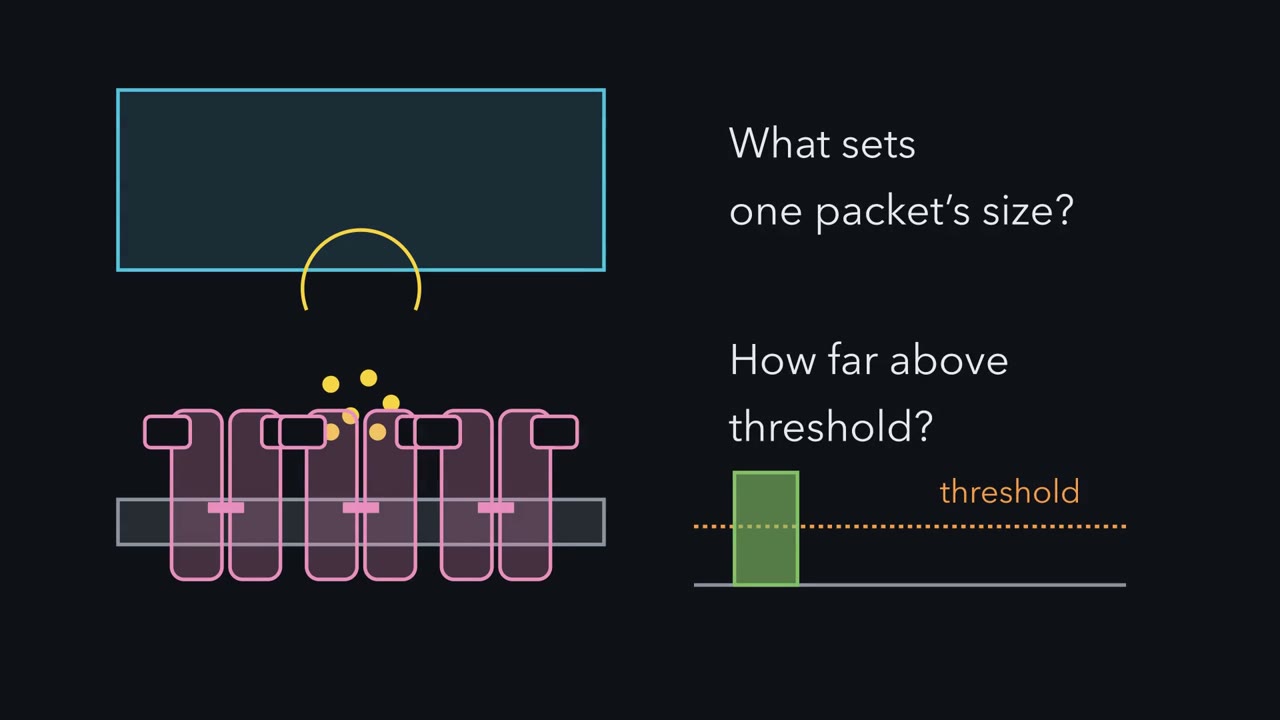
How do you count packets when the bumps blur together? You want one number: the mean quantal content, It is the average number of packets one impulse releases. There are two ways to get it. They rest on different assumptions, and that is the point. The first is direct. Every response is a whole number of packets. So the average response, divided by the size of one packet, gives the average count. Count each failure as a response of zero. This needs evoked packets the same size as miniatures, and packets that add linearly. The second way sounds like a trick. It counts only the failures. Picture the terminal as a row of release sites, like tiny lamps.
On each impulse, every site has a small chance to flash, independently of the others. A flash is one packet released. A failure means every single site stayed dark. The more packets released on average, the rarer an all-dark trial becomes.
Each site stays dark with chance one minus p. The sites are independent, so multiply those chances together. When p is small, that product comes very close to e^(−m). So the fraction of failures fixes the average count. The formula is on screen. Suppose an impulse releases one packet on average. How often does it release nothing at all?
More than a third of the time. The number is on screen. The average is pulled up by trials that release two or three. Why bother with two methods? Because the failure method never uses the size of a packet. If evoked packets differed in size from miniatures, the direct method would go wrong. The failure method would not, as long as failures can still be told apart from noise. So when the two estimates agree, that agreement supports two things. That evoked and spontaneous packets are the same units, and that release behaves like many small, independent chances. In a made-up recording of two hundred stimuli, the two estimates both come out near one packet.
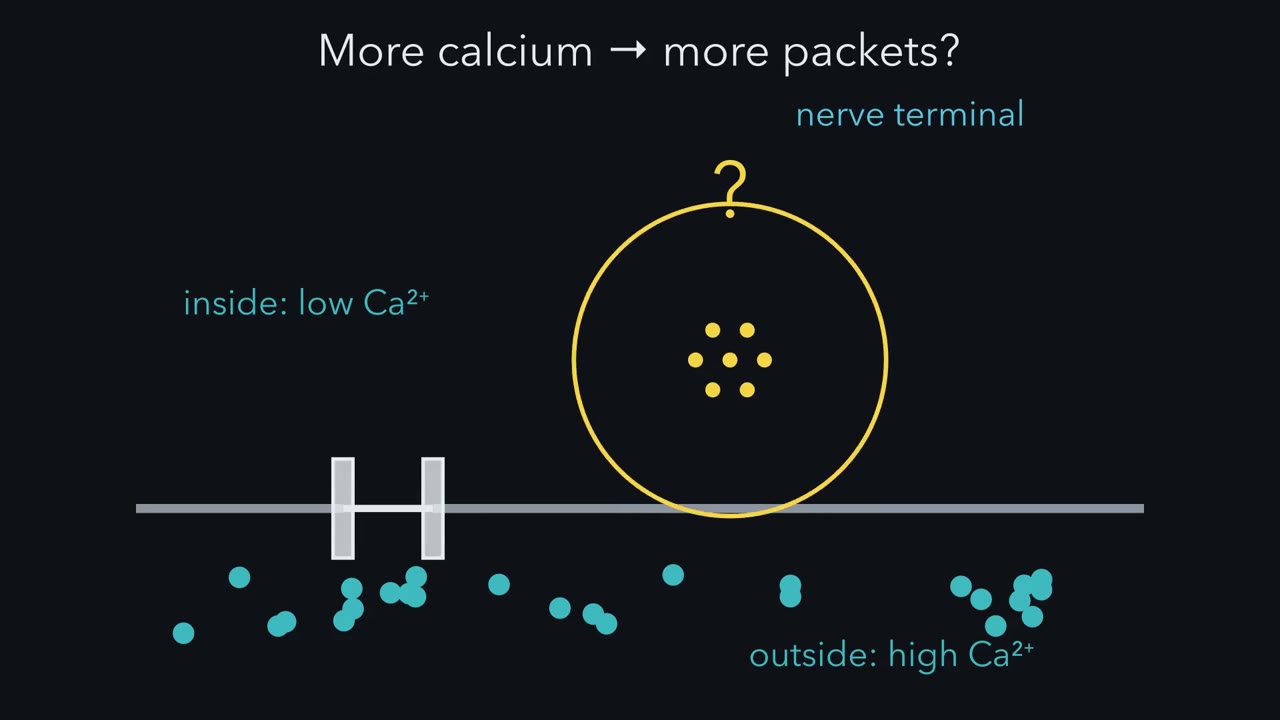
The same reasoning predicts how many trials release each number of packets. That is the Poisson distribution. Each site's chance must be small. Small, not equal. Now restore normal calcium. The total release becomes large, tens of packets on every impulse. Failures vanish, so there is nothing left to count. Low calcium is what makes failures common enough to measure. Low calcium is not just convenient. It makes the chances small and failures common, as the mathematics needs.
A resting frog muscle fibre shows small voltage blips at its endplate with no nerve impulse at all. Those blips are the units of the evoked response at this junction.
Continue in the lesson: Synaptic Transmission and Quantal Release →
3:16 · Free, with captions and a transcript. The lesson has the full text, the questions and the sources.
More films from this lesson

How this film was made. Narration: an AI narrator voice (Kokoro, af_heart) reading narration written from this lesson's text. Animation: AI-generated in code (Manim) by Claude, a schematic with no drawn molecular structures. Captions come from the narration script. See something wrong? Report it.