A Gate That Needs Two Signals
Read the transcript of “A Gate That Needs Two Signals”
Film transcript: A Gate That Needs Two Signals
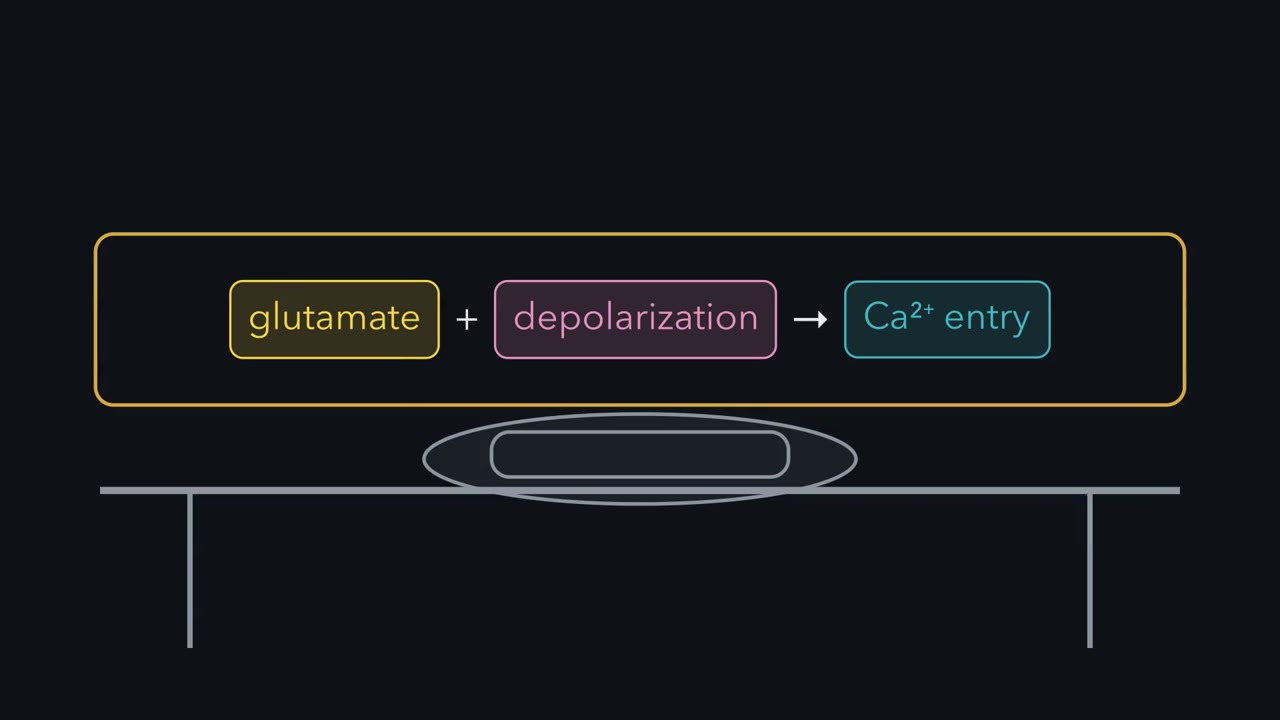
A synapse must know that its input fired, and that its own cell is active. What molecule could read both? Look at one synapse, from CA3 onto CA1. The terminal releases glutamate onto a spine, a small bud on the dendrite. Two kinds of ionotropic glutamate receptor sit there. AMPA receptors need only glutamate to open. They carry most of the ordinary EPSP. NMDA receptors also bind glutamate. They need a co-agonist too, glycine or D-serine, which is normally present. But at rest, a magnesium ion from outside sits in their pore and blocks it. Once the block clears, they pass sodium, potassium and calcium. What clears the block? Depolarization. Magnesium is positive, held in by the negative inside.
Make the inside less negative, and it is pushed out. Where does the depolarization come from? Recall the balance point from the action potential lesson. It works like a tug of war. Take an isolated compartment, with fixed ohmic conductances, and no injected or axial current. Its voltage relaxes toward a weighted average. Each current's reversal potential counts in proportion to its conductance. AMPA current reverses near 0 mV. When many receptors open at once, they pull the local balance point up from near minus −70 A spike fired by the cell and spreading back into the dendrite also depolarizes the spine. So the spine voltage reports what the postsynaptic cell is doing.
And the magnesium block reads that voltage. A spike is one source of depolarization, not the only one. Now put the signals together, as a product of three factors. First, glutamate must be bound. Second, depolarization clears the block. Third, calcium still needs an inward push. The active terminal supplies glutamate. The other two factors are set by the voltage of the postsynaptic membrane. With no glutamate, no calcium enters through these receptors, at any voltage. That makes the NMDA receptor a coincidence detector. Near rest, with glutamate bound, about one receptor in twenty is unblocked. Depolarize the spine, and about one in three is.
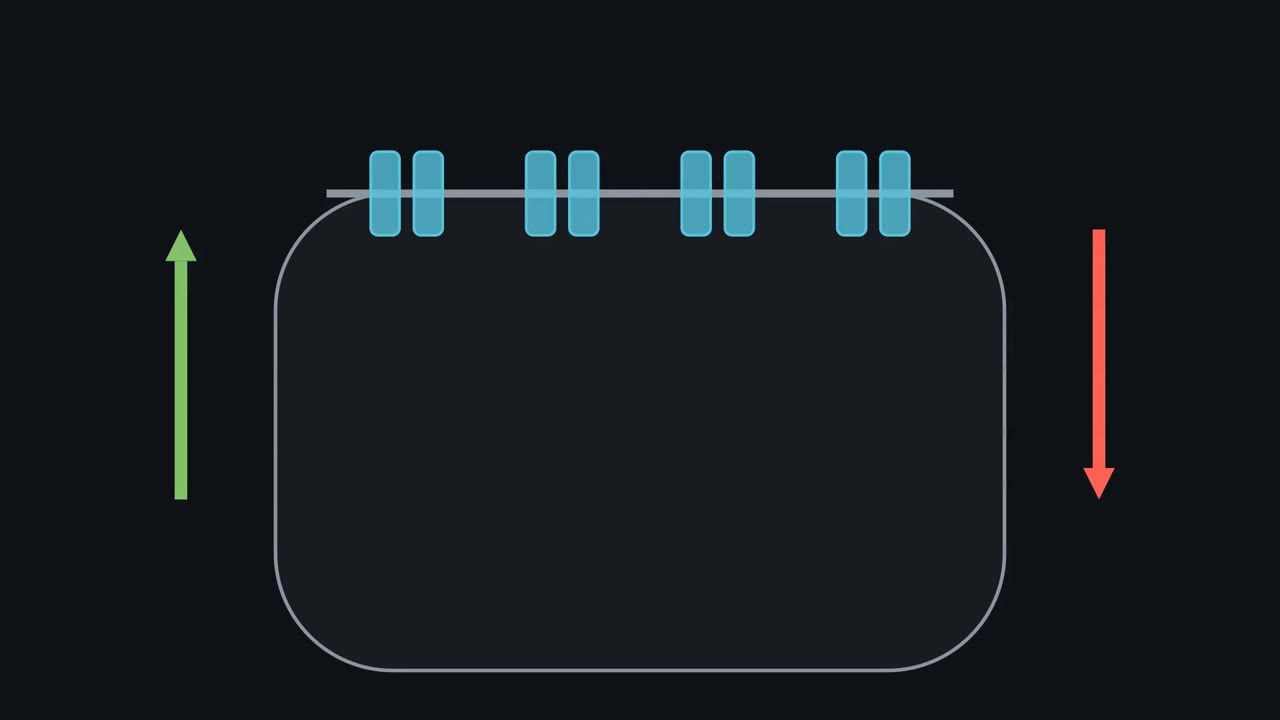
Glutamate arrives at a spine sitting near rest. Does any calcium get in? A little. The gate is graded, not a switch. Even at rest a few receptors are unblocked, so glutamate alone lets in a trickle. more depolarization is not always better. In this model, with normal magnesium, calcium entry through the receptor peaks near minus −20 mV, then falls. That is the third factor. Depolarization weakens the inward push on calcium. So for the same receptor, minus −30 instead of minus −70 speeds calcium entry only about four times. Where does the big difference come from? Mainly from summation. During a fast train, glutamate keeps arriving faster than the receptors close.
And the depolarization builds. The receptors stay activated while the responses summate, and the calcium in the spine climbs steeply. The takeaway: at normal magnesium levels, an NMDA receptor lets in much calcium only when glutamate and depolarization coincide.
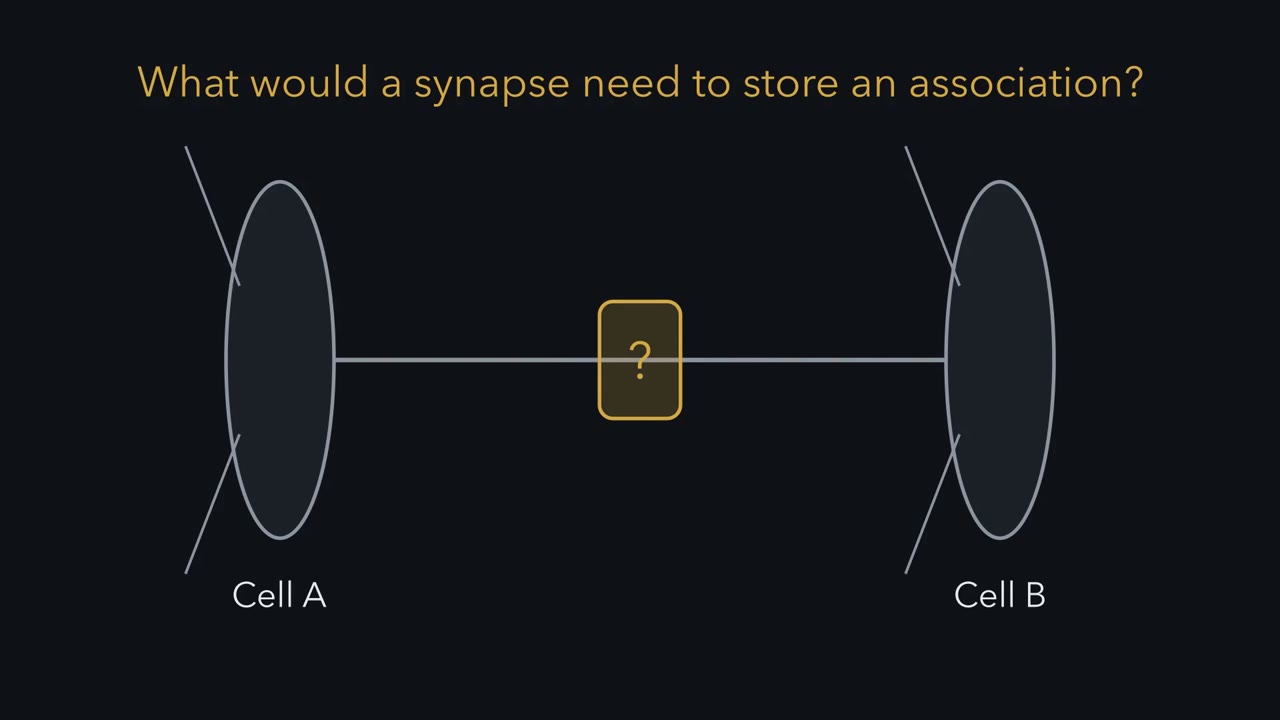
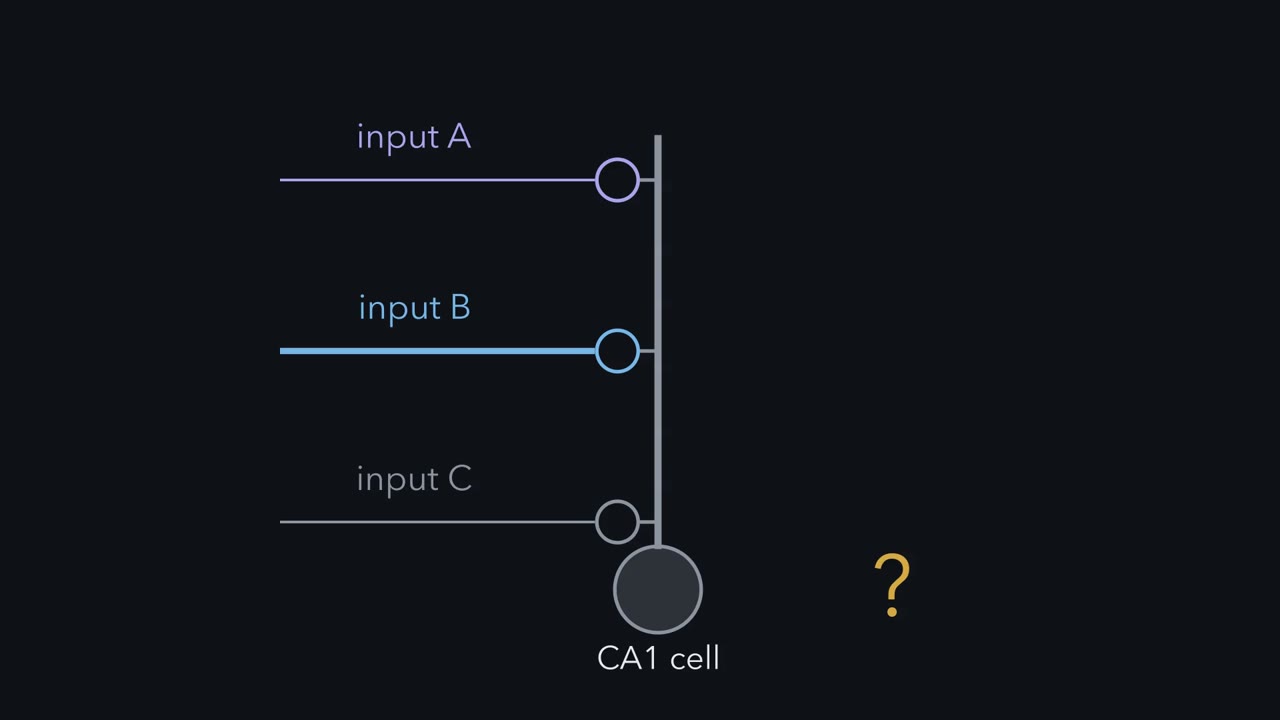
A synapse that stores an association should strengthen when its own input is active at the same moment as the cell it talks to. How could one synapse know what the whole cell is doing?
Continue in the lesson: Synaptic Plasticity →
3:55 · Free, with captions and a transcript. The lesson has the full text, the questions and the sources.
More films from this lesson
How this film was made. Narration: an AI narrator voice (Kokoro, af_heart) reading narration written from this lesson's text. Animation: AI-generated in code (Manim) by Claude, a schematic with no drawn molecular structures. Captions come from the narration script. See something wrong? Report it.