Press play to start at .
Making Pulses and Fixing Place
From the film
- Delayed negative feedback makes pulses, and location restricts which targets answer.
- When negative feedback acts after a delay, is strong enough and its proteins are short-lived enough, a steady stimulus can produce repeating pulses, as in NF-κB and IκBα.
- Anchoring proteins such as AKAPs hold PKA beside selected membrane targets so a local rise in cAMP can activate nearby kinase without reaching distant pools.
- On an artificial membrane with no cell, LAT clusters concentrate kinases and exclude phosphatases, while whether bright spots in living cells are liquid droplets remains debated.
Read the transcript of “Making Pulses and Fixing Place”
Film transcript: Making Pulses and Fixing Place
Tap a sentence to play from there.
- 0:02 In the first film, a cell read how long a signal lasted and how fast spikes arrived.
- 0:09 When an outside stimulus stays steady, how does a cell make pulses, or keep one signal local? Both answers come from how cells wire loops and organize space.
- 0:21 Negative feedback normally pulls an active pathway back to steady level.
- 0:27 Add a delay, and the brake arrives late.
- 0:30 Like a shower tap on a long pipe, you overshoot too hot, then too cold.
- 0:36 When the feedback is strong and its proteins short-lived, activity can rise and fall in pulses.
- 0:42 Watch NF-κB inside this cell.
- 0:46 A steady signal triggers destruction of its inhibitor, IκB, freeing NF-κB to enter the nucleus. There, activation builds its own brake.
- 0:57 NF-κB switches on the gene for a fresh inhibitor, IκBα, which takes time.
- 1:04 When fresh IκBα arrives, it binds NF-κB and pulls it back out.
- 1:11 Because the steady stimulus stays on, the new inhibitor breaks down too, starting the next pulse. Now stay in this cell to see place.
- 1:21 One messenger can carry different orders in different spots of a cell.
- 1:26 An anchoring protein parks the kinase PKA beside one membrane channel.
- 1:32 A local cloud of cAMP switches on that nearby PKA.
- 1:38 Identical PKA parked across the cell may never see it.
- 1:43 Proteins can also build a signaling spot on demand.
- 1:47 On a glass slide with no cell, a kinase put phosphate on a receptor tail.
- 1:53 Phosphates then reached the purified adaptor LAT.
- 1:57 Many weak contacts pulled it and its partners into a liquid-like cluster that sorts enzymes.
- 2:04 On the slide, that cluster pulls kinases in and keeps phosphatases, the enzymes removing phosphates, outside.
- 2:13 Predict what happens inside the cluster.
- 2:16 Compared with outside, will phosphate signals inside stay on longer, or shut off faster?
- 2:28 They stay on longer, because adding phosphates speeds up while removing them slows down. In living cells, the usual test bleaches a bright spot with a laser and times its refill. Refilling shows molecules exchange, which happens in a droplet and also on a fixed scaffold.
- 2:48 So cellular droplets remain debated.
- 2:52 Cells encode meaning in feedback loops and in space, not just in molecule names.
- 2:58 Delayed negative feedback turns steady cues into pulses, and location decides which targets answer. Read on for circuits that test both.
The shape of a signal: the same idea, other levels
A level is a place to start, not a rank. If this loses you, the rung below teaches the same idea, told more simply.
Graduate · the level you chose
The Shape of a Signal: Size, Duration, Frequency and Place · this lesson
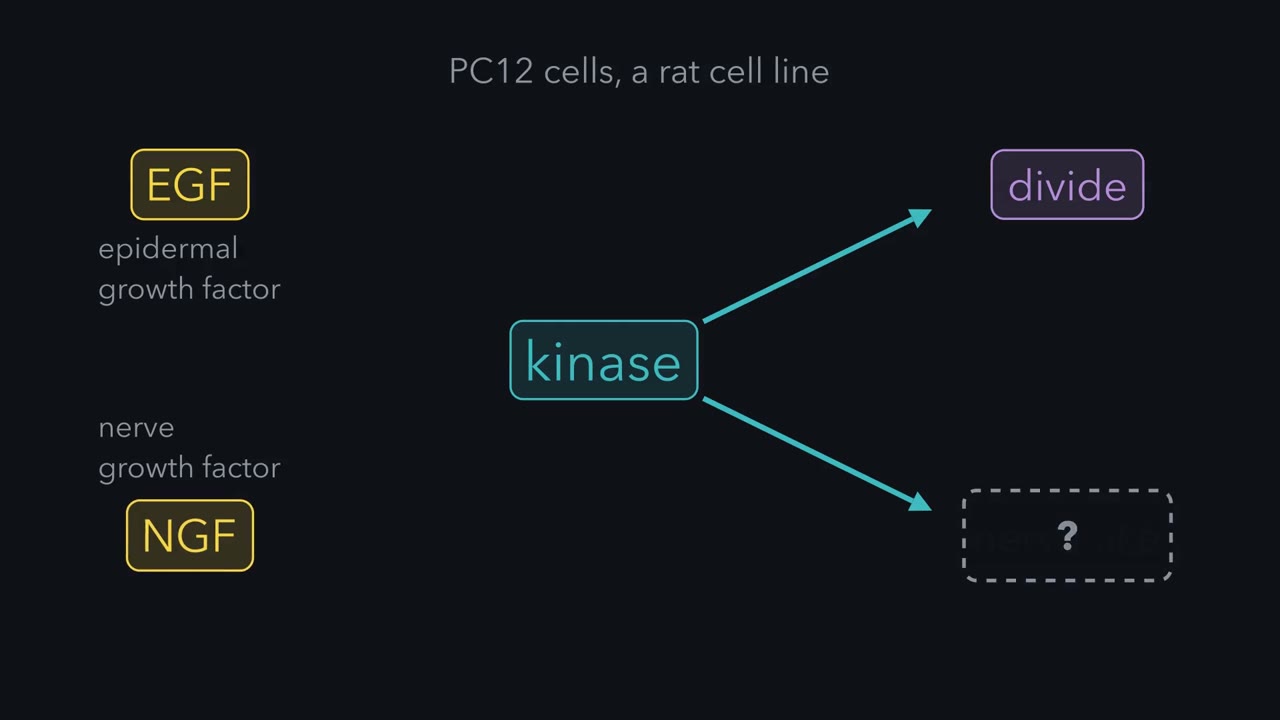
EGF and NGF both switch on ERK; length, frequency and place carry the difference.
Cell Signaling · about 22 min · film 3:11 · 3 practice questions
Next door
- Calcium imaging: One Question for Every Number · 2:17 · College: going further Imaging calcium in living cells shows size, timing and place of signals directly.
- Daily body clocks: A Clock You Can Transplant, and How Light Sets It · 2:48 · College: going further A daily rhythm is a signal read by its timing, not just its size.
- Long-term potentiation: A Synapse That Could Learn · 3:43 · College: going further A burst of fast input strengthens a synapse where a slow trickle does not, so frequency carries meaning.
More films from this lesson
Continue in the lesson: The Shape of a Signal: Size, Duration, Frequency and Place →
Free, with captions and a transcript. The lesson has the full text, the questions and the sources.
How this film was made. Narration: an AI narrator voice (Kokoro, af_heart) reading narration written from this lesson's text. Animation: AI-generated in code (Manim) by Claude, a schematic with no drawn molecular structures. Captions come from the narration script. See something wrong? Report it.