A Clock You Can Transplant, and How Light Sets It
Read the transcript of “A Clock You Can Transplant, and How Light Sets It”
Film transcript: A Clock You Can Transplant, and How Light Sets It
Destroy one tiny pair of nuclei above the optic chiasm, and a rat's daily rhythms of drinking and running vanish. Is that a clock, or a relay? The rats still drank, but not on a daily schedule. Yet a lesion also cuts passing fibres, so it cannot tell a clock from a relay. In hamsters, a mutation called tau makes the clock run fast, which labels whose clock is running. Destroy a host's suprachiasmatic nucleus, or SCN. Then graft in SCN tissue from a donor of a different genotype. Whose period comes back?
The donor's, whatever the host's genotype. A relay would pass on the host's timing. A clock imposes its own. How does a cell keep time? Two proteins, CLOCK and BMAL1, pair up and switch on the genes for PER and CRY. PER and CRY proteins build up, bind each other, and enter the nucleus. There they stop CLOCK and BMAL1, so PER and CRY switch off their own genes. That is the brake. Only as PER and CRY are broken down does the brake come off. Then a new cycle begins. Why does it cycle, instead of settling? Think of a shower with a long pipe. You turn toward hot, and nothing changes. You turn further. When the hot water arrives, you have overshot.
Feedback that is delayed enough, and strong enough, keeps overshooting. In the clock, these steps together set a cycle of about a day. About a day, not exactly. So light resets it each day. Some retinal ganglion cells sense light themselves, using a pigment called melanopsin. Their axons reach the clock through the retinohypothalamic tract. When the light arrives matters. Light in your biological evening says the day is not over yet. The clock runs later. Light in your biological morning says the day began early. Which way does that move the clock?
Earlier. The switchover falls near the daily low of body temperature, in the early morning hours. In one study, the human clock averaged a little longer than a day. For a clock like that, the morning advance must outweigh the evening delay. Keep this. The SCN imposes its own period. A gene loop keeps its time. Daily light keeps it on the day.
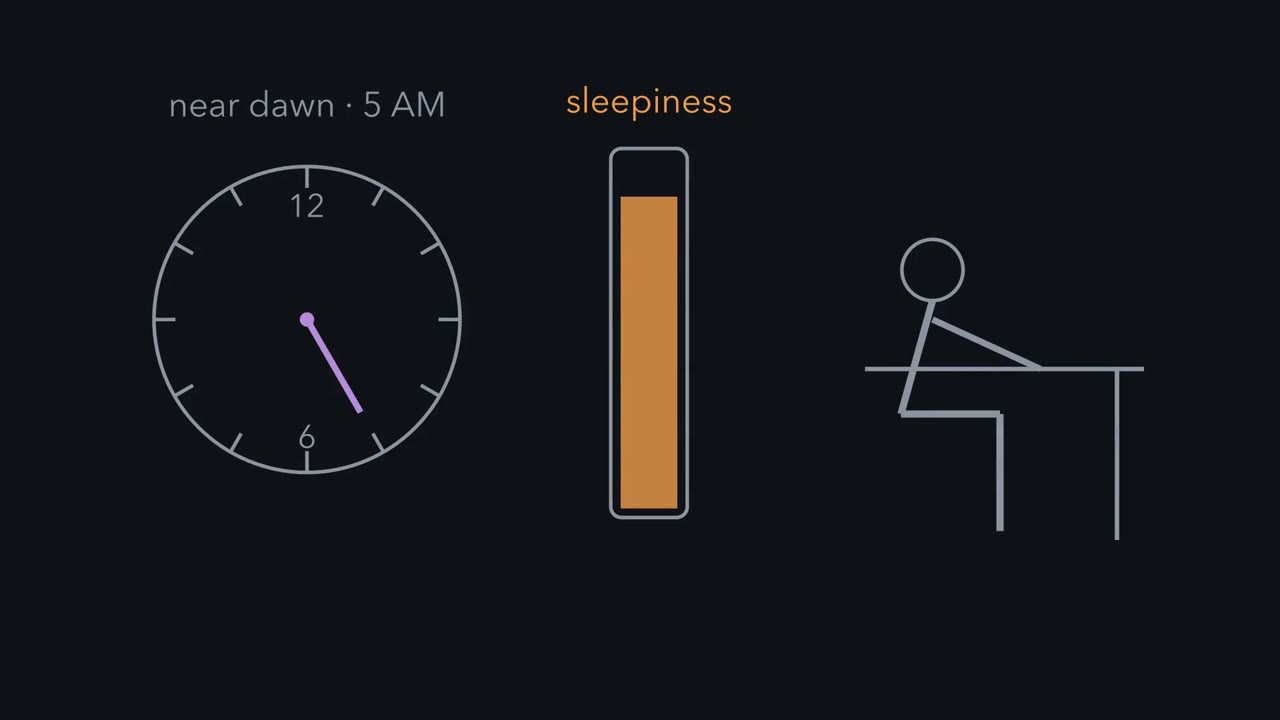
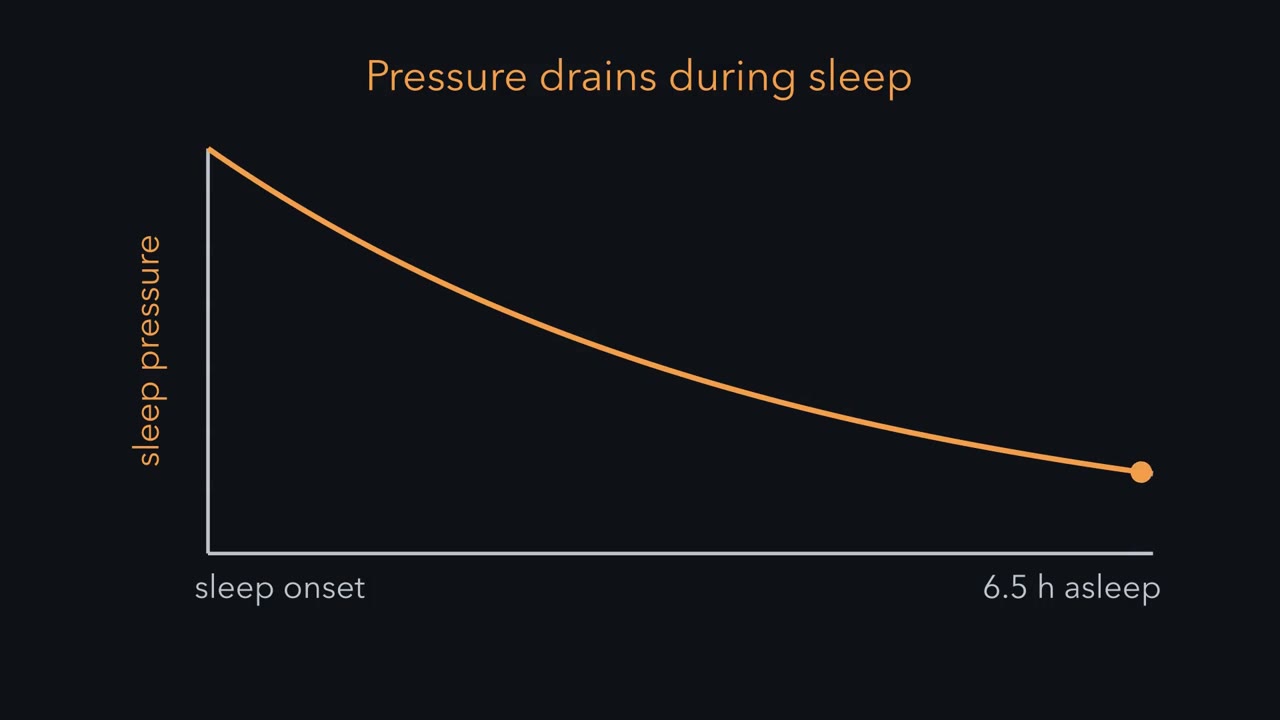
Stay up all night and you feel worst near dawn, then better by the afternoon, still without sleep. How can more time awake make you less sleepy?
Continue in the lesson: Circadian Rhythms and Sleep →
2:48 · Free, with captions and a transcript. The lesson has the full text, the questions and the sources.
More films from this lesson
How this film was made. Narration: an AI narrator voice (Kokoro, af_heart) reading narration written from this lesson's text. Animation: AI-generated in code (Manim) by Claude, a schematic with no drawn molecular structures. Captions come from the narration script. See something wrong? Report it.