Sealed Inside, a Receptor Goes Silent
Read the transcript of “Sealed Inside, a Receptor Goes Silent”
Film transcript: Sealed Inside, a Receptor Goes Silent
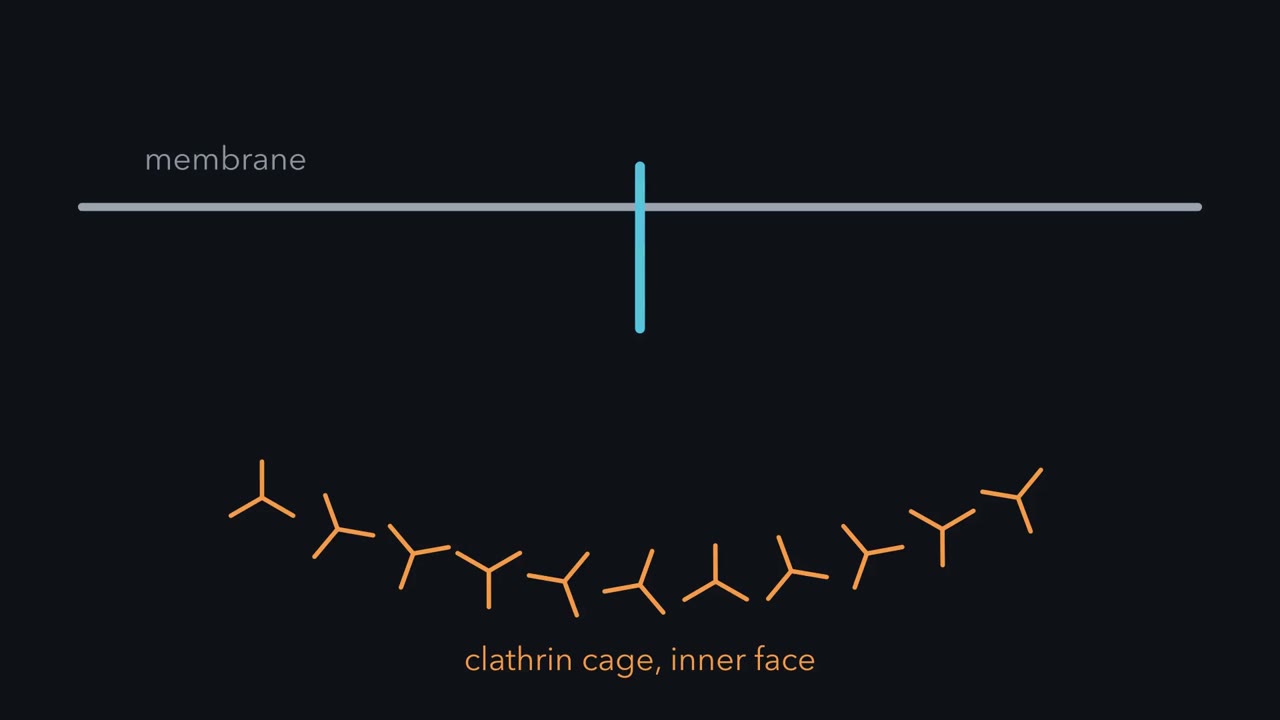
A macrophage swallows the equivalent of its whole surface about every half hour, and it does not shrink. Many receptors in that membrane make the trip too. At the surface, the tail of a receptor points into the cell. So where does the receptor go once it is inside? And what does the trip do to its signal? A receptor can enter a pit through a tail sequence that an adaptor can read. The adaptor links the tail to a coat of clathrin. The pit deepens until it hangs by a thin neck. A protein called dynamin builds a collar around the neck. When it breaks down GTP, the neck is cut and the vesicle is free.
The vesicle reaches the early endosome, the first stop for almost all cargo that is taken in. On the outer membrane, the tail still points into the cytosol and can still reach its partners. So a receptor can go on signaling from here. A receptor with no other instruction spreads into thin tubes. The tubes pinch off, and that receptor mostly goes back to the surface. A receptor leaves that default route when it carries a tag. The tag is ubiquitin. For an active EGF receptor, an enzyme called Cbl adds it. A set of proteins on the endosome, called ESCRT, binds the tag. They gather the tagged receptors into a patch. ESCRT pushes the patch inward until it pinches off as a small vesicle inside the endosome. Now ask which way the tail faces.
Inside that vesicle, the tail is sealed in and cannot reach the cytosol at all. Its partners are out of reach, so the signal ends. That happens before the lysosome, a bag of digestive enzymes, destroys anything. Now break the sorting. In some lung cancers, the receptor MET loses the docking site for the enzyme that adds ubiquitin. Poorly tagged, it escapes the lysosome and keeps signaling for longer than it should. The fault is not an overactive kinase, but a receptor that misses its turn. So keep this rule: taken in, a receptor can still signal, but sealed in, it cannot.
When a receptor is pulled into the cell, does its signal end, or does it move somewhere new?
Continue in the lesson: Endocytosis and Signaling Endosomes →
2:45 · Free, with captions and a transcript. The lesson has the full text, the questions and the sources.
More films from this lesson
How this film was made. Narration: an AI narrator voice (ElevenLabs, Sarah) reading narration written from this lesson's text. Animation: AI-generated in code (Manim) by Claude, a schematic with no drawn molecular structures. Captions come from the narration script. See something wrong? Report it.