Tuning the Mix
Read the transcript of “Tuning the Mix”
Film transcript: Tuning the Mix
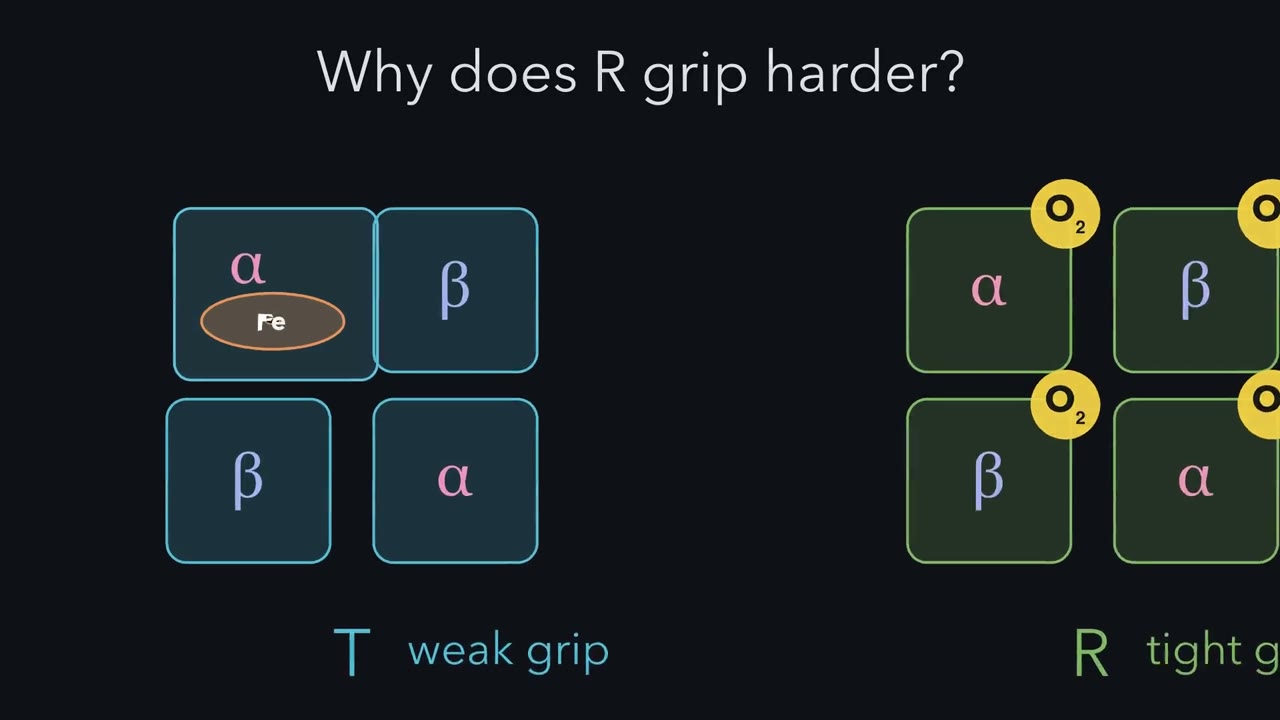
Working muscle needs more oxygen. How does the blood know to let go of more there? Use the rule. Anything that binds one shape better shifts the mix toward that shape. Three regulators prefer T: acid carbon dioxide and a small molecule called BPG. Its full name is 2,3-bisphosphoglycerate. It is a small anion with about four to five negative charges. Red cells hold nearly one BPG for every hemoglobin. It wedges into a central pocket between the β chains. That pocket is wide open only in T. Predict. Add BPG to hemoglobin. Which way does P50 move?
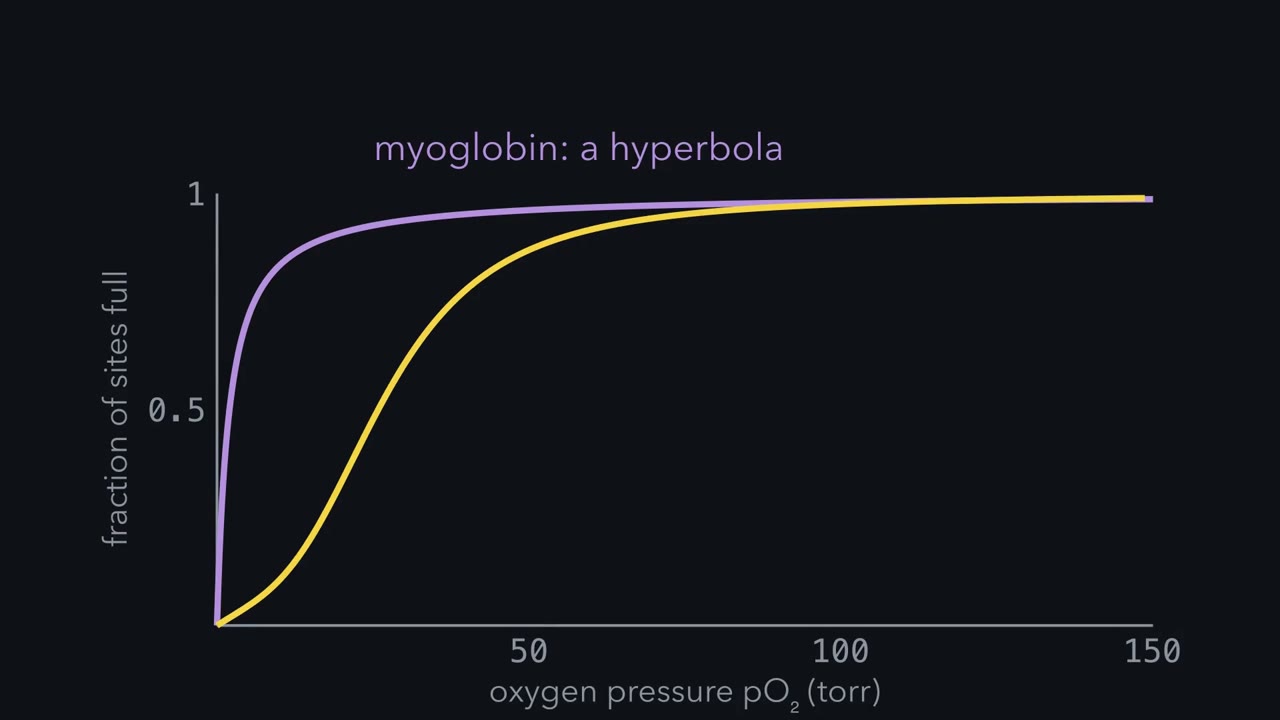
BPG holds the molecule in T, like a doorstop. It takes more oxygen to tip the mix, so the curve shifts right. Acid works through the Bohr effect. Protons add to certain groups, chiefly a histidine near the end of each β chain. Those groups can then form salt bridges that steady T. So low pH lowers oxygen affinity. Working muscle makes acid. The acid tips hemoglobin toward T exactly where a straining muscle needs the oxygen. Carbon dioxide binds the ends of hemoglobin's chains as carbamate. Those groups form their own salt bridges that favor T. In exercising muscle, three fast signals arrive at once: falling oxygen, falling pH, and rising carbon dioxide.
Does a right shift spoil loading in the lungs? Acid and carbon dioxide are high in tissue, not in the lungs. So their shift happens where unloading happens. BPG shifts the curve everywhere. But the lung end sits on the flat top of the curve, so a modest shift costs little loading. A very large shift would start to cost loading, so more is not always better. BPG is the slower dial. It rises over hours to days at high altitude, part of how you acclimatize. Fetal hemoglobin has two γ chains in place of the two β chains. At position 143, it has a serine instead of a histidine. So it binds BPG weakly and stays at higher oxygen affinity than the mother's hemoglobin.
That lets fetal blood pull oxygen across the placenta from the mother's blood. Acid, carbon dioxide and BPG all favor T. So they shift the mix toward T where oxygen must let go.
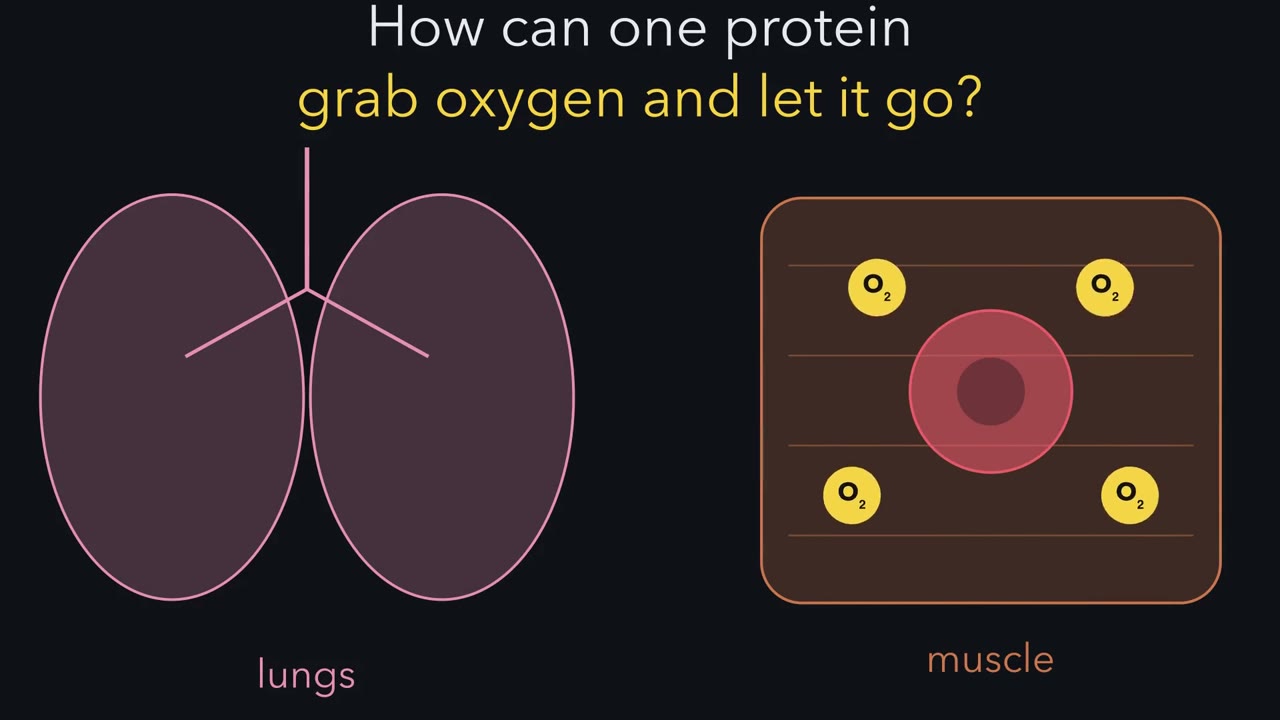
Your blood has to grab oxygen in the lungs and let go of about two-thirds of it in hard-working muscle. A tighter grip than hemoglobin's would make it worse. What does hemoglobin do instead?
Continue in the lesson: Protein Binding and Allostery: How Hemoglobin Loads and Delivers Oxygen →
2:55 · Free, with captions and a transcript. The lesson has the full text, the questions and the sources.
More films from this lesson
How this film was made. Narration: an AI narrator voice (Kokoro, af_heart) reading narration written from this lesson's text. Animation: AI-generated in code (Manim) by Claude, a schematic with no drawn molecular structures. Captions come from the narration script. See something wrong? Report it.