One Site, One Curve
Read the transcript of “One Site, One Curve”
Film transcript: One Site, One Curve
How do you put a number on how tightly a protein holds its partner? Binding is never permanent. A protein and its ligand keep joining and coming apart. Write the reaction in the direction it comes apart. The bound complex splits into free receptor and free ligand. The dissociation constant, Kd, is the ratio of what is loose to what is bound. Two concentrations on top and one below leave one. So Kd has units of concentration. Now pick the ligand level where exactly half the receptors are bound. Free and bound receptor are then equal. They cancel. So Kd is simply the free ligand concentration at half occupancy. That makes the scale run backwards.
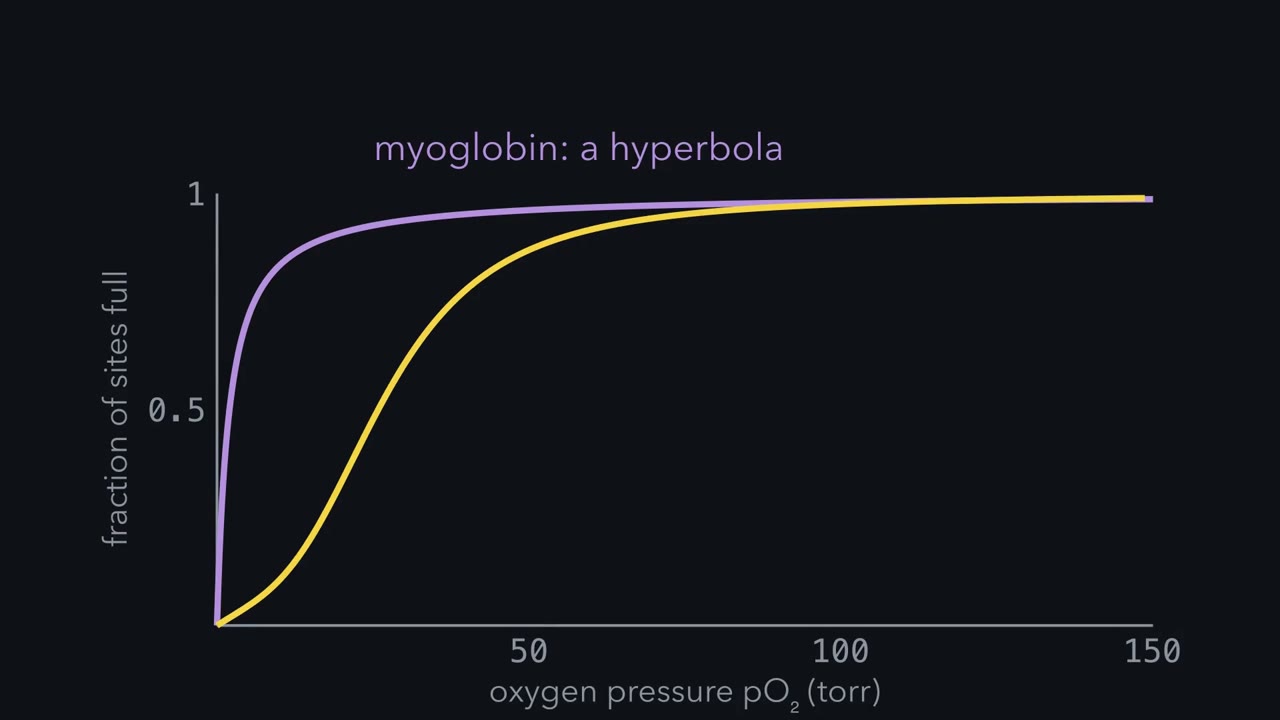
A small Kd means tight binding, because little ligand fills half the sites. The most common error is flipping it. Its reciprocal, the association constant runs the other way. For Kd, lower is tighter. Plot fraction bound against free ligand. You get a hyperbola. It rises steeply, then bends over and creeps toward full. Oxygen is a gas, so we use its pressure. The dissolved concentration is proportional to the partial pressure. So for a single site, P50, the pressure at half full, is just Kd measured in torr. Myoglobin is the test case. One chain, one heme, one site. Its P50 is about 2 torr. Predict. Myoglobin is about 98% % full in the lungs.
How full is it at 20 torr, in working muscle? Still about 91% % full. 20 torr is far above its P50, so it barely lets go. So myoglobin gives up only about seven percent. It is a sponge that grips oxygen and lets go only when oxygen gets truly scarce. Hemoglobin's curve is not a hyperbola at all. It is an S. The next chapter builds that S. One site gives a hyperbola, and Kd, or P50, sets where it sits.
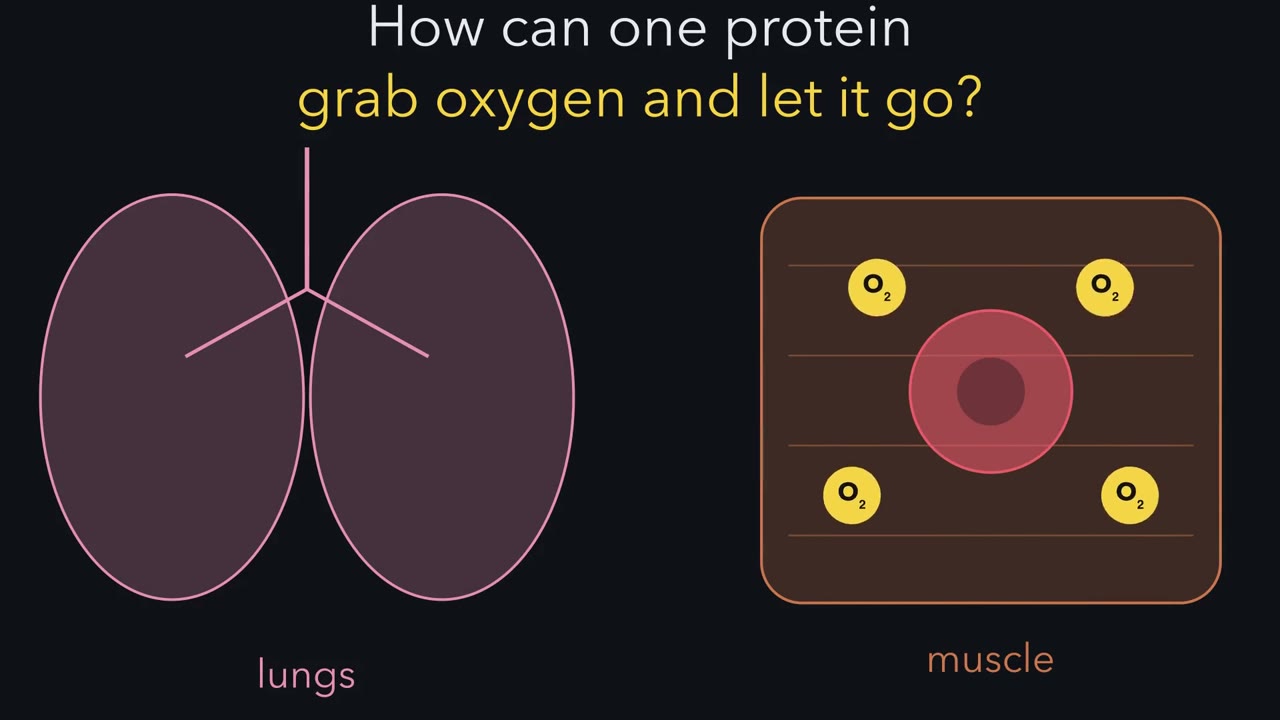
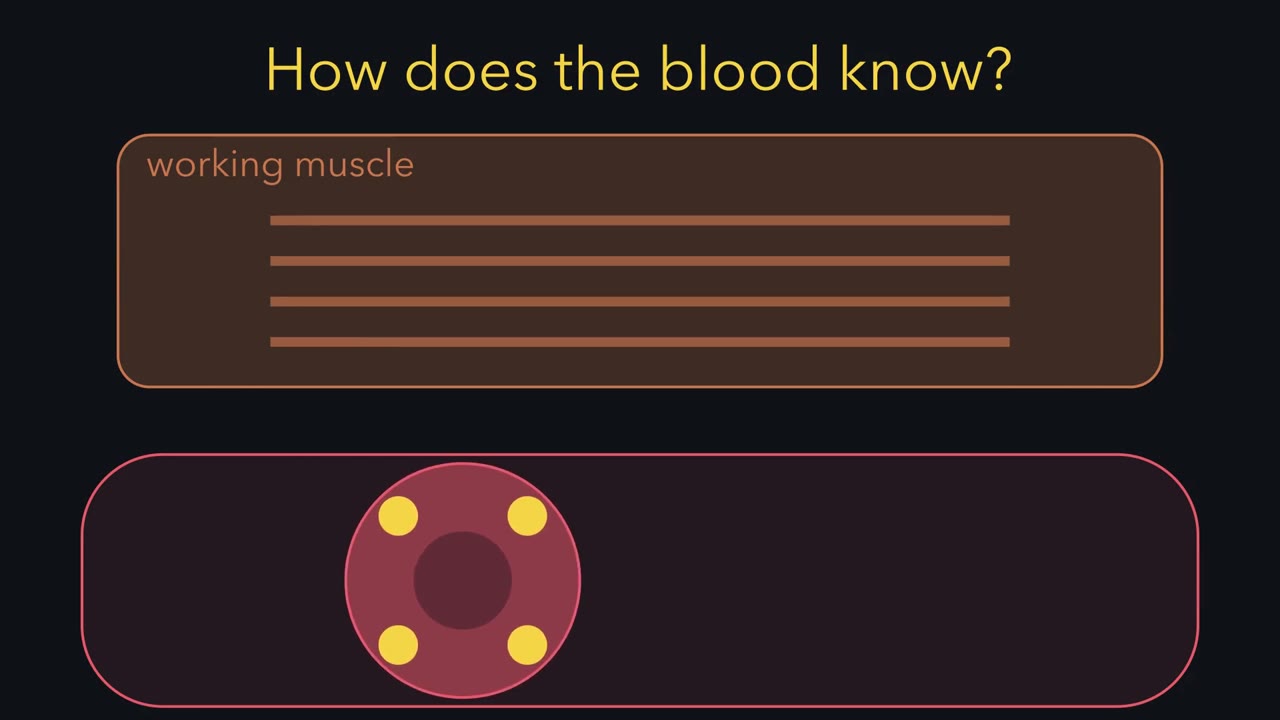
Your blood has to grab oxygen in the lungs and let go of about two-thirds of it in hard-working muscle. A tighter grip than hemoglobin's would make it worse. What does hemoglobin do instead?
Continue in the lesson: Protein Binding and Allostery: How Hemoglobin Loads and Delivers Oxygen →
2:26 · Free, with captions and a transcript. The lesson has the full text, the questions and the sources.
More films from this lesson
How this film was made. Narration: an AI narrator voice (Kokoro, af_heart) reading narration written from this lesson's text. Animation: AI-generated in code (Manim) by Claude, a schematic with no drawn molecular structures. Captions come from the narration script. See something wrong? Report it.