Films · Developmental Neuroscience
The Window and the Patch
Read the transcript of “The Window and the Patch”
Film transcript: The Window and the Patch
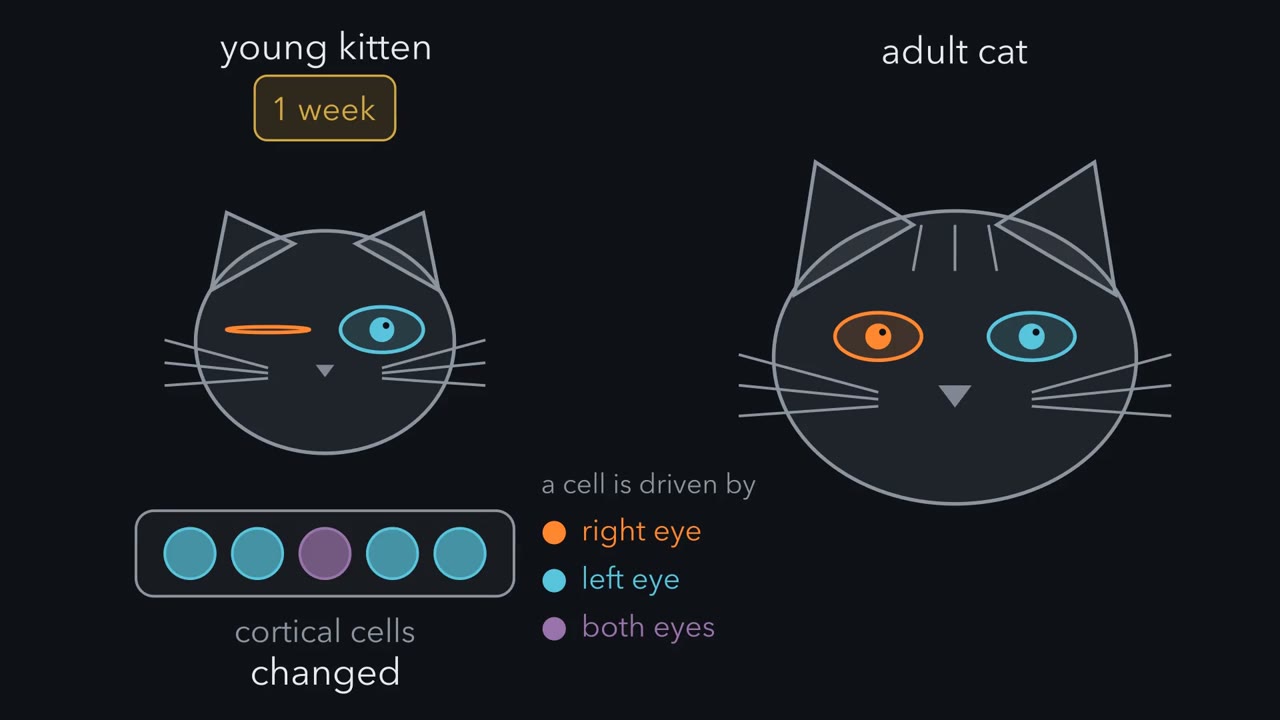
Why does a week of closure rewire a kitten's cortex, while months do nothing visible in an adult? Every result so far depends on age. Two terms help. A sensitive period is a window in which experience has an unusually strong effect. A critical period, in Eric Knudsen's definition, is a sensitive period with two extra features. The experience is essential for normal development. And its effects last. Real windows often fall between the two. How sharp one looks depends on the species, the manipulation and the measure. An adult cat's histogram may not move after a closure. That does not mean the adult cortex cannot change at all. Name the species with every number, because the window differs.
In kittens, susceptibility begins around the start of the fourth week. It stays high to about six to eight weeks, then declines through the third month. In macaques, early closure has its strongest effect in the first weeks after birth. In mice, Joshua Gordon and Michael Stryker found the strongest shifts near postnatal day 28. The same few days of closure in adult mice did little. Mice have no ocular dominance columns. Their value is genetics, used to ask what opens and closes the window. Now the clinic. Amblyopia is reduced vision, usually in one eye, that glasses do not immediately restore. No structural disease of the eye explains it. It usually arises when the two eyes give the young brain unequal input.
Common causes are strabismus, a large difference in focus between the eyes, and anything that blocks one eye's image. Strabismus affects a few percent of children. Predict. A young child's left eye sees poorly after early strabismus. Glasses correct the optics. Which eye do you patch?
The good eye. A patch covers it for part of the day, or atropine drops blur it. Then the weak eye carries the useful visual input. For those hours the weak eye is the one helping the shared cells fire, so the contest tilts its way. That can work because the weak eye keeps pathways that can still be strengthened, even if some connections were lost. Treatment generally works best in young children, consistent with a sensitive period. Trials have found some older children still improve. A cataract that blocks one eye from birth is usually removed early in infancy, for the same reason. Takeaway: the cell keeps the eye that helps it fire. That contest counts most while the window is open.
What opens and closes that window is the next lesson's question.
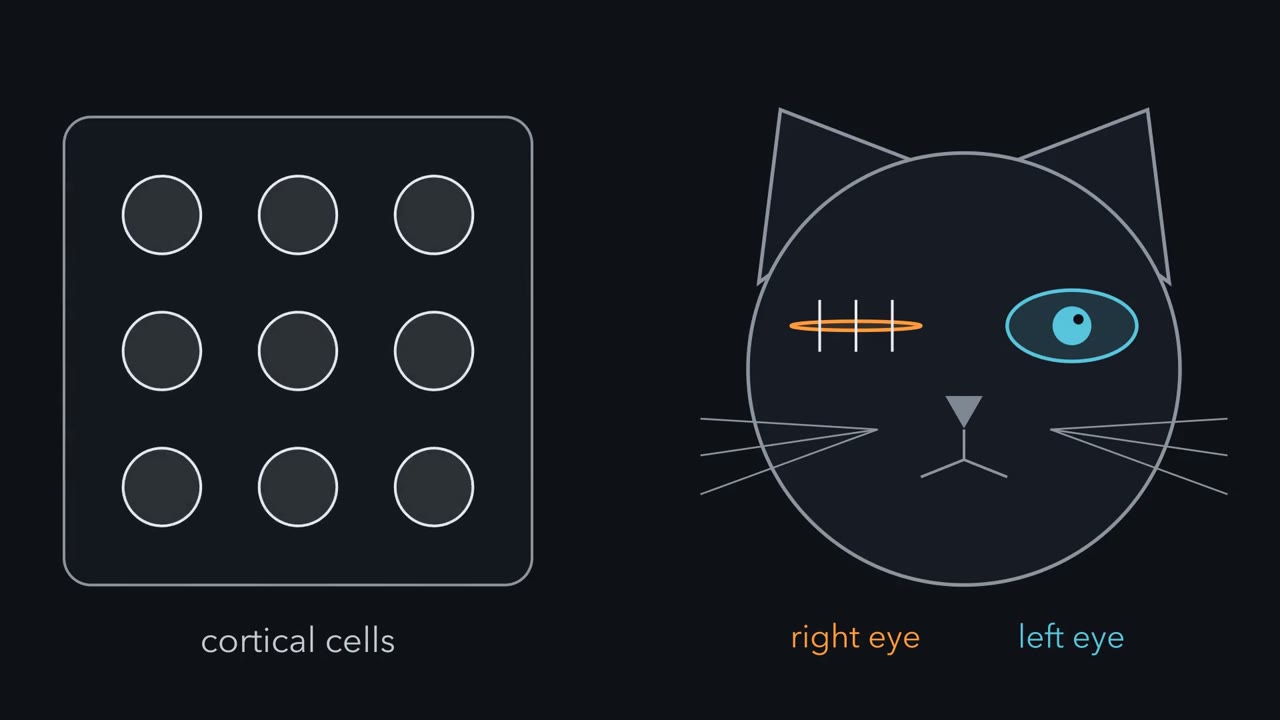
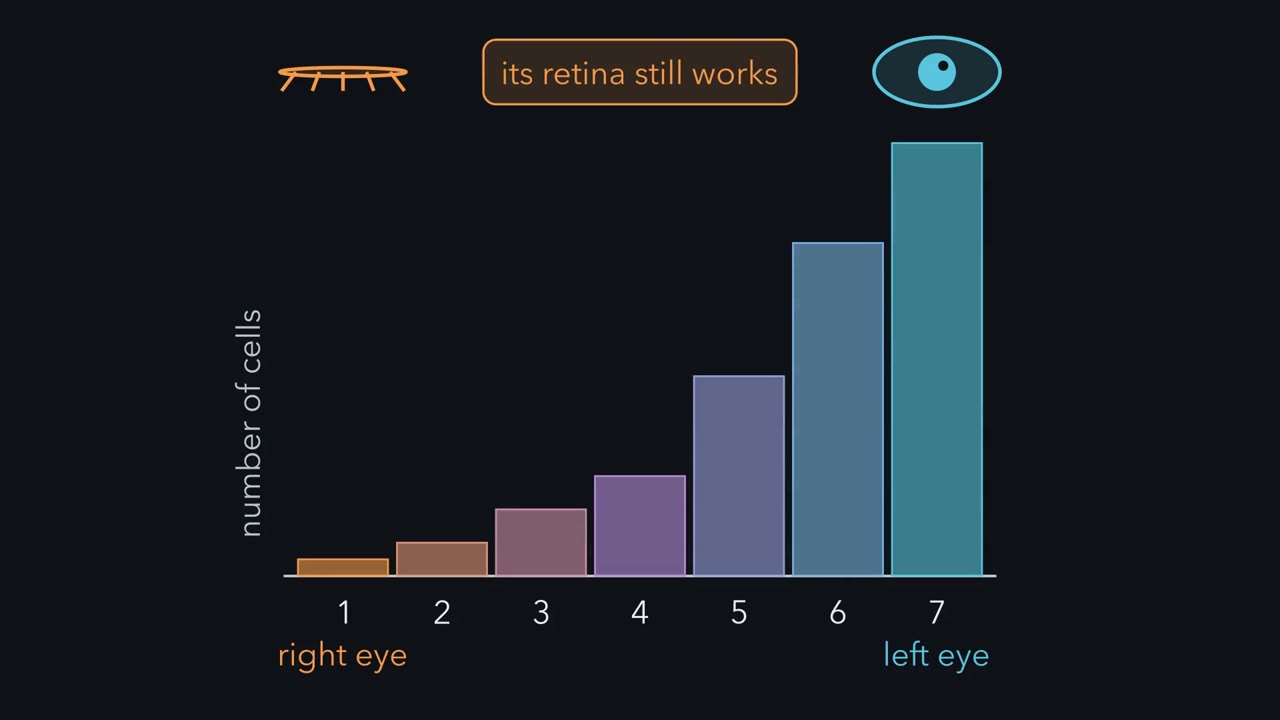
Why does closing one eye of a kitten for a week rewire its cortex, when closing both eyes shifts the balance much less?
Continue in the lesson: Ocular Dominance and the Critical Period →
3:14 · Free, with captions and a transcript. The lesson has the full text, the questions and the sources.
More films from this lesson
How this film was made. Narration: an AI narrator voice (Kokoro, af_heart) reading narration written from this lesson's text. Animation: AI-generated in code (Manim) by Claude, a schematic with no drawn molecular structures. Captions come from the narration script. See something wrong? Report it.