Films · Developmental Neuroscience
Two Closed Eyes
Read the transcript of “Two Closed Eyes”
Film transcript: Two Closed Eyes
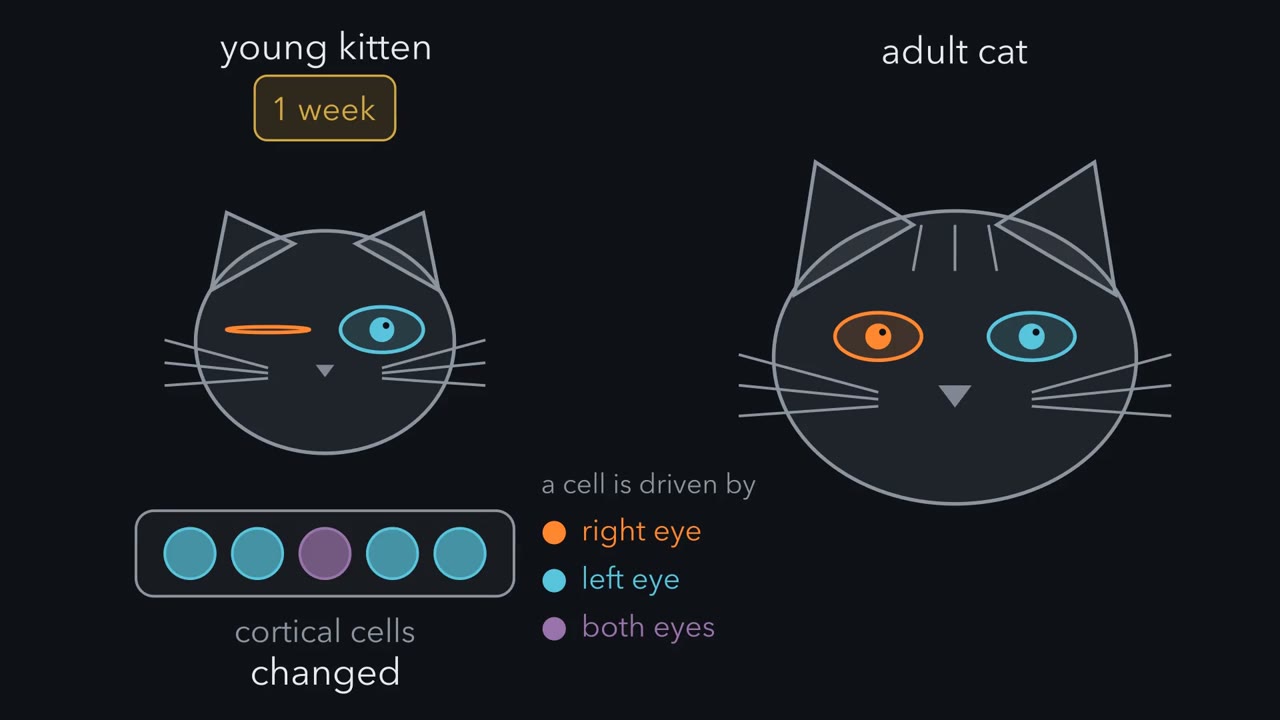
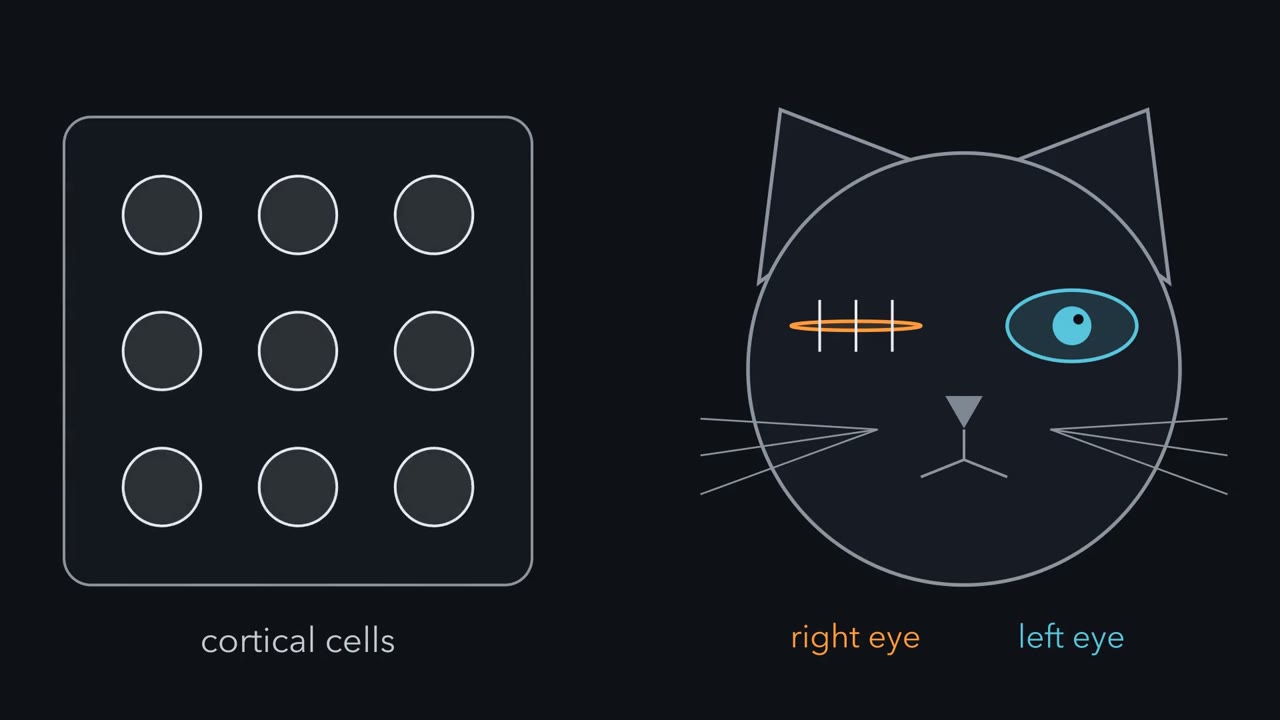
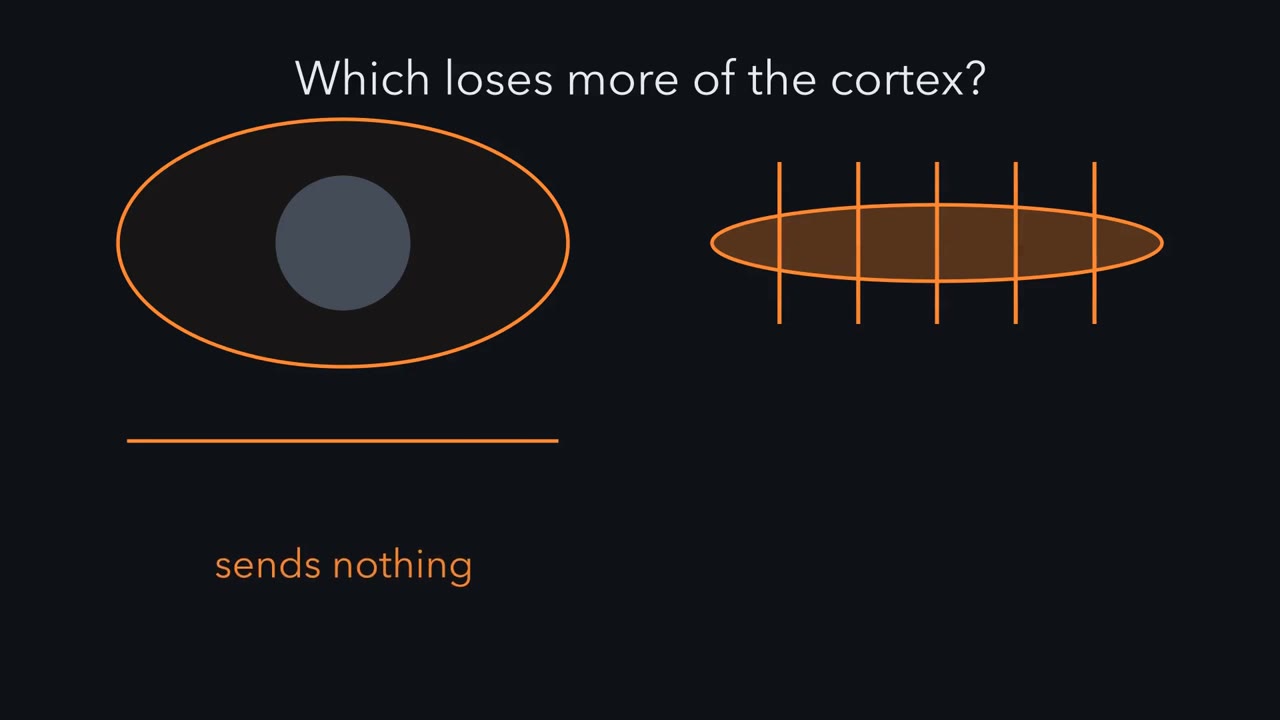
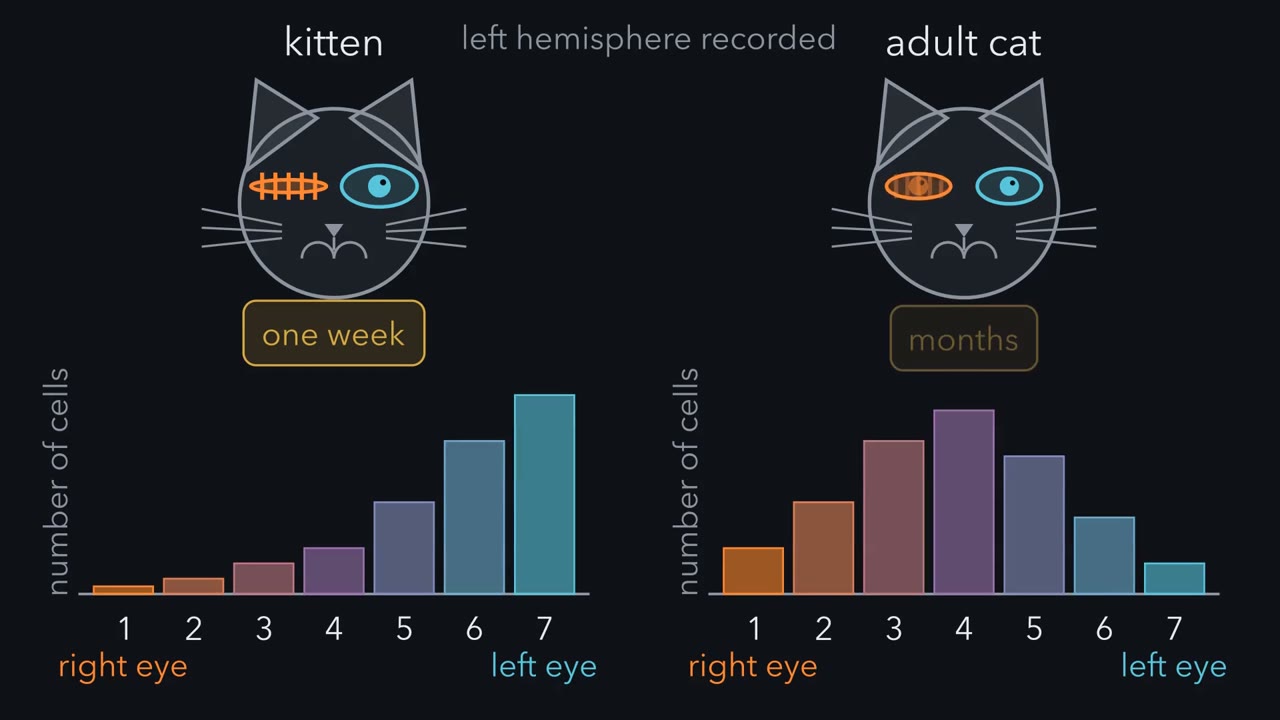
The closed eye lost the cortex, though its retina still worked. Was that disuse, or competition? Disuse says connections that carry little signal wither. On this reading, an eye's fate depends on its own use. Competition says the two eyes compete for influence over each shared cell. One eye's advantage costs the other its share. On this reading, an eye's fate depends on its use compared with the other eye's. For one closed eye, both ideas predict the same loss. So that experiment cannot tell them apart. They part company when both eyes are closed. Some toy bookkeeping makes this concrete. The numbers are illustrative, not measured. Give an open eye 10 units of useful activity, and a sutured eye 1 unit.
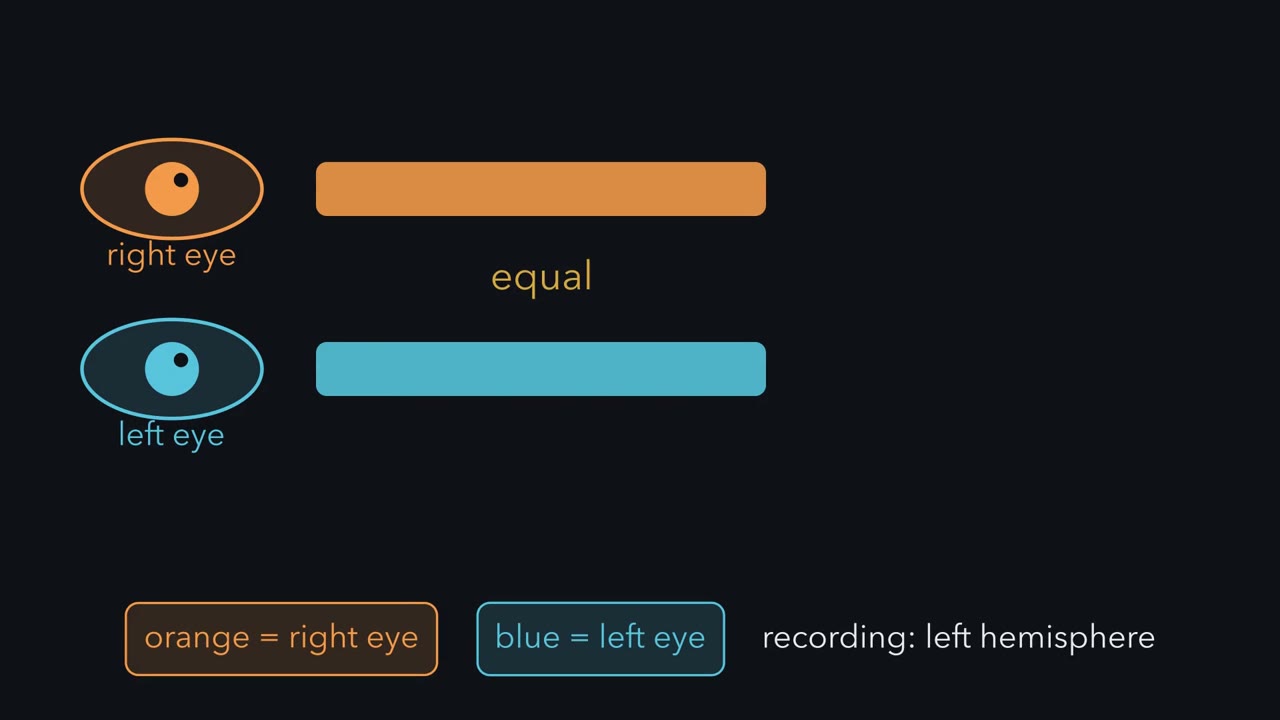
With both eyes open, disuse says each eye keeps all of its own connections. Competition gives each eye half the influence. Close one eye. Under disuse, it keeps only what its own use supports, a tenth. Under competition, its share shrinks to a sliver. Now close both. Under disuse, each eye is as unused as the single closed eye was. Under competition, neither eye has an advantage. Predict. Close both eyes of young kittens for the same weeks. What does each idea expect the histogram to show?
Disuse expects weak responses to both eyes, and perhaps many silent cells. Competition expects the balance to hold. Wiesel and Hubel did this experiment in 1965. They scored many cells on the seven-group scale. They also counted cells that responded abnormally, or not at all. Many cells still responded to each eye. The balance moved far less than after one-eye closure.
A share of cells did respond abnormally or not at all. So going without vision is not harmless. But the large loss that disuse predicts was absent. What cost the single closed eye its cells was mainly the open eye's advantage. That is the first part of the rule. The two eyes compete for the cells they share. One warning about the table. It is only bookkeeping. Models of competition add feedback. An eye that gets ahead is strengthened further. So inside the window, a strong imbalance can move most cells, not a fixed fraction of them. The rule gives the direction of change. It does not say where the balance finally settles. Takeaway: closing both eyes shifts the balance far less.
So what hurt one closed eye was mainly the open eye's advantage. But is the amount of activity all that counts? The next chapter keeps the amounts equal.
Why does closing one eye of a kitten for a week rewire its cortex, when closing both eyes shifts the balance much less?
Continue in the lesson: Ocular Dominance and the Critical Period →
3:12 · Free, with captions and a transcript. The lesson has the full text, the questions and the sources.
More films from this lesson
How this film was made. Narration: an AI narrator voice (Kokoro, af_heart) reading narration written from this lesson's text. Animation: AI-generated in code (Manim) by Claude, a schematic with no drawn molecular structures. Captions come from the narration script. See something wrong? Report it.