Films · Developmental Neuroscience
Out of Step
Read the transcript of “Out of Step”
Film transcript: Out of Step
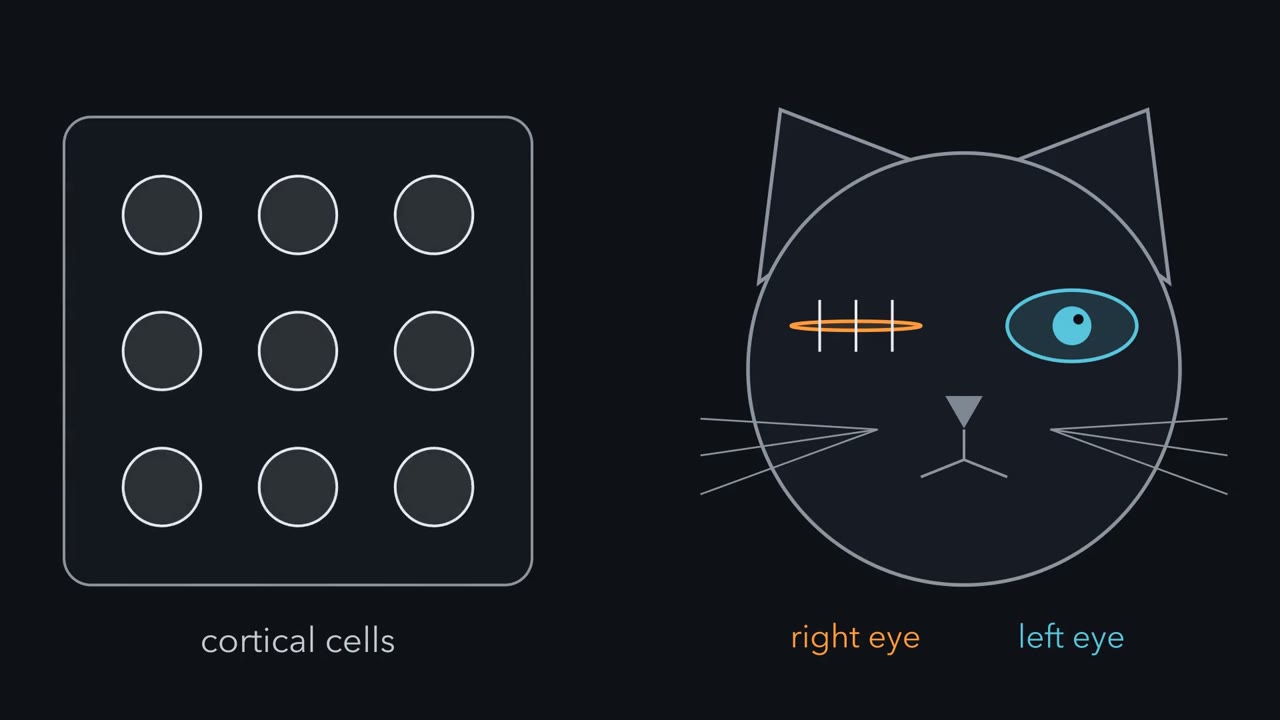
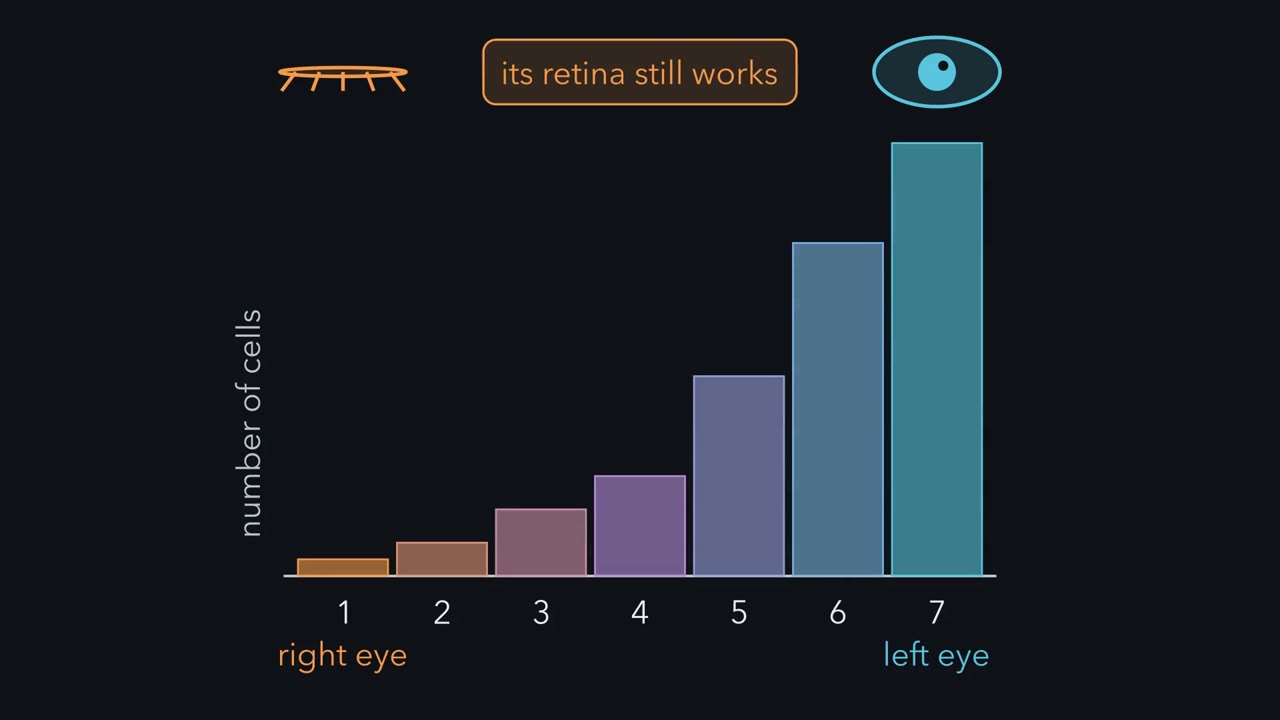
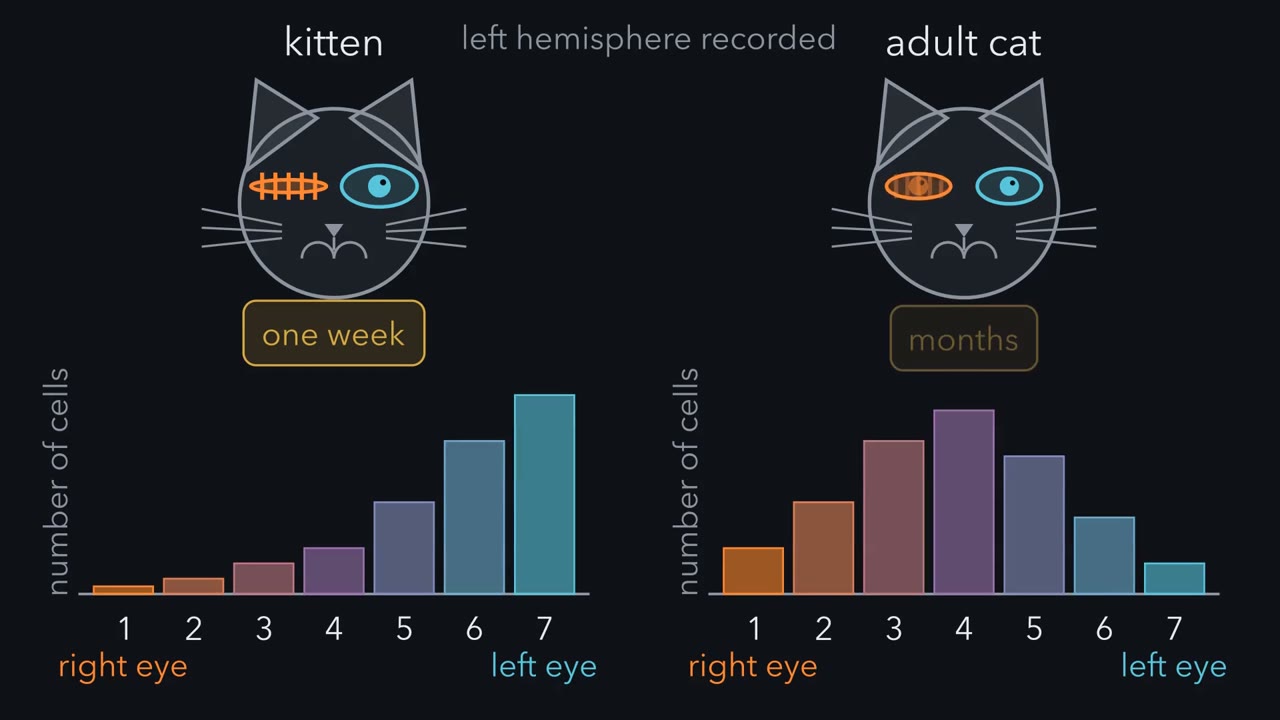
If two eyes send equal amounts of activity, should they always share a cell? The bookkeeping counts only amount. Strabismus tests whether amount is enough. In strabismus the eyes are misaligned. Each points at a different part of the scene. Hubel and Wiesel produced it in young kittens by cutting one eye muscle. Each eye still received a normal amount of patterned light. Predict. Each eye sends about as much activity as in a normal kitten. If amount were all that mattered, what should the histogram look like?
If amount alone set each cell's split, the histogram would look like a normal one. It did not. Most cells answered to one eye or the other, and few to both. The histogram had piles at groups 1 and 7, and a hollow middle.
Neither eye took over. The cells the two eyes had shared went to one eye or the other. Equal amounts were not enough. What changed was not the amount, but the timing between the eyes. When the eyes are aligned, they look at the same point. An edge crossing that point excites both eyes' inputs to a shared cell at nearly the same moments. Their signals are in step, or correlated. When the eyes are misaligned, each eye's input arrives while the other is doing something unrelated. A rule that explains this starts with Donald Hebb, in 1949. Hebb proposed that an input that repeatedly takes part in firing a cell is strengthened. Later models added a weakening half.
In the BCM model, an active input weakens when the cell responds, but only weakly. An active input strengthens when the cell responds strongly. A silent input changes little. The line between strong and weak slides with the cell's recent activity. Two eyes in step arrive together. The cell responds strongly when both are active, so both are kept. Out of step, each eye's input often arrives alone. Suppose one eye starts slightly stronger at this cell. Alone, it drives a strong response and is strengthened. Alone, the other drives only a weak response, and is weakened. The lead grows until the cell answers mainly to one eye. Which eye leads differs from cell to cell.
One molecular candidate for detecting together is the NMDA receptor. It passes much current only with glutamate and a co-agonist bound and the cell depolarized enough to clear magnesium from its pore. Now we have both halves of the rule. The cell keeps the eye that helps it fire. Takeaway: amount matters, but only activity in step with the cell's firing helps an eye keep it. Next, a sharper test: an eye that is silent, against an eye that is noisy.
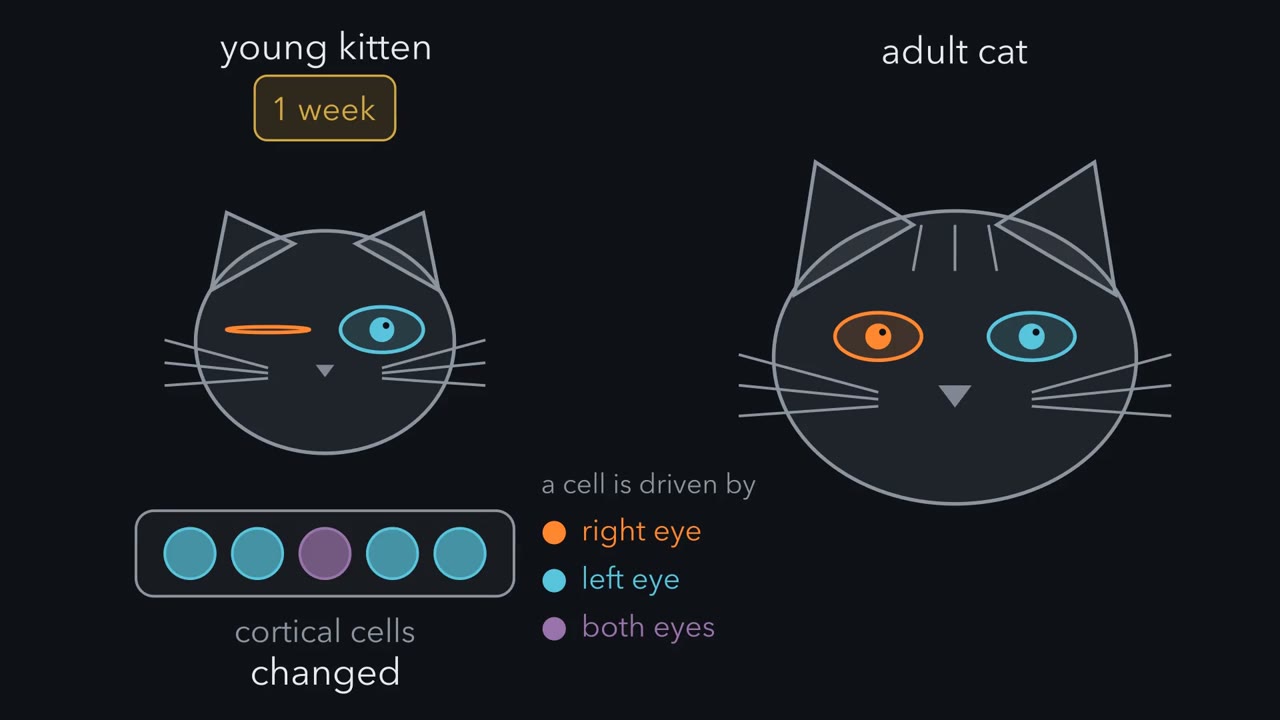
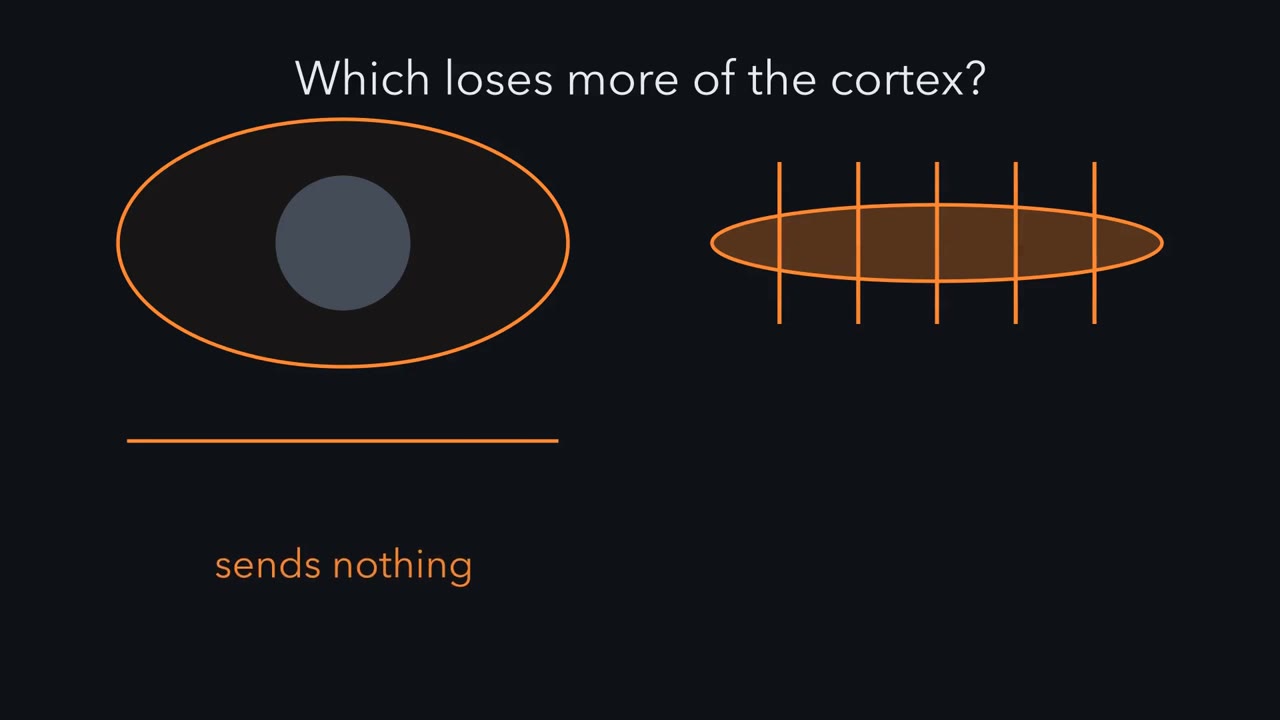
Why does closing one eye of a kitten for a week rewire its cortex, when closing both eyes shifts the balance much less?
Continue in the lesson: Ocular Dominance and the Critical Period →
3:16 · Free, with captions and a transcript. The lesson has the full text, the questions and the sources.
More films from this lesson
How this film was made. Narration: an AI narrator voice (Kokoro, af_heart) reading narration written from this lesson's text. Animation: AI-generated in code (Manim) by Claude, a schematic with no drawn molecular structures. Captions come from the narration script. See something wrong? Report it.