Films · Developmental Neuroscience
Silence Is Not Noise
Read the transcript of “Silence Is Not Noise”
Film transcript: Silence Is Not Noise
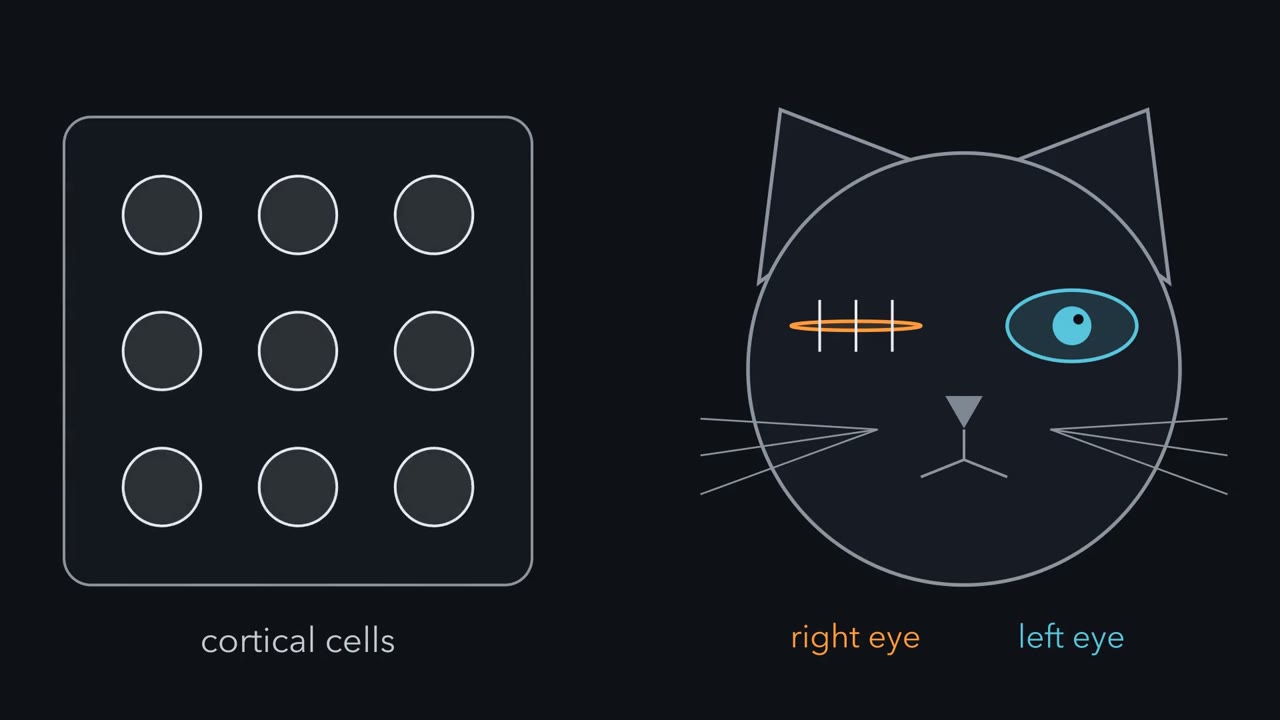
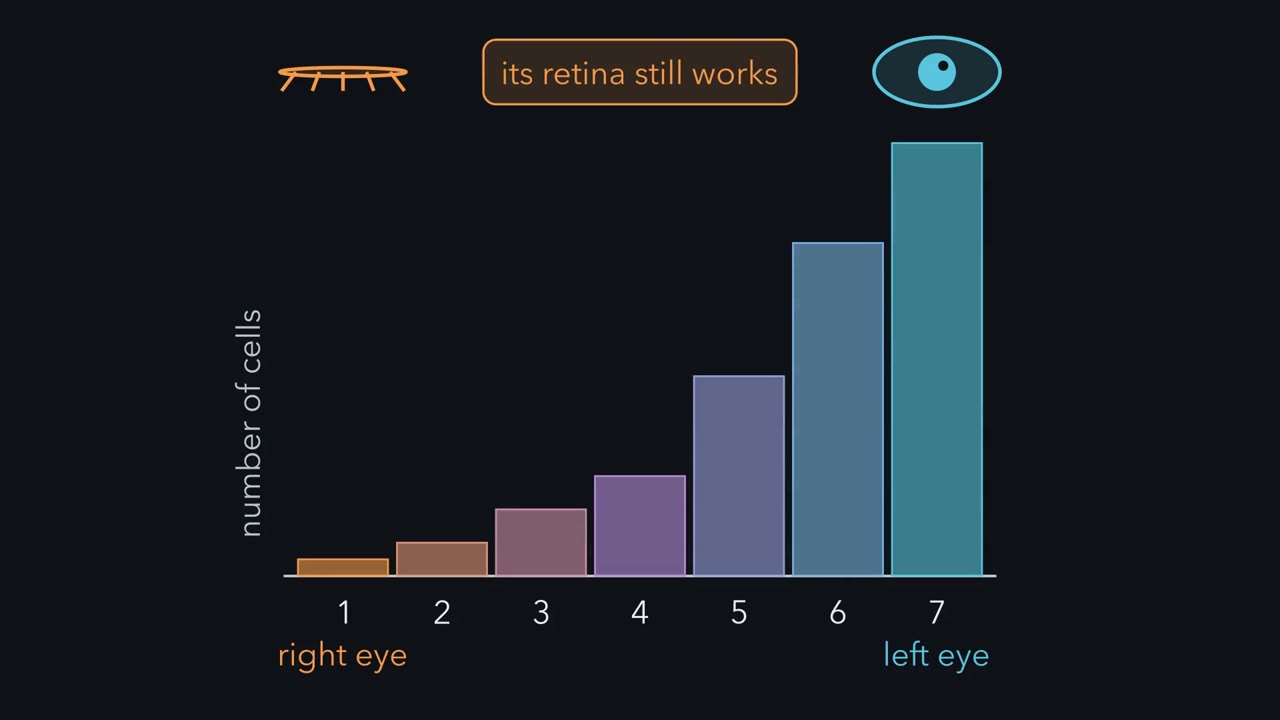
Which loses more of the cortex: an eye that sends nothing, or an eye that sends noise? Lid suture blurs an eye's image. But its retina keeps firing under the lid. In 1986, Michael Stryker's laboratory asked whether electrical activity itself is what counts. They silenced one eye of kittens with tetrodotoxin, a toxin that blocks sodium channels. It silences the retinal ganglion cells, the eye's output neurons. Cortical responses shifted toward the eye that kept firing. So an imbalance of electrical activity between the eyes is enough to cause a shift. In the same year, Stryker and William Harris silenced both eyes during development. Then the two eyes' axons failed to separate into stripes.
Now there are two ways to take an eye out of the contest. A sutured eye, whose retina still fires. And a silenced eye, which sends nothing at all. Predict. If the more active eye simply wins, which closed eye should lose more? What does our rule predict?
By amount, the silenced eye is quieter, so it should lose more. It loses less. In kittens, lid suture weakens the closed eye's responses more than tetrodotoxin does. Why? The sutured eye's retina is still active under the lid. That leftover activity is unpatterned. It is out of step with the cells it drives. And it seems to weaken the eye's own synapses. A silent eye is never active at the wrong moments. So it loses less. So the rule that the more active eye wins fails this test. So does simple disuse. The rule in the box can account for the difference. The sutured eye's input is the kind its weakening half acts on; a silent input is left nearly alone.
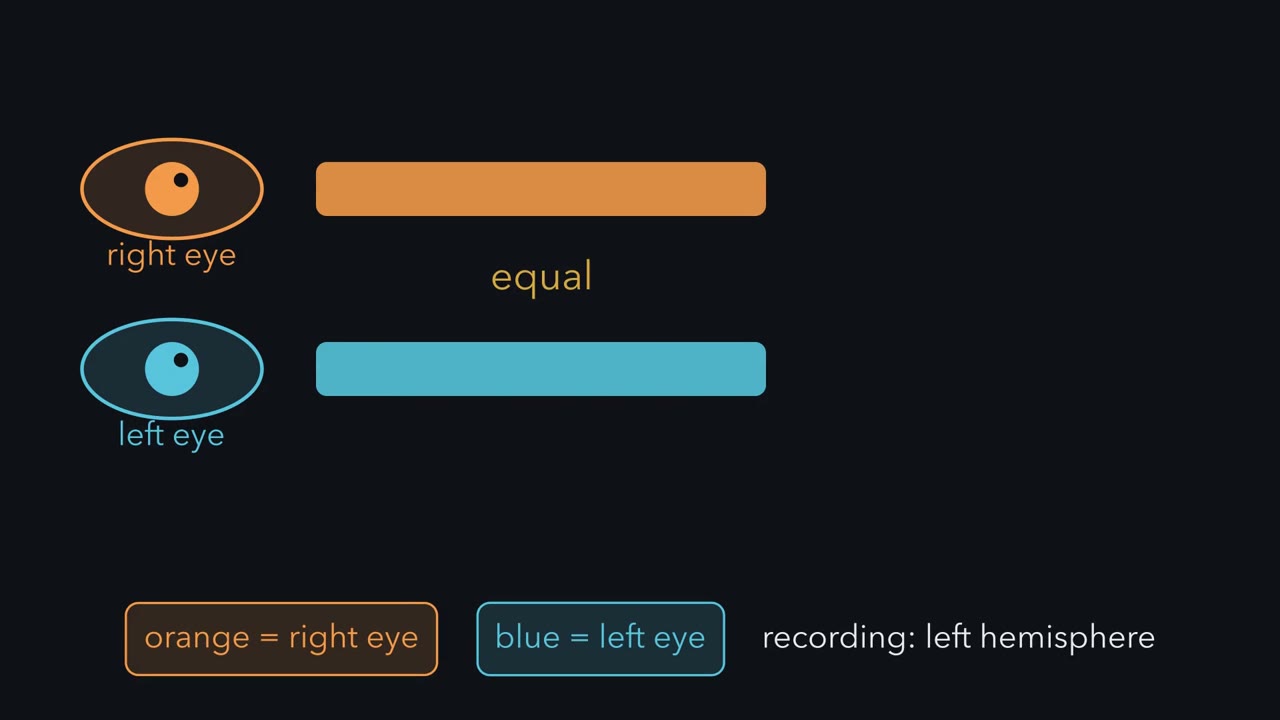
The open eye drives the cell's strong responses. On its own, the sutured eye evokes only weak ones. Takeaway: silence is not the same as noise. An eye whose activity is out of step with the cell loses more than an eye that is simply silent. One question remains. Why does all of this work mainly in the young?
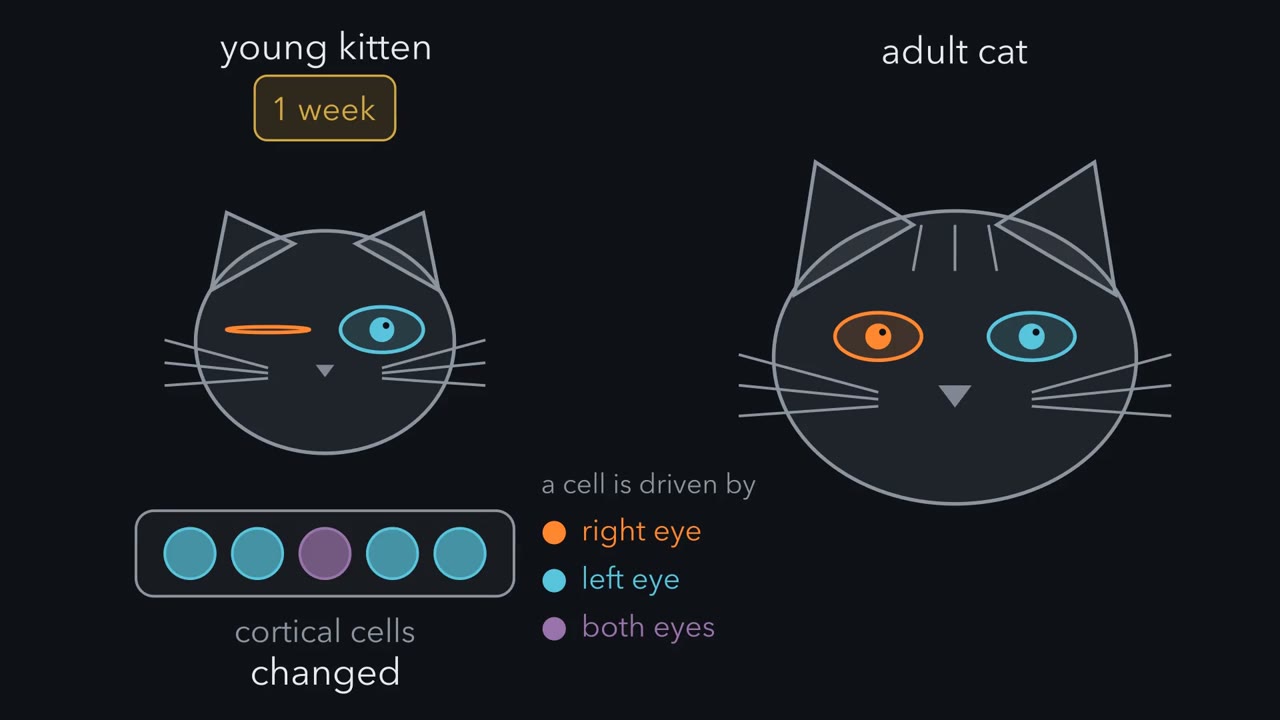
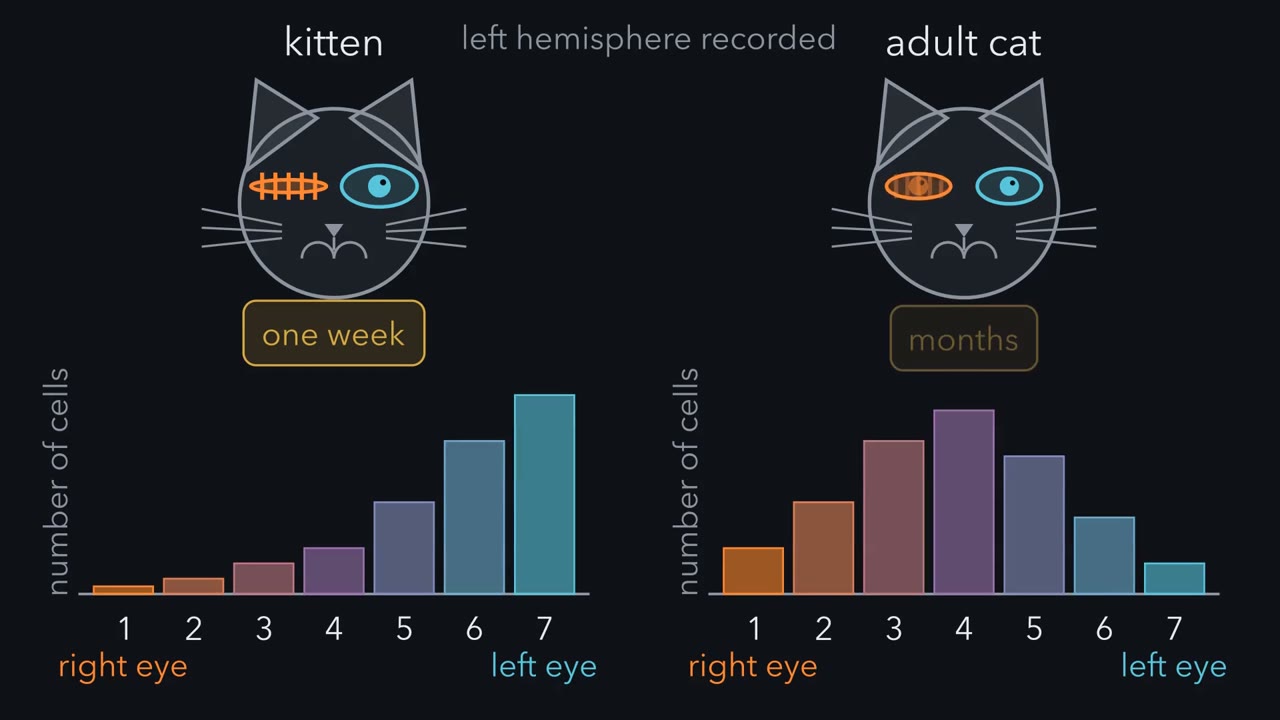
Why does closing one eye of a kitten for a week rewire its cortex, when closing both eyes shifts the balance much less?
Continue in the lesson: Ocular Dominance and the Critical Period →
2:38 · Free, with captions and a transcript. The lesson has the full text, the questions and the sources.
More films from this lesson
How this film was made. Narration: an AI narrator voice (Kokoro, af_heart) reading narration written from this lesson's text. Animation: AI-generated in code (Manim) by Claude, a schematic with no drawn molecular structures. Captions come from the narration script. See something wrong? Report it.