The Sixty-Fold Gap
Read the transcript of “The Sixty-Fold Gap”
Film transcript: The Sixty-Fold Gap
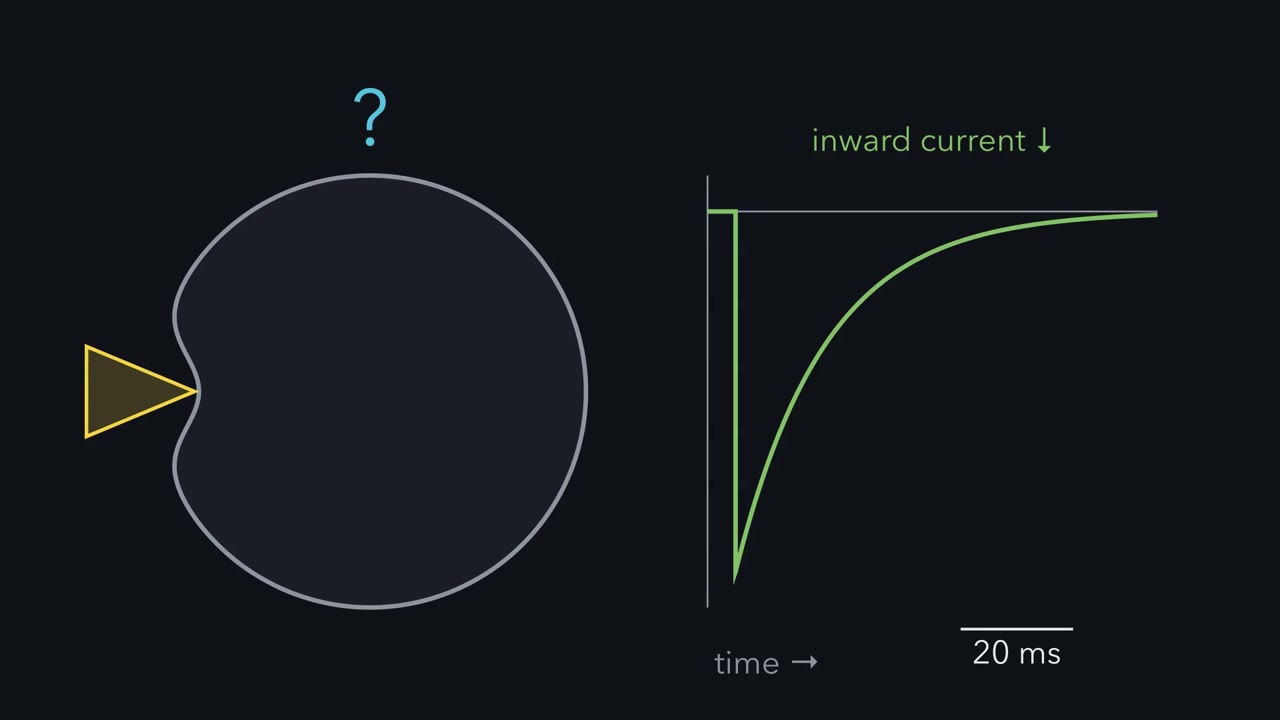
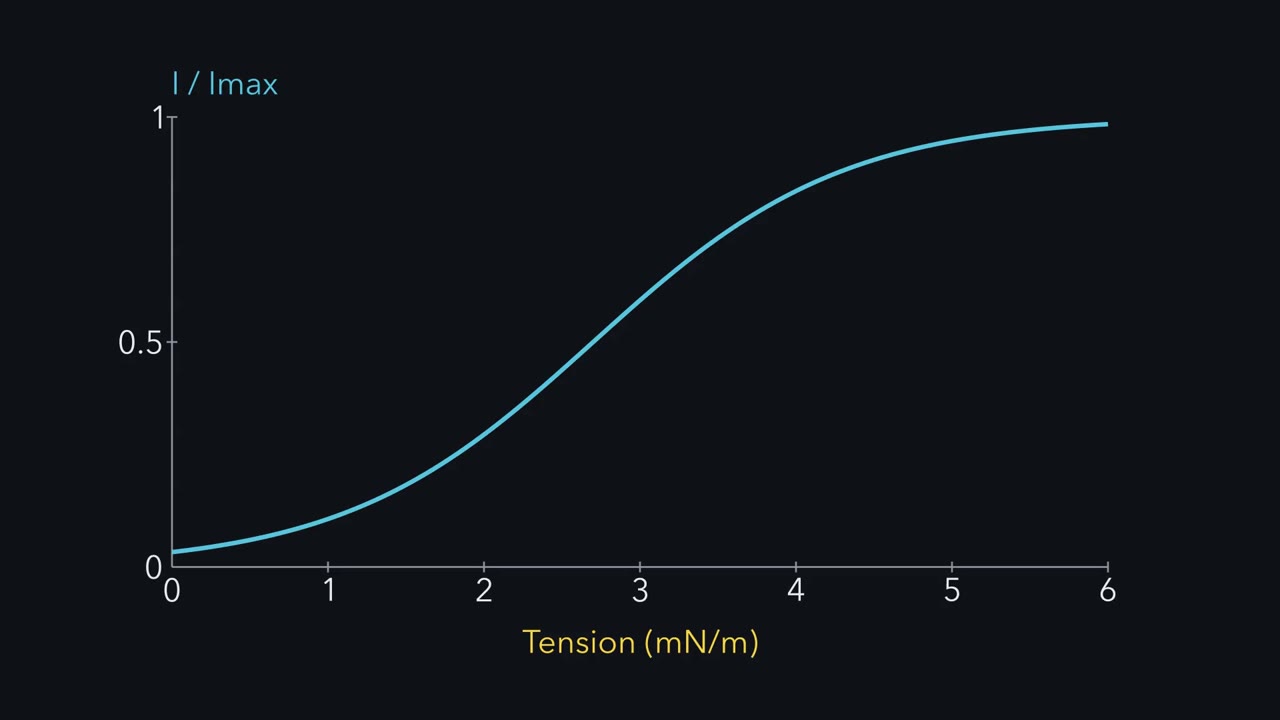
Structures suggest the channel gains hundreds of square nanometres. A two-state reading of the current says about five. Do they describe the same change? Yang and colleagues put purified mouse Piezo1 into lipid vesicles. Cryo electron microscopy sorted it into two classes, from one sample. One class was curved, the other flattened. Between them was about three hundred square nanometres of in-plane expansion. Their abstract hedges whether this rearrangement is the gating transition itself. Suppose all three hundred square nanometres were coupled to opening. How steep would the current curve be?
Nearly vertical. The channel would go from ten to ninety percent open over a tiny range of tension. The measured curve is about sixty times shallower. The half-activation tensions are of the same order. The slopes are not.
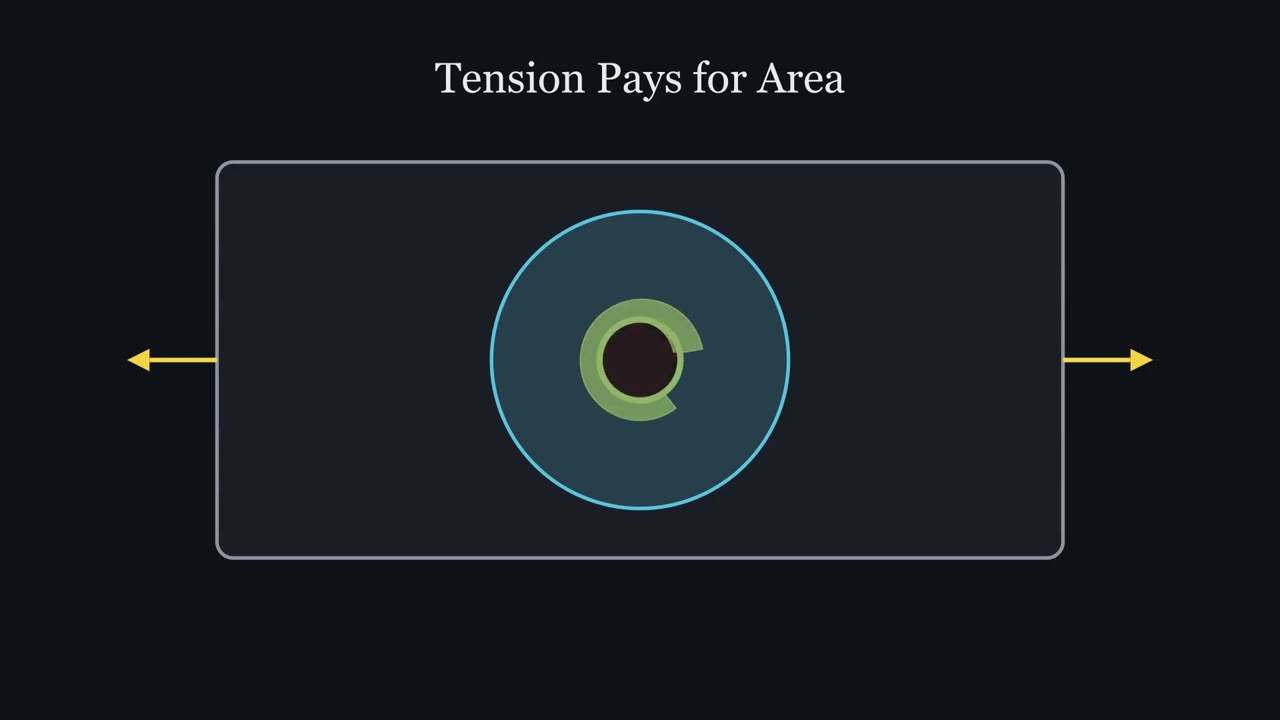
Geometry makes a change that large plausible. On paper, an idealized Piezo2 dome gains about three hundred and ten square nanometres when it flattens. So why is the measured switch so shallow? The question is open. Here are three testable answers. First, the dome may not be a two-state switch. If it flattens gradually, like a spring, one area no longer describes it. Second, a patch curve is a population curve. Uneven tension across a patch could spread the half-activation tensions. Suppose otherwise identical two-state channels sit at equilibrium and differ only by fixed offsets in half-activation tension. Then averaging broadens their response, and the slope-derived area underestimates their common opening area.
Outside that model it is an effective area, not a guaranteed bound. And the published curve also pools different patches. Third, the flattened class may not be the open channel. A structure is not a current recording. There is one more twist. In an elasticity model by Haselwandter and MacKinnon, the membrane bends away around the dome. That skirt reaches well past the protein. So tension does work on the footprint as well as on the channel. Their numbers are model inputs, not the structural three hundred. Keep the two apart. Neither five square nanometres nor hundreds has been shown to be the area gained on pore opening. The structural expansion is real; which part of it couples to opening is still open.
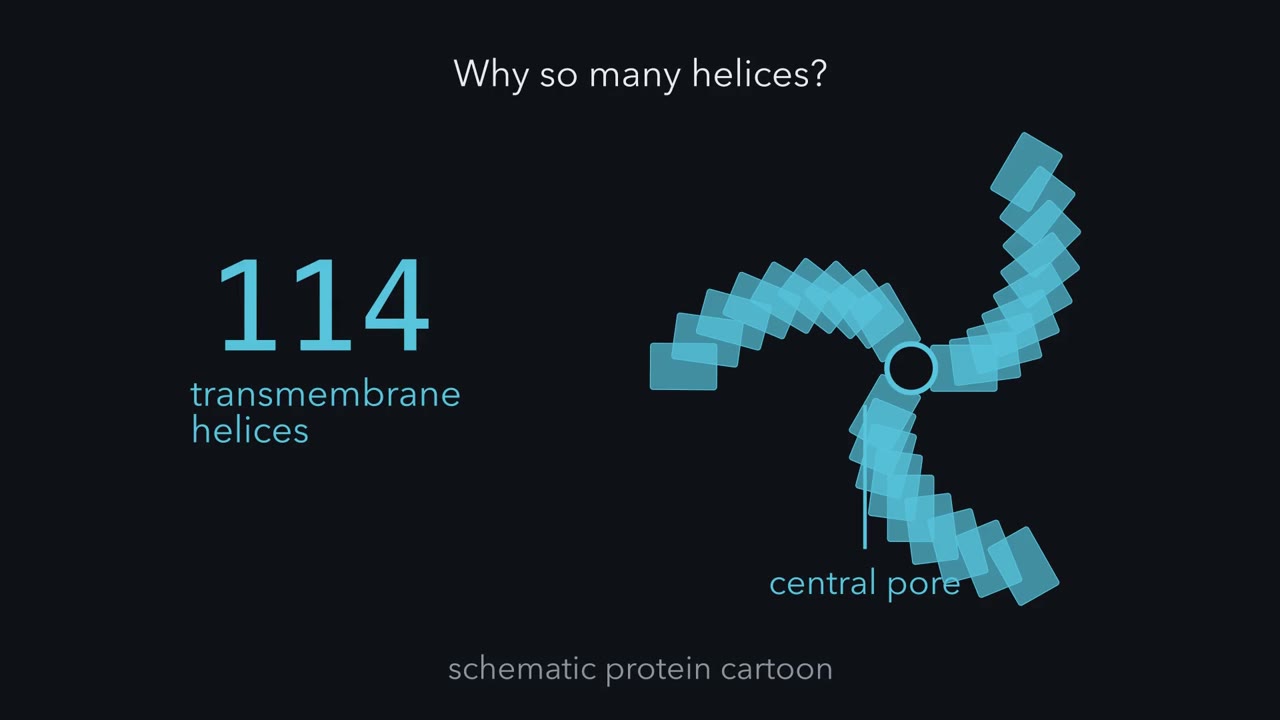
Mouse PIEZO2 threads 114 transmembrane helices through the membrane to build one ion channel, and its pore sits at the centre. Why would a channel need so much protein around one pore?
Continue in the lesson: Piezo Channels and the Physics of Force →
2:56 · Free, with captions and a transcript. The lesson has the full text, the questions and the sources.
More films from this lesson
How this film was made. Narration: an AI narrator voice (Kokoro, af_heart) reading narration written from this lesson's text. Animation: AI-generated in code (Manim) by Claude, a schematic with no drawn molecular structures. Captions come from the narration script. See something wrong? Report it.