Press play to start at .
Courier or Relay? Testing What Travels
From the film
- To separate courier from relay, test what only one model predicts.
- Blocking dynein kills target-dependent neurons, but it cannot separate a courier from a relay whose local steps also use dynein.
- Inhibiting TrkA kinase only in the middle stretch of the axon would break a TrkA relay but not a passing endosome, and survival was spared.
- Neutralizing NGF arriving in the cell body removes survival, supporting a carried NGF-TrkA complex without ruling out other routes.
Read the transcript of “Courier or Relay? Testing What Travels”
Film transcript: Courier or Relay? Testing What Travels
Tap a sentence to play from there.
- 0:02 The first film showed how a dynein-carried signaling endosome crosses a centimeter in hours. Since a relay could beat diffusion too, how can an experiment tell whether the receptor actually travels?
- 0:17 Or does it stay at the tip while local signals march home?
- 0:21 Picture two competing models on the same axon.
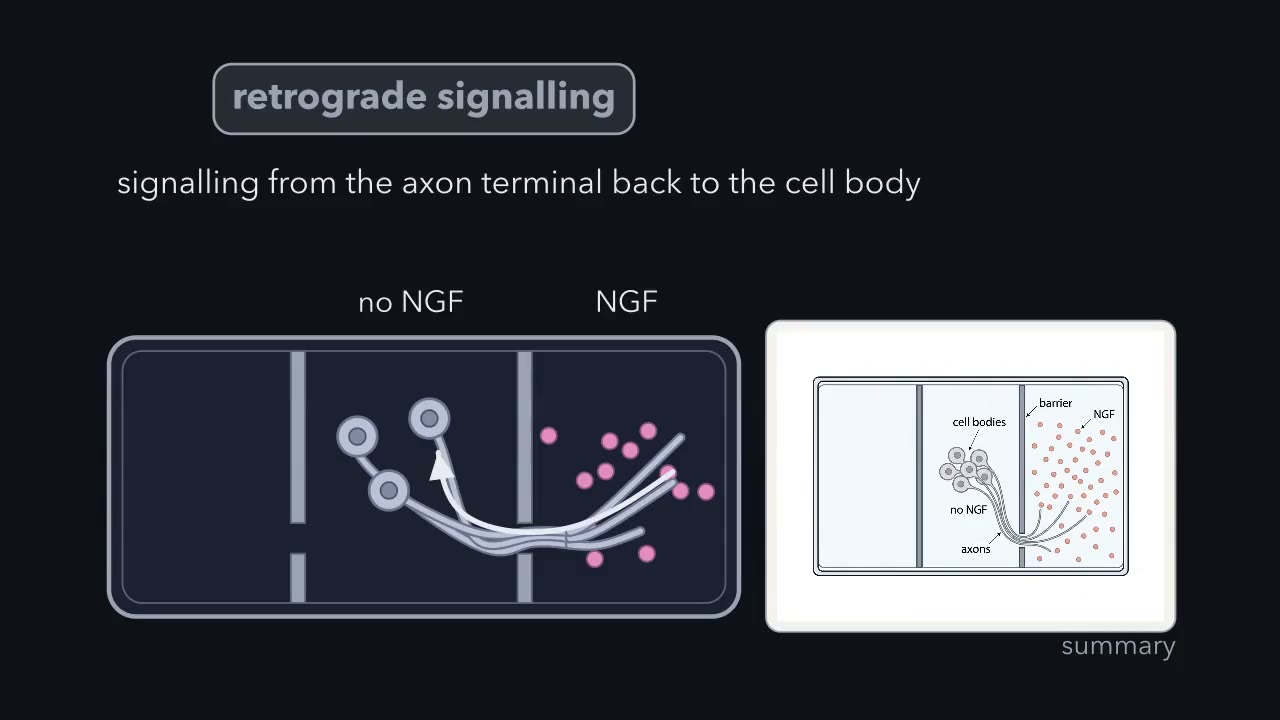
- 0:26 In the courier model, one active NGF and TrkA endosome rides dynein all the way home. In the relay model, TrkA stays at the tip.
- 0:36 Like a bucket brigade, each stretch hands a local signal to the next.
- 0:41 Both wake nuclear CREB.
- 0:44 Timing alone cannot choose, because a fast relay can also arrive within hours.
- 0:50 A natural next test is to disable the motor dynein.
- 0:55 Suppose you give NGF only to the far axons, block dynein, and the neurons die.
- 1:00 Predict: does death after blocking dynein prove one vesicle carried the receptor?
- 1:12 No, because both models can need dynein.
- 1:16 Blocking it stops a courier endosome from leaving the tip.
- 1:20 But a relay could also use dynein for short local handoffs within each stretch of axon. If each local step needs dynein, blocking the motor halts the brigade too.
- 1:31 Both models predict death.
- 1:35 To tell two models apart, test an outcome only one predicts.
- 1:40 Instead of stopping dynein everywhere, divide the axon across three sealed chambers: tip, middle stretch, and cell body.
- 1:49 Now add a drug that blocks TrkA kinase activity only inside the middle chamber.
- 1:55 Watch how the two tracks split.
- 1:58 A relay passing TrkA activity from stretch to stretch hits the inhibitor and dies in the middle. The courier behaves differently.
- 2:07 Even if the drug quiets its kinase during transit, dynein carries the vesicle through with NGF still bound inside.
- 2:16 In the drug-free cell body, TrkA can signal again.
- 2:20 In 2003 Ye and colleagues ran this test, and survival was spared.
- 2:26 That argues against a propagating wave of TrkA activity.
- 2:31 Still, what if another signal reached the cell body while NGF stayed behind?
- 2:36 Neutralizing NGF once it arrives in the cell body takes survival away.
- 2:42 So the carried ligand matters, though other routes remain open.
- 2:46 Notice why the three-chamber design succeeded where disabling dynein failed.
- 2:53 A perturbation that breaks a shared requirement can never separate rival mechanisms.
- 2:59 When two hypotheses both fit the timing, aim your test at the exact step where their predictions diverge.
Retrograde signals: the same idea, other levels
A level is a place to start, not a rank. If this loses you, the rung below teaches the same idea, told more simply.
Graduate · the level you chose
Long-Distance Signaling in Neurons · this lesson
Diffusion needs 58 days per centimeter; Campenot's three-chamber dish shows axon-tip NGF suffices.
Cell Signaling · about 19 min · film 3:38 · 3 practice questions
The Signal from the Target Travels Home
Diffusion needs about two months over 1 cm, so dynein carries NGF home.
Developmental Neuroscience · about 25 min · film 2:56 · 3 practice questions
Next door
- Signaling endosomes: Endocytosis and Signaling Endosomes A vesicle carrying the receptor and its signal can travel back along the axon to the cell body.
- Nerve growth factor: A Tumor That Reaches Nerves Without Touching · 1:34 The survival signal a young nerve cell takes in at its tip comes from the tissue it connects to.
- Motor proteins: Grip, Swing, Let Go · 3:09 · College: the core Motor proteins walk along tracks inside the axon, carrying cargo toward the cell body.
More films from this lesson
Continue in the lesson: Long-Distance Signaling in Neurons →
Free, with captions and a transcript. The lesson has the full text, the questions and the sources.
How this film was made. Narration: an AI narrator voice (Kokoro, af_heart) reading narration written from this lesson's text. Animation: AI-generated in code (Manim) by Claude, a schematic with no drawn molecular structures. Captions come from the narration script. See something wrong? Report it.