Films · Developmental Neuroscience
Still On When It Gets There
Read the transcript of “Still On When It Gets There”
Film transcript: Still On When It Gets There
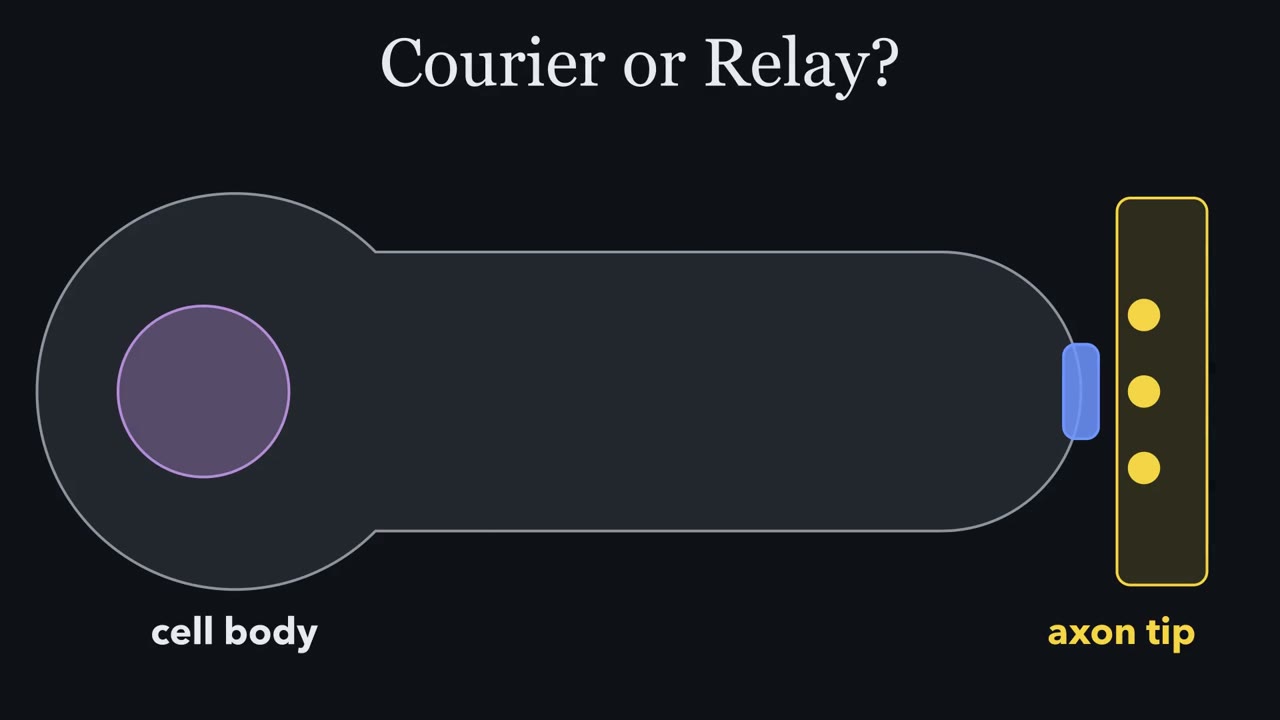
A neuron hears its survival signal at the far end of its axon. How does the message get home? A sympathetic neuron collects NGF at axon terminals that can sit centimetres from its cell body. The terminal hears the factor. But the nucleus decides whether the cell lives. In these young neurons, dying needs new genes switched on in the nucleus. So a survival signal from the tip has to be able to act on the cell body. Here is the idea to carry through. A target keeps a neuron alive only if its signal makes the trip home. And it must be able to signal when it gets there. On when it arrives, not necessarily on every second of the trip. Binding at the tip is not enough.
So could the signal simply drift home, by diffusion? Diffusion time grows with the square of the distance. For a typical soluble protein and an axon one centimetre long, how long would the trip take? Roughly two months. Over a few centimetres, many months.
Worse, many signals are proteins carrying a phosphate. Enzymes called phosphatases keep removing it. Suppose a phosphate lasts about ten seconds. Then the active signal falls to about a third every ten micrometres from the tip. A centimetre is a thousand of those steps. The rates are illustrative, but the conclusion holds. It does not arrive late. It arrives switched off.
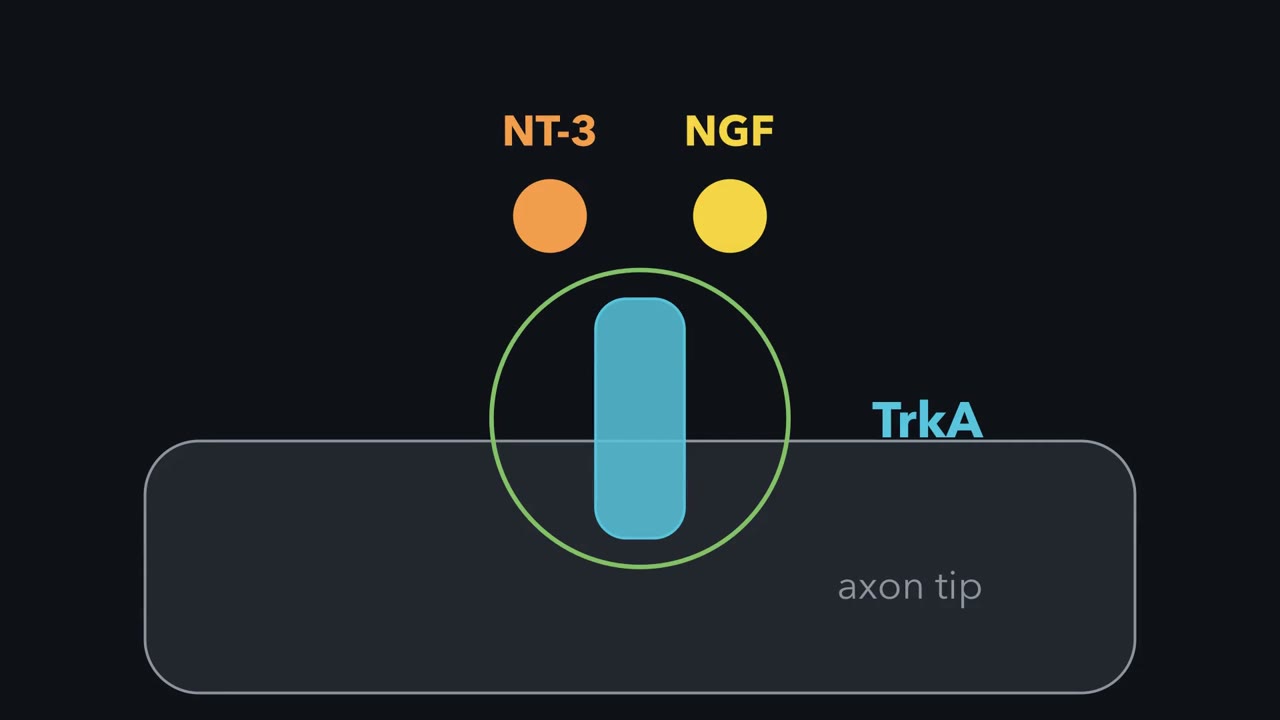
So the signal needs a vehicle or a relay. And it must be able to signal when it arrives. One candidate fits both needs. At the tip, NGF binds its receptor, TrkA. Ligand and active receptor are pulled into the cell together, in a vesicle called the signaling endosome. It can keep signaling while carried. The motor protein dynein drags it along microtubules toward the cell body. At roughly a micrometre each second, a centimetre takes a few hours. So what arrives must still be able to signal, after hours on the way. Carrying alone is not enough. This model is favoured. But is it proven? Hold that question. Takeaway: a survival signal must make it home still able to signal.
A neuron hears its survival signal at the far end of its axon. How does the message get home?
Continue in the lesson: The Signal from the Target Travels Home →
2:45 · Free, with captions and a transcript. The lesson has the full text, the questions and the sources.
More films from this lesson
How this film was made. Narration: an AI narrator voice (Kokoro, af_heart) reading narration written from this lesson's text. Animation: AI-generated in code (Manim) by Claude, a schematic with no drawn molecular structures. Captions come from the narration script. See something wrong? Report it.