Separate Cells for the Clock and the Pupil
Read the transcript of “Separate Cells for the Clock and the Pupil”
Film transcript: Separate Cells for the Clock and the Pupil
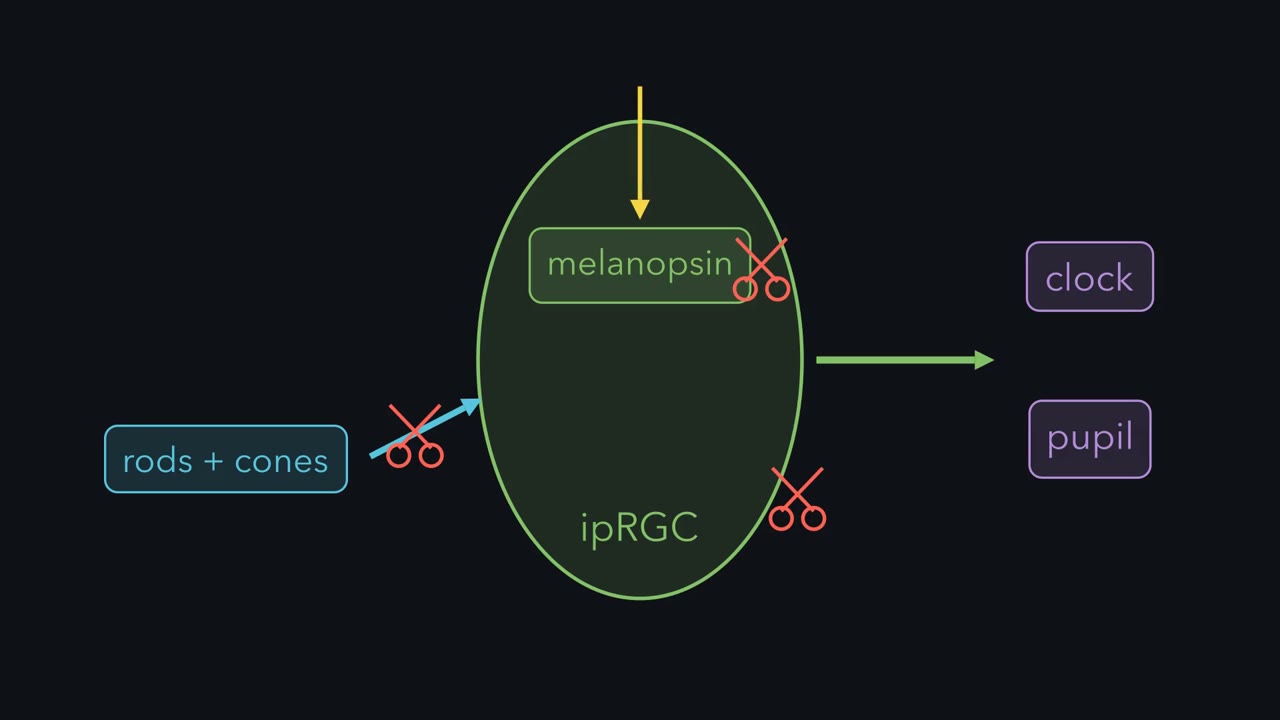
Do the same cells set the clock and narrow the pupil? Or do separate cells do each job? To find out, you need a way to mark one set of cells. Here the marker is Brn3b. Brn3b is a transcription factor. Most ganglion cells make it, but a subset of M1 cells does not. In 2011, Chen, Badea and Hattar traced where each set goes.
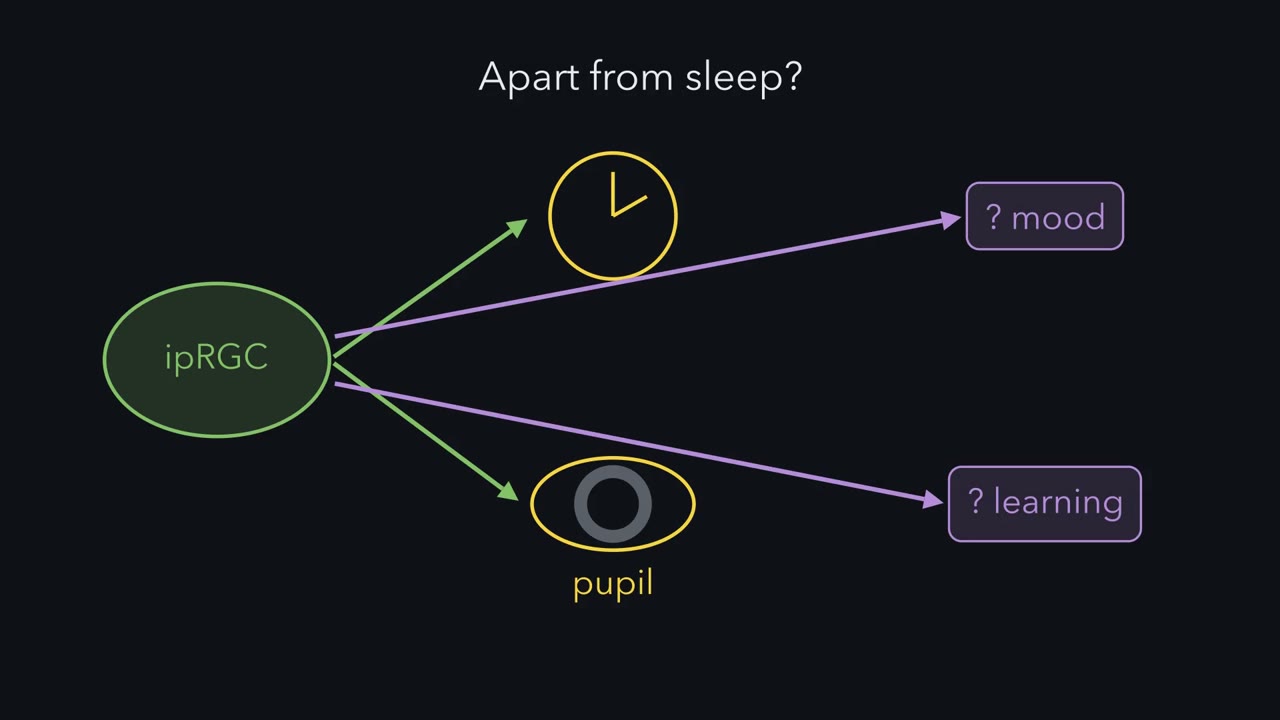
Brn3b-negative M1 cells reached the SCN, the clock. Brn3b-positive cells reached the olivary pretectal nucleus, which drives the pupil. Predict. Kill only the Brn3b-positive ipRGCs, leaving other ganglion cells intact. What happens to the pupil? And to the clock?
The pupil light reflex was severely impaired. But circadian photoentrainment was spared. The Brn3b-negative cells that reach the SCN were still there. So the two behaviours depend on partly different cells. The outputs can be pulled apart. Notice what the marker defines here. Brn three B marks an output set, not one morphological type. Those outputs come from a varied population. Mouse ipRGCs are named M1 to M6. They differ in shape, in where their dendrites sit, and in where their axons go. M1 cells are the classic clock and pupil cells. Their dendrites lie in the outermost stratum of that layer. That stratum is conventionally called OFF. The name describes where the dendrites sit, not the cell's own response.
M2 dendrites lie in the inner band. M3 cells have dendrites in both bands. M4 is the mouse sustained ON alpha cell, and it is intrinsically photosensitive. M5 and M6 send axons to the thalamic relay for image-forming vision. The letters name mouse cells. They are not six matching human types. A marker can separate the clock route from the pupil route. It cannot, by itself, name the subtype behind each job.
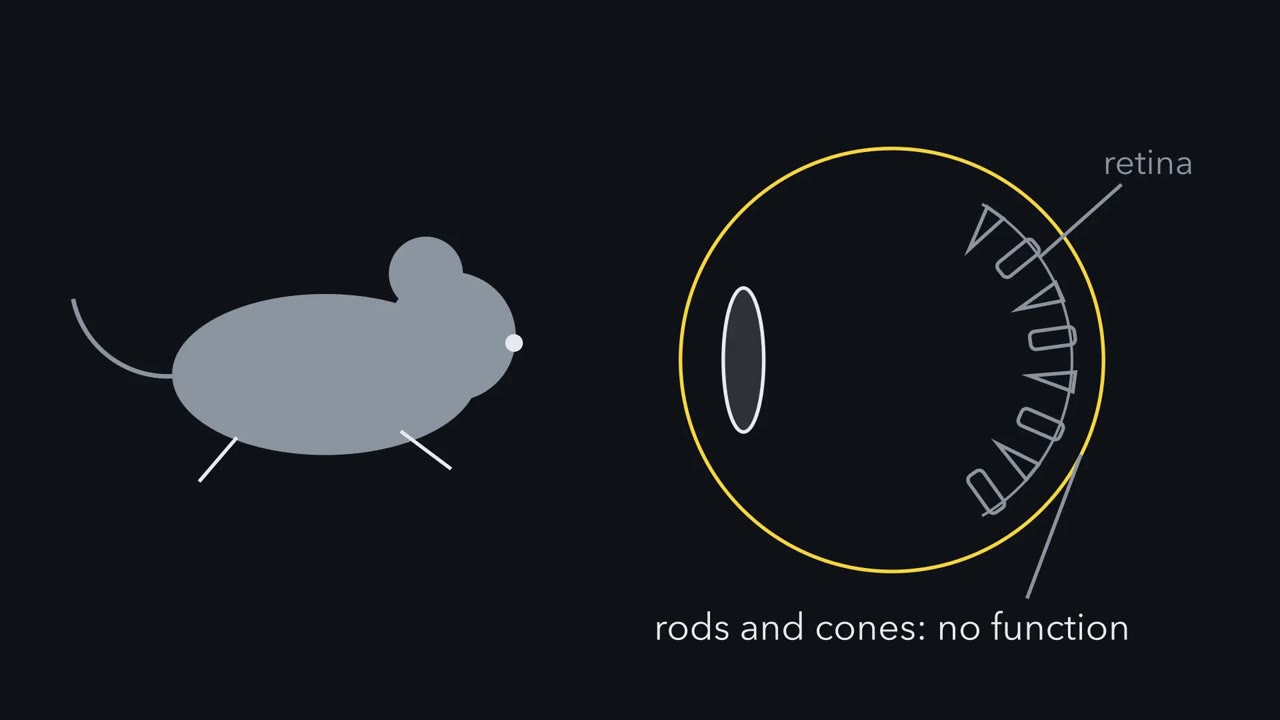
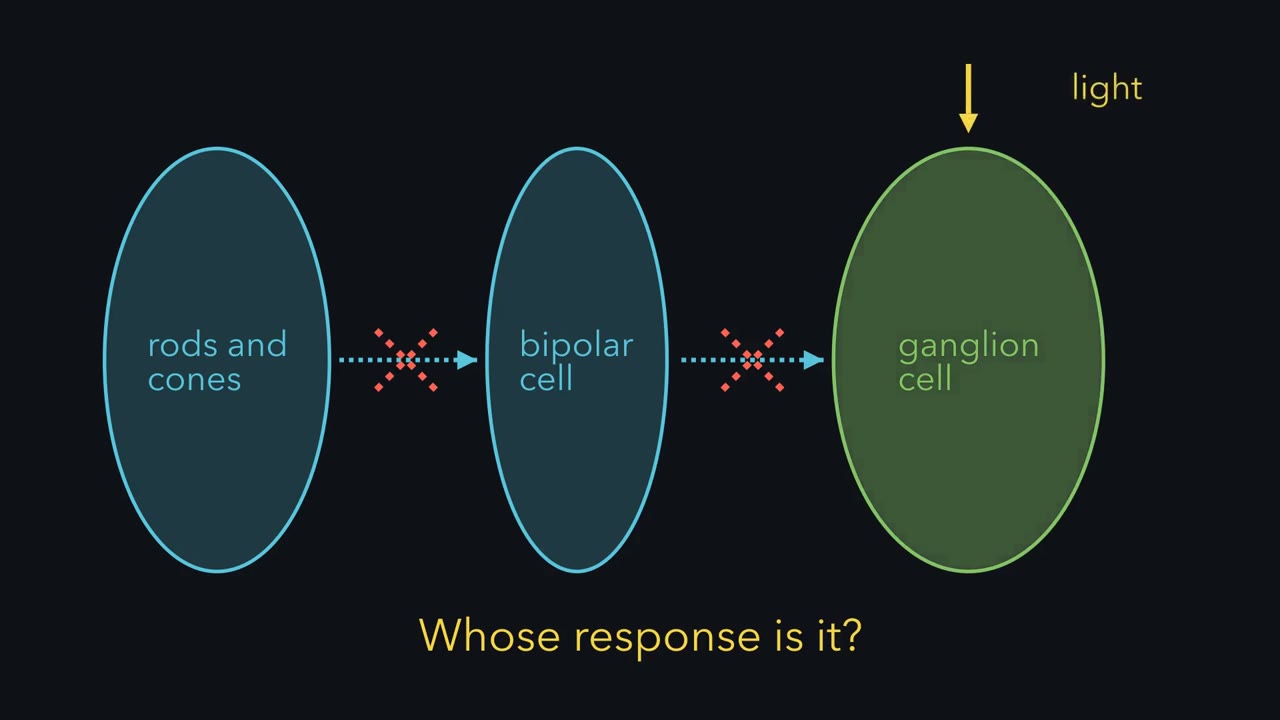
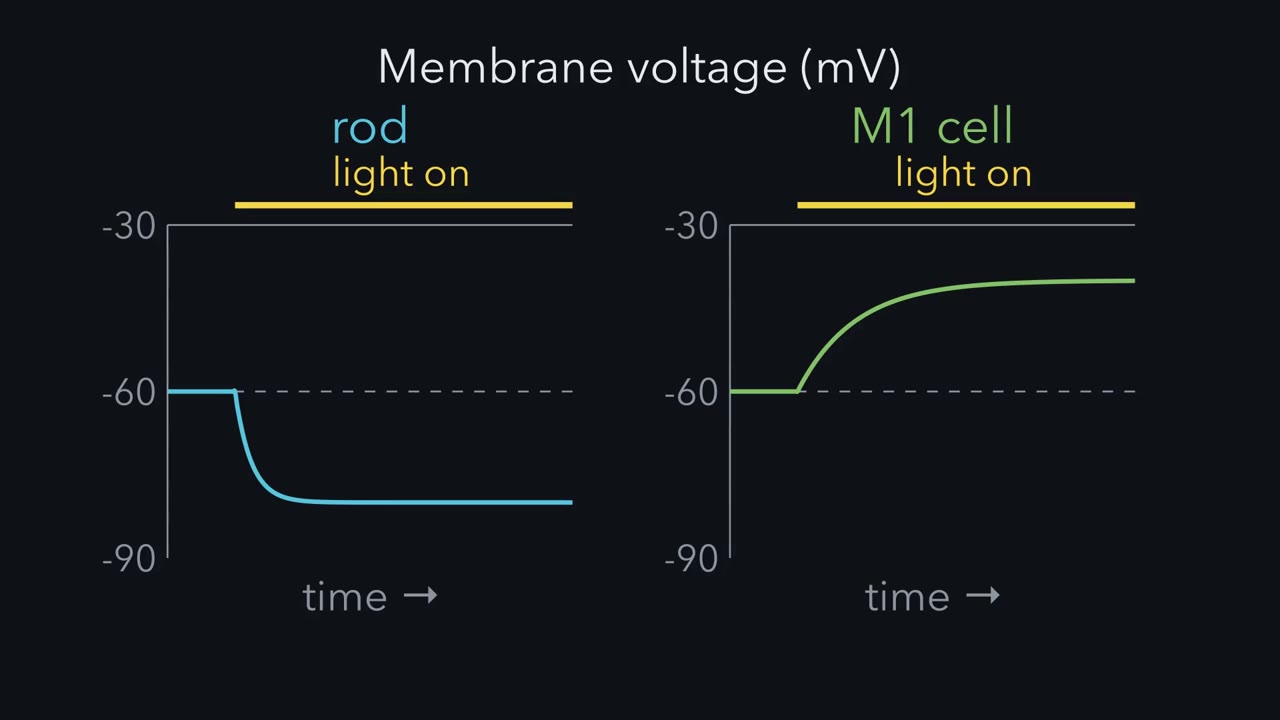
A mouse with no working rods or cones still sets its body clock to the day and still narrows its pupils in bright light. Which cells are measuring the light?
Continue in the lesson: Melanopsin Cells: Light for the Clock and the Pupil →
2:32 · Free, with captions and a transcript. The lesson has the full text, the questions and the sources.
More films from this lesson
How this film was made. Narration: an AI narrator voice (Kokoro, af_heart) reading narration written from this lesson's text. Animation: AI-generated in code (Manim) by Claude, a schematic with no drawn molecular structures. Captions come from the narration script. See something wrong? Report it.