Press play to start at .
Two Clocks for Pressure
From the film
- When pressure rises, stretch receptors in the carotid sinuses and aortic arch fire faster.
- The brainstem then turns vagal output up and sympathetic output down: the heart slows and small arteries and veins relax.
- Gain is correction divided by the error left; a gain of 2 removes two thirds of a fast disturbance.
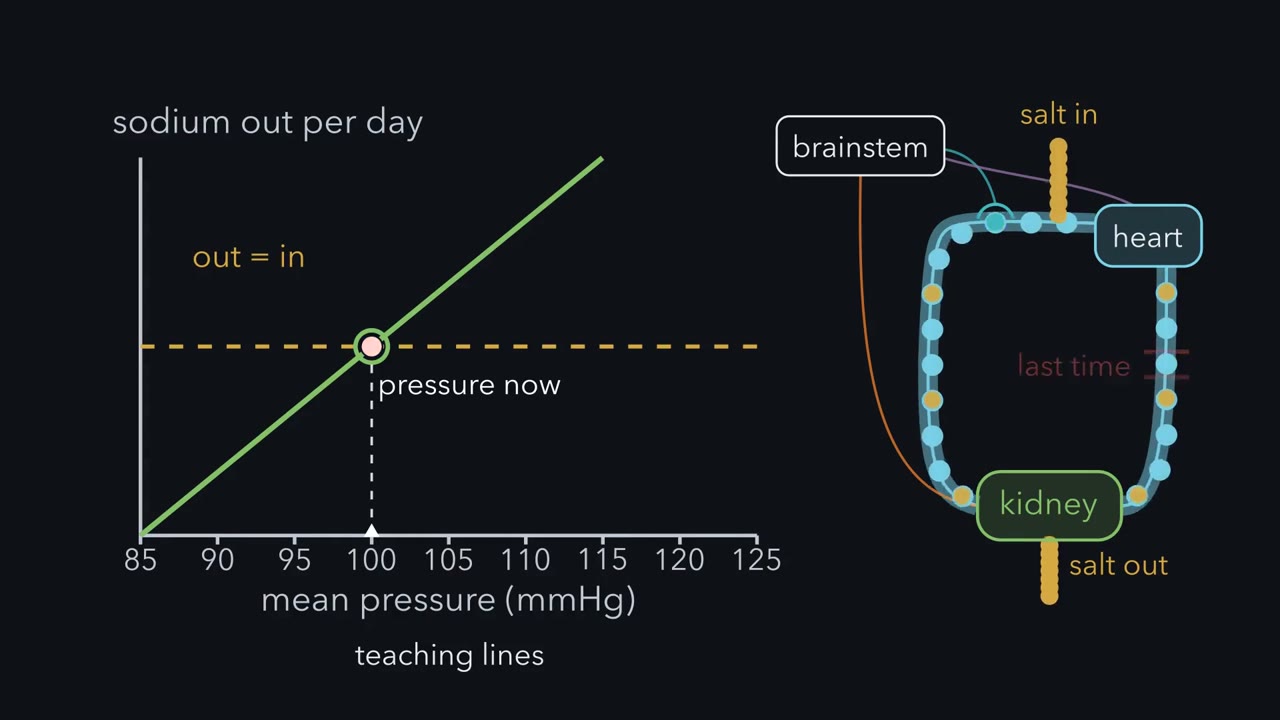
- The kidney excretes more sodium as pressure rises, and only where salt out equals salt in can pressure rest.
- In Guyton's framework, the reflex decides how far pressure strays and the kidney decides where it ends up.
Read the transcript of “Two Clocks for Pressure”
Film transcript: Two Clocks for Pressure
Tap a sentence to play from there.
- 0:00 All day, posture and activity push your arterial pressure around.
- 0:05 Within seconds, a reflex pushes back, but it never quite finishes.
- 0:11 So what decides where pressure settles?
- 0:16 An adult's mean arterial pressure at rest is about 93 mmHg.
- 0:23 Call it 100. Squeeze the small arteries, and with no reflex, it would climb to 120.
- 0:31 That rise of 20 is the disturbance.
- 0:35 But stretch receptors sit in the carotid sinuses, in the neck, and in the aortic arch. They fire faster as the walls stretch.
- 0:44 Their signals reach the brainstem, which turns vagal output to the heart up, and sympathetic output down.
- 0:52 The heart slows. Small arteries relax, so resistance falls.
- 0:59 Veins relax, so less blood returns.
- 1:02 Pressure settles near 106.7.
- 1:06 The reflex removed 13.3 and left 6.7.
- 1:12 Correction divided by what is left gives a gain of 2.
- 1:15 A gain of 2 removes two thirds of a fast disturbance.
- 1:20 The further pressure strays, the harder the reflex pushes.
- 1:25 So why does it stop short of 100?
- 1:32 Its push is proportional to the error it still sees.
- 1:37 At 100, the error would be zero, and so would the push.
- 1:41 Here is the one idea.
- 1:44 In Guyton's framework, the textbook account, two controllers answer two questions.
- 1:49 The reflex decides how far pressure strays.
- 1:53 The kidney decides where pressure ends up.
- 1:56 Switch clocks, from seconds to days.
- 1:59 The squeeze stays on.
- 2:02 As pressure rises, the kidney excretes more sodium, and water follows.
- 2:08 Plotted, the kidney's line climbs with pressure.
- 2:11 The salt you eat is a flat line, the same at every pressure.
- 2:16 The two lines cross once.
- 2:19 Only at that crossing does salt out equal salt in.
- 2:23 Above it, the body loses salt and water every day.
- 2:28 Volume shrinks, less blood returns, and pressure falls.
- 2:32 Lower pressure means less excretion, so each day's loss shrinks.
- 2:37 But the loss stops only at the crossing.
- 2:40 The squeeze is still on, so the heart now pumps less.
- 2:44 The reflex left an error; the kidney leaves none.
- 2:48 The kidney keeps changing volume while any imbalance remains.
- 2:53 Guyton called that an infinite gain.
- 2:56 It is slow, but in his framework, it has the final say.
- 3:00 So the nerves answer within seconds, and the kidney answers over days.
- 3:06 Whether the reflex also helps set the level over weeks is still argued.
Kidney and blood pressure: the same idea, other levels
A level is a place to start, not a rank. If this loses you, the rung below teaches the same idea, told more simply.
College, upper level · the level you chose
Regulating Arterial Pressure · this lesson
Pressure settles where salt out equals salt in; Liddle syndrome moves the line.
Physiology · about 29 min · film 3:15 · 5 practice questions
Next door
- The adrenal glands: An Enzyme Guards the Receptor · 2:34 The adrenal salt hormone aldosterone changes how much salt the kidney keeps, and so shifts blood pressure.
- Cardiac output: Output Is Where the Curves Cross · 3:12 More blood volume from kept salt raises the blood that returns to the heart and the output.
More films from this lesson
Continue in the lesson: Regulating Arterial Pressure →
Free, with captions and a transcript. The lesson has the full text, the questions and the sources.
How this film was made. Narration: written from this lesson's text and read by an AI narrator voice (Kokoro, af_heart). Animation: AI-generated in code (Manim) by Claude, a schematic with no drawn molecular structures. Captions come from the narration script. See something wrong? Report it.